
Peptide Suppliers With Batch-Level Traceability
Table of Contents
- Peptide Suppliers and Batch-Level Traceability: What to Compare
- Research Peptide Supplier Comparison at a Glance
- What a Batch-Specific Peptide Certificate of Analysis Must Contain
- Peptide HPLC and Mass Spectrometry Testing: Reading the Raw Data
- Supplier-by-Supplier Breakdown: Traceability and Documentation
- What Batch Traceability Proves, and What It Does Not
- A Verification Rubric for Missing or Unverifiable Records
- Conclusion
- Frequently Asked Questions
Last Updated: October 21, 2026
Peptide Suppliers and Batch-Level Traceability: What to Compare
Peptide suppliers with consistent batch-level traceability can hand you a batch-specific certificate of analysis tied to a lot number, back it with raw HPLC and mass spectrometry data, and reproduce that evidence across every order.
A certificate of analysis is a summary; a batch record is the underlying evidence.
The comparison that follows covers certificate contents, raw analytical data, lot traceability, and what to do when records are missing, built for analytical chemists and principal investigators who need evidence, not marketing copy.
Research Peptide Supplier Comparison at a Glance
The table below summarizes how several suppliers present traceability and documentation, based only on what each publicly states. Undisclosed contents or methods are noted as gaps rather than assumed away.
| Supplier | Stated Testing Approach | Batch Traceability Detail | Certificate Availability |
|---|---|---|---|
| FROPeptides | Multi-stage HPLC plus mass spectrometry on every batch | Batch-level traceability and CoA documentation per vial | Provided with orders |
| GenScript | Custom synthesis service | Not specified in public materials | Not specified publicly |
| Biosynth | Peptide services across four acquired businesses | Not specified in public materials | Not specified publicly |
| Verified Peptides | States every batch independently tested by Janoshik | Supplier-stated per-batch testing | Certificates stated as provided |
| NuRev Peptides | Describes compounds as high-purity | Not specified in public materials | Not specified publicly |
| Bachem | Manufacturer serving institutions and drug developers | Not specified in public materials | Not specified publicly |
Ask every supplier for a sample certificate from a batch shipped at least six months ago, not the most recent one. Older records reveal whether documentation is maintained over time or only produced for new launches.
What a Batch-Specific Peptide Certificate of Analysis Must Contain
A batch-specific peptide certificate of analysis must link a unique lot number to the analytical results for that exact production run, including test methods, purity percentage, and identity confirmation method. Without a lot number, it is a marketing document, not an analytical record.
Here is what to check, in order:
- Lot or batch number that matches the vial label exactly
- Peptide sequence and molecular weight as synthesized
- HPLC method details, including column type, gradient, and wavelength
- Purity percentage with the integration method stated
- Mass spectrometry result confirming molecular identity
Matching a Vial Label to Its Batch Record
Start with the label. The lot number on the vial should appear verbatim on the certificate, which should reference the same peptide sequence and fill date.
Next, request the raw chromatogram for that lot and compare retention time and peak profile against the reported purity. A high-purity claim with no chromatogram is a claim, not evidence. The match takes about ten minutes per batch.
Peptide HPLC and Mass Spectrometry Testing: Reading the Raw Data
HPLC separates the peptide from impurities and reports each as a percentage of total peak area; mass spectrometry confirms the molecular weight matches the intended sequence.
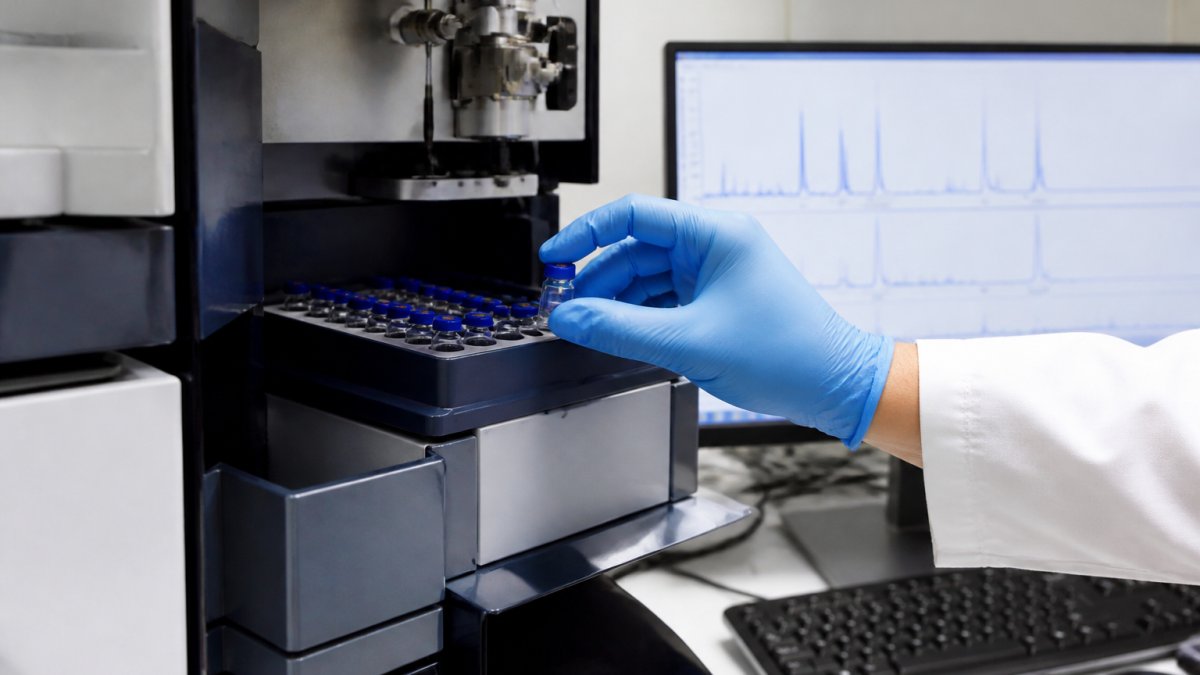
Mass spectrometry data should show a mass consistent with the calculated molecular weight for the stated sequence.
According to the U.S. Pharmacopeia’s general chapter on chromatographic separation techniques, analytical methods should be described in enough detail to be reproducible by a second laboratory.
A certificate that reports purity but omits the HPLC method and integration parameters cannot be independently checked. Accepting it means trusting the number without the means to confirm it, which is exactly the risk procurement is trying to reduce.
Supplier-by-Supplier Breakdown: Traceability and Documentation
FROPeptides builds traceability into the batch itself. Temperature-controlled storage and dispatch protect compound integrity between the lab and your bench. Current pricing is listed on our website.
Biosynth brings together peptide expertise from four acquired businesses, which can mean broad capability but also inconsistent documentation across legacy entities.
Verified Peptides states that every batch is independently tested by Janoshik and that certificates are provided.
NuRev Peptides focuses on bulk and wholesale purchasing and describes its compounds as high-purity.
Bachem is a peptide manufacturer serving research institutions, universities, and drug developers.
A Reproducible Comparison Rubric
Rather than ranking suppliers by reputation, score each against the same seven evidence requirements, making comparisons repeatable across buyers and time.
| Evidence requirement | What counts as a pass | What counts as a fail |
|---|---|---|
| Lot number on label matches certificate | Exact match, same sequence and fill date | Mismatch, missing lot, or generic certificate |
| HPLC method stated | Column, gradient, wavelength, and integration parameters listed | Purity percentage with no method |
| Mass spectrometry identity confirmation | Expected molecular weight reported with the method | Identity asserted without a mass value |
| Testing laboratory named | In-house or independent lab identified | Laboratory unnamed |
| Raw chromatogram available | File provided on request within a stated time | Refusal or indefinite delay |
| Historical certificates available | Certificates for batches older than six months | Only current-batch certificates |
| Document version control | Revision identifier or issue date present | Undated or unversioned documents |
Score each supplier pass or fail per row. Clearing the first four rows makes a supplier usable for most molecular analysis work; clearing all seven suits regulated or publication-bound environments. Batch-level traceability is visible only when the same evidence standard is applied across suppliers and batches.
Pros and Cons Summary for Each Supplier
- FROPeptides: Pros include batch-level traceability, multi-stage HPLC, mass spectrometry on every batch, and CoA documentation per vial. Con: pricing for volume orders is not explicitly detailed in public materials.
- GenScript: Pros include custom synthesis and reported fast turnaround. Con: public materials do not specify batch-level documentation.
- Biosynth: Pros include peptide expertise across four businesses. Con: traceability detail is not publicly described and may vary by business unit.
- Verified Peptides: Pros include stated per-batch independent testing and certificates. Con: certificate contents and methods are not shown publicly.
- NuRev Peptides: Pros include bulk wholesale purchasing. Con: batch-level testing detail is not established publicly.
- Bachem: Pros include manufacturing scale and institutional customers. Con: analytical documentation depth is not specified publicly for research-grade catalog items.
When you request a sample certificate, ask for the corresponding raw chromatogram file in the same message. Suppliers that can produce both together are more likely to have a maintained batch record than suppliers that treat the certificate as a standalone marketing document.
Laboratories running molecular analysis where a result must be traceable to a specific lot, with raw HPLC and mass spectrometry data available on request.
What Batch Traceability Proves, and What It Does Not
Batch-level traceability proves that a specific vial connects to a specific production run and its analytical results. It does not prove the peptide will behave identically in your assay, that stability holds under your storage conditions, or that the synthesis route was optimal.
Traceability is a chain-of-custody tool: it tells you what was tested, when, by whom, and with what method, not how the material will perform in a buffer you have not yet tried.
What traceability does deliver is a fast path to diagnosis when something goes wrong. As the FDA’s guidance on data integrity in pharmaceutical quality makes clear, attributable and contemporaneous records are what make quality decisions defensible.
Longitudinal consistency is the harder test. Request certificates from three or four batches produced across a year and compare purity percentages and chromatogram shapes side by side.
A Verification Rubric for Missing or Unverifiable Records
Most supplier guidance stops at a checklist. The harder problem is what to do when a record is missing, incomplete, or unverifiable, and how to distinguish verified evidence from supplier claims from evidence that does not exist. The rubric below scores each supplier 0-2 per requirement so comparisons are reproducible.
Scoring Each Evidence Requirement
Score each row 0, 1, or 2. A score of 2 means the evidence is verified and reproducible; 1 means it is supplier-claimed but not independently checkable; 0 means it is missing or refused.
| Evidence requirement | 2 (verified) | 1 (claimed) | 0 (missing) |
|---|---|---|---|
| Lot number on label matches certificate | Exact match, same sequence and fill date | Certificate provided but lot not independently confirmable | No certificate or mismatch |
| HPLC method and integration parameters | Column, gradient, wavelength, and integration stated | Purity percentage only | No method information |
| Mass spectrometry identity confirmation | Expected molecular weight reported with method | Identity asserted without a mass value | No identity data |
| Testing laboratory named | Independent lab named and contactable | In-house lab named | Laboratory unnamed |
| Raw chromatogram available | File provided within a stated time | Promised but not delivered | Refused or ignored |
| Historical certificates available | Certificates for batches older than six months | Only current-batch certificates | No historical records |
| Document version control | Revision identifier and issue date present | Issue date only | Undated or unversioned |
A total score of 10-14 indicates a supplier with a maintained batch record suitable for publication-bound or audit-facing work. A score of 5-9 indicates usable documentation with gaps you should document in your own records.
Handling Missing or Unverifiable Records
When a record is missing, the response itself is data. Ask for the document in writing and note the response time and specificity.
Three patterns are worth walking away from: copy-pasted reports repeating identical values across different lot numbers, which suggests a template rather than a record; certificates that omit the testing laboratory entirely, preventing independent follow-up; and refusals framed as confidentiality when the request is for a summary certificate rather than proprietary synthesis details.
Distinguishing Verified, Claimed, and Unavailable Evidence
Keep three categories separate in your procurement notes. Verified evidence is documentation you have checked against the vial and, where possible, a second source such as an independent laboratory. Claimed evidence is what the supplier states in marketing or email but has not shown in a checkable document. Unavailable evidence is what the supplier cannot or will not produce. Keeping them separate makes a comparison defensible if a result is later questioned.
The strongest signal of supplier consistency is not a single certificate but a set of certificates across multiple batches that hold steady on purity and method, scored against the same rubric and with missing records documented rather than assumed away. Ask for the set, not the sample.
Conclusion
The challenge is not finding a supplier that claims high purity; it is finding one whose documentation survives a ten-minute verification check. Batch-level traceability, raw analytical data, and consistent records across lots separate a reliable partner from a risky one.
FROPeptides was built around that standard. Every batch goes through multi-stage HPLC testing and mass spectrometry verification, ships with certificate of analysis documentation, and is stored and dispatched under temperature control.
Frequently Asked Questions
What is batch-level traceability for research peptides?
Batch-level traceability means every vial you receive can be tied to a specific production lot with its own documented testing history. That record should include a lot number, synthesis date, raw material lot references, HPLC purity results, mass spectrometry identity confirmation, and the analytical method used. The point is to let you reconstruct what happened to that exact batch before it reached your bench. Traceability is not the same as purity: a supplier can report 98% purity without showing you which batch was tested or whether the report belongs to your vial.
How can I verify a peptide supplier’s batch-specific certificate of analysis?
Start with the lot number on the vial label and confirm it matches the CoA exactly, character for character. Check that the CoA shows the analytical method, the purity percentage, the mass spectrometry result, and a testing date that precedes your shipment. Then look for a verification link or sequence identifier that lets you pull the record independently rather than trusting a PDF alone. Red flags include copy-pasted reports with identical chromatograms across different batches, missing method details, or CoAs that list only a catalog number with no lot reference.
What analytical tests should a research peptide supplier provide?
At minimum, expect HPLC for purity and mass spectrometry for identity confirmation. HPLC separates the peptide from impurities and gives you a purity percentage from the chromatogram area; mass spectrometry confirms the molecular weight matches the expected peptide sequence. Stronger documentation adds the specific analytical method, column and gradient conditions for HPLC, and the ionization method for mass spec. Third-party testing through an independent laboratory adds another layer, since it means the supplier is not grading its own work. Ask whether testing happens per batch or per product line.
How do I compare research peptide suppliers for molecular analysis?
Build a rubric before you talk to anyone. Score each supplier on whether CoAs are batch-specific, whether raw HPLC and mass spec data are available on request, whether testing is third-party, how lot numbers are formatted and tracked, and how quickly documents arrive. Request two or three CoAs from different batches of the same product and compare them side by side. Consistent retention times, similar impurity profiles, and matching documentation formats across batches tell you more than a single impressive certificate. Suppliers that cannot produce records for older batches usually cannot produce them under audit either.