Bulk Peptide Pricing for Labs: 2026 Guide
Table of Contents
- Understanding Bulk Peptide Pricing for Labs
- How to Request a Bulk Peptide Quote
- Research Peptide Pricing Per Milligram: What Affects Cost
- Peptide Certificate of Analysis: Quality Verification Requirements
- Peptide Supplier Comparison: Evaluating Wholesale Options
- Building a Procurement Checklist for Bulk Orders
- Comparing Wholesale Peptide Pricing: Tools and Benchmarks
- Negotiating Payment Terms and Delivery for Research-Grade Compounds
- Frequently Asked Questions
Last Updated: October 20, 2026
Understanding Bulk Peptide Pricing for Labs
Bulk peptide pricing for labs depends on far more than the compound itself: quantity thresholds, synthesis method, purity grade, and supplier overhead all shape the figure. Most labs expect a simple per-milligram rate and instead receive a custom quote tied to minimum orders, batch size, and delivery timeline.
Research-grade peptides aren’t commodities. Every batch requires synthesis, testing, documentation, and temperature-controlled storage. A 95% purity vial costs differently than 99%, and that 4% can mean the gap between usable data and failed experiments. At FROPeptides, we price based on the actual work: multi-stage HPLC testing, mass spectrometry verification, and batch-level traceability.
Understanding how suppliers calculate bulk peptide pricing for labs helps you negotiate better terms and avoid overpaying for unnecessary specifications.
How to Request a Bulk Peptide Quote
Requesting a bulk peptide quote requires specificity. Suppliers need to know exactly what you’re ordering before they can price it.
Start with your compound list: name each peptide sequence, specify quantity per vial, and state how many vials you need. List multiple compounds separately, since synthesis complexity and per-unit costs vary.
Next, specify delivery and documentation needs. Same-day shipping carries a premium.
Include your timeline. Suppliers price predictable, recurring orders better than one-time urgent requests, so mention whether this is a pilot order or a long-term project.
When quotes arrive, compare on a per-milligram basis, not total price. A $500 order for 100 mg costs differently per unit than a $1,200 order for 500 mg.
Request quotes from at least three suppliers using the exact same specifications. Pricing variance across vendors for identical compounds can be substantial. A spreadsheet comparing per-milligram cost, purity, lead time, and COA turnaround makes the decision faster and defensible to your PI.
Research Peptide Pricing Per Milligram: What Affects Cost
Pack Size and Quantity Thresholds
Pack size directly affects per-milligram cost. A 1 mg vial costs more per unit than a 10 mg vial of the same compound; the synthesis work is similar, but the cost is distributed differently.
Quantity thresholds trigger bulk discounts. Many suppliers tier pricing: under 50 mg, 50-500 mg, and 500+ mg. Some suppliers structure discounts around a multiple of the largest pack size, typically five times the standard pack.
If your lab needs 150 mg total but the bulk discount kicks in at 200 mg, ordering the extra 50 mg might cost less per unit than staying at 150 mg. Run the math before finalizing your order quantity.
Purity Grade and Synthesis Method
Purity grade is the largest cost driver after quantity. A 95% pure peptide requires less purification than 99% pure, and 99% often costs 40-60% more for the same compound.
Synthesis method also matters. Standard solid-phase peptide synthesis (SPPS) is the industry baseline and generally the most affordable. Custom methods for difficult sequences or modified peptides cost more, so expect pricing to reflect added complexity for fluorescent tags, isotope labels, or D-amino acid substitutions.
Temperature-controlled storage and shipping add cost too, since peptides degrade at room temperature. For research-grade work, cold chain is non-negotiable, but understanding it as a line item helps you evaluate total cost.
Volume Discounts and Minimum Order Quantities
Volume discounts reward larger orders. Some suppliers apply a flat discount to orders exceeding a certain amount, while others use tiered discounts.
Minimum order quantities (MOQs) vary by supplier and compound. Some have no MOQ for catalog compounds but require 100 mg for custom synthesis; others set a $500 or $1,000 minimum per order. Clarify MOQs before requesting a quote, since an attractive per-milligram price doesn’t help if the supplier requires a $5,000 minimum.
The lowest per-milligram price is not always the best value. A supplier with slightly higher per-unit cost but no MOQ, faster lead time, and included COAs may save your lab money and time versus a cheaper supplier with rigid minimums and slow documentation turnaround.
Peptide Certificate of Analysis: Quality Verification Requirements
A Certificate of Analysis (COA) proves the peptide you received matches the specification you ordered, documenting purity, identity, and batch consistency. It’s essential for peer-reviewed research and mandatory for regulatory compliance.
HPLC and Mass Spectrometry Testing Standards
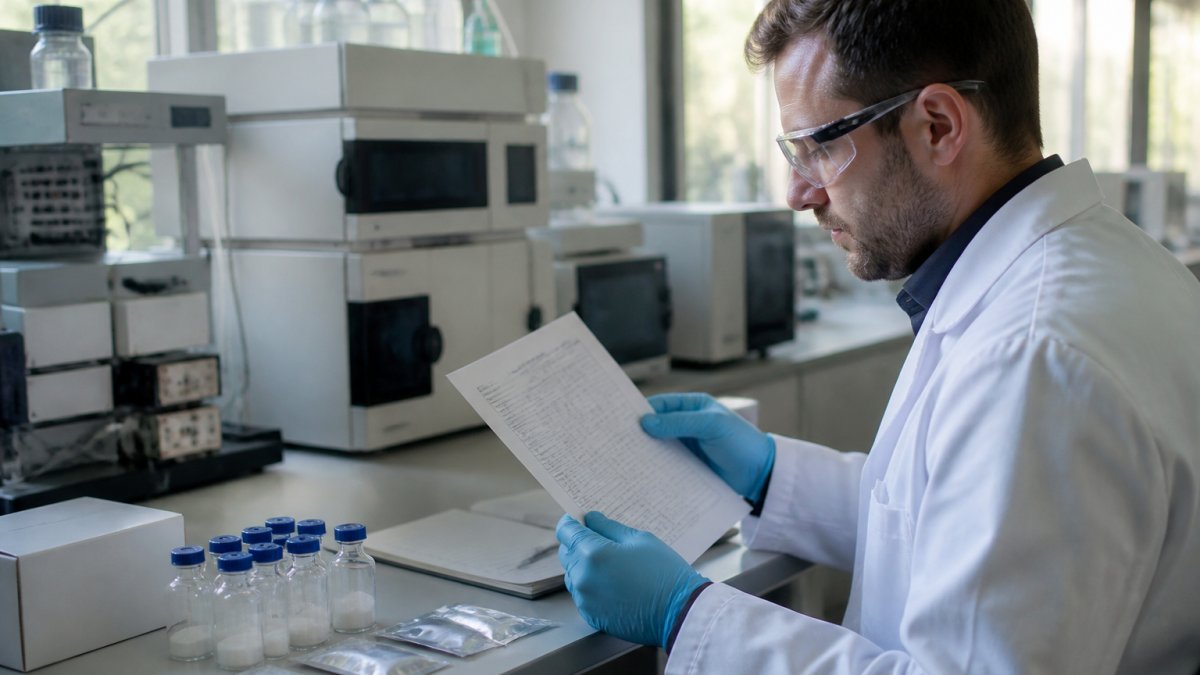
HPLC (High-Performance Liquid Chromatography) measures purity by separating peptide components and quantifying each peak (SURVEY OF PEPTIDE QUANTIFICATION METHODS AND THEIR REPRODUCIBILITY COMPARISON).
Mass spectrometry (MS) confirms molecular weight, verifying that the peptide you received is actually the peptide you ordered, not a similar compound or degraded variant. HPLC alone cannot distinguish peptides with identical purity profiles but different sequences; MS closes that gap.
Multi-stage HPLC testing, running the same sample under different conditions, catches impurities a single run might miss. FROPeptides performs multi-stage HPLC and mass spectrometry on every batch to ensure compound integrity. Suppliers that skip this step may offer lower prices, but also lower confidence in batch quality.
Batch Documentation and Traceability
Batch documentation ties a specific vial to its test data. A COA should include the batch number, synthesis date, testing date, lot number, and the specific HPLC and MS data for that batch, not a generic template showing “typical” results.
Traceability matters for reproducibility. If an experiment produces unexpected results, you need to know whether the peptide degraded, purity was lower than specified, or something else went wrong.
Request batch-level COAs, not batch-range COAs. A single COA for 10 vials from the same synthesis run is acceptable only if the vials are stored identically and tested immediately. For long-term storage or varied handling, individual vial documentation is safer.
Peptide Supplier Comparison: Evaluating Wholesale Options
Comparing wholesale peptide suppliers requires a consistent framework, because price alone is misleading. A supplier with the lowest per-milligram cost but 90-day lead times and generic COAs is not a better value than one charging 15% more but delivering in 5 days with batch-specific documentation.
Key Supplier Evaluation Criteria
Start with purity and testing. Does the supplier offer third-party HPLC and MS testing, or in-house? Third-party testing adds cost but removes bias. Does every batch receive a COA, or only samples?
Lead time matters for research planning. Some suppliers offer same-day shipping; others require 2-3 weeks. If your timeline is tight, fast turnaround is worth a premium; if you plan 8 weeks ahead, the cheaper supplier with longer lead times may make sense.
Minimum order quantities and payment terms affect cash flow. A supplier requiring $1,000 minimums and Net 30 terms differs from one with no MOQ and Net 15 terms. For smaller labs, flexible terms reduce financial friction.
Lead Time and Supply Continuity
Lead time is often overlooked in pricing comparisons but critical for ongoing research. A supplier guaranteeing 5-day delivery on catalog peptides but 6 weeks for custom compounds requires different planning than one offering 10-day turnaround across the board.
Supply continuity is equally important. Does the supplier stock common research peptides or synthesize on demand? Stock-on-hand suppliers ship faster; on-demand suppliers may offer lower prices but longer waits. For long-term projects, ask about synthesis capacity and recurring monthly orders.
Academic research labs with predictable budgets and 4-8 week planning windows should prioritize per-milligram cost and batch documentation. Industry R&D teams with shorter timelines should weight lead time and supply reliability higher, even if per-unit cost is 10-15% higher.
Building a Procurement Checklist for Bulk Orders
Use this checklist before finalizing a bulk peptide order to compare apples to apples and avoid costly oversights.
Compound Specifications:
- Peptide sequence confirmed and spelled correctly
- Desired purity grade (95%, 99%, or higher) specified
- Quantity per vial and total vials needed documented
- Any modifications (tags, isotopes, non-standard amino acids) listed
- Synthesis method preference noted (if applicable)
Quality and Documentation:
- COA requirement confirmed (batch-specific or batch-range acceptable?)
- HPLC and MS testing standards specified
- Third-party testing required or in-house acceptable?
- Storage and handling requirements documented
Logistics and Cost:
- Lead time acceptable for your timeline
- Shipping method and cold chain requirements confirmed
- Total cost including shipping and handling calculated
- Minimum order quantity and payment terms reviewed
- Volume discount thresholds identified
Supplier Evaluation:
- Supplier reputation and experience verified
- References or case studies reviewed (if available)
- Guarantee or replacement policy clarified
- Support responsiveness tested (quote turnaround, question response time)
Comparing Wholesale Peptide Pricing: Tools and Benchmarks
Several tools help labs benchmark peptide pricing and compare suppliers, normalizing pricing across vendors and compounds to spot outliers and identify genuine value.
These tools are benchmarking aids, not shopping platforms. Use them to understand market pricing, then request detailed quotes from your top three candidates. Benchmarking prevents inflated quotes but doesn’t replace direct supplier evaluation.
Negotiating Payment Terms and Delivery for Research-Grade Compounds
Once you’ve identified a preferred supplier, negotiation begins. Most have standard terms, but many will negotiate for larger orders or recurring business.
Payment terms are often negotiable.
Shipping and handling can be negotiated too. For multiple compounds, ask whether the supplier will consolidate shipments to reduce per-order costs.
Lead time may be flexible.
Volume commitments unlock better pricing. Commit to $5,000 in orders over 12 months and many suppliers will offer a 10-15% discount or waive minimum order quantities.
Do not agree to payment terms that strain your lab’s cash flow. A 2% discount for paying upfront is not worth depleting your research budget. Similarly, avoid suppliers that require prepayment for custom synthesis, reputable suppliers invoice after delivery and testing confirm the order meets spec.
For research-grade compounds, delivery guarantees matter. Ask what happens if a shipment arrives compromised or purity falls short of specification. Reliable suppliers offer replacement stock or refunds without hassle; get this commitment in writing before ordering.
At FROPeptides, we deliver research-grade peptides with multi-stage HPLC testing and mass spectrometry verification included.
Sourcing bulk peptides requires more than finding the cheapest supplier. Quality, documentation, lead time, and reliability shape your total cost of ownership.
Frequently Asked Questions
What factors affect bulk peptide pricing for laboratories?
Bulk peptide pricing depends on pack size, purity grade, synthesis method, compound complexity, order quantity, and minimum order thresholds. Labs purchasing higher volumes typically receive volume discounts. Pricing also reflects the cost of quality verification: HPLC testing, mass spectrometry, and certificate of analysis documentation. Suppliers factor in temperature-controlled storage and delivery, batch-level traceability, and lead time into their wholesale pricing models.
How should labs compare peptide prices per milligram across suppliers?
Calculate the cost per milligram by dividing the total price by the milligram quantity in each vial or pack. This normalized measure allows direct comparison across different pack sizes and suppliers. Use pricing comparison tools and platforms that track per-milligram costs across vendors. Request quotes from multiple suppliers using identical specifications: compound, purity, vial size, and quantity. Document the COA requirements and delivery timeline for each quote to ensure true cost comparison.
What documentation should a lab request with a bulk peptide quote?
Request a certificate of analysis (COA) for every batch, including HPLC purity data and mass spectrometry results. Verify that testing is third-party or independently verified. Ask for batch-level traceability information, storage conditions, and shelf-life data. Clarify payment terms (Net 15, Net 30), shipping method, temperature-controlled delivery confirmation, and replacement guarantees if the shipment arrives compromised. Request the supplier’s quality control procedures and any published research citations using their compounds.
Do peptide suppliers offer discounts for larger orders?
Yes. Most research peptide suppliers structure pricing to reward volume. Common models include tiered discounts based on total order value or quantity thresholds, and bulk wholesale pricing that applies when orders exceed a stated minimum. Some suppliers apply flat discounts across their catalog for orders over a specific dollar amount. Minimum order quantities vary by supplier and compound; requesting a custom quote is the fastest way to determine volume discount eligibility for your lab’s specific needs.
How can a lab evaluate a research peptide supplier’s quality controls?
Review the supplier’s multi-stage HPLC testing protocols and mass spectrometry capabilities. Request batch-level certificates of analysis for recent orders. Ask whether testing is performed in-house or by third-party labs. Verify that each batch includes documented purity percentages and that the supplier maintains batch-to-batch consistency records. Check for temperature-controlled storage and shipping practices. Look for published research citations or case studies showing their compounds in peer-reviewed publications, and ask about their track record on replacement guarantees for compromised shipments.