
Batch Level Certificates of Analysis: A 2026 Guide
Table of Contents
- What a Batch Level Certificate of Analysis Actually Documents
- How to Read a Certificate of Analysis Without Missing Red Flags
- Peptide Purity Testing Methods Behind the Numbers
- Mass Spectrometry Peptide Identification: Confirming the Sequence
- Why a Batch-Specific COA Beats a Generic Certificate
- Matching a COA to the Vial in Your Hand
- Frequently Asked Questions
Last Updated: October 13, 2026
What a Batch Level Certificate of Analysis Actually Documents
A batch level certificates of analysis is a document that reports the measured test results for one specific production lot of a material, not for a product line in general. It ties a unique batch number to the analytical data generated when that lot was tested. Identity and purity claims mean nothing without a lot to attach them to.
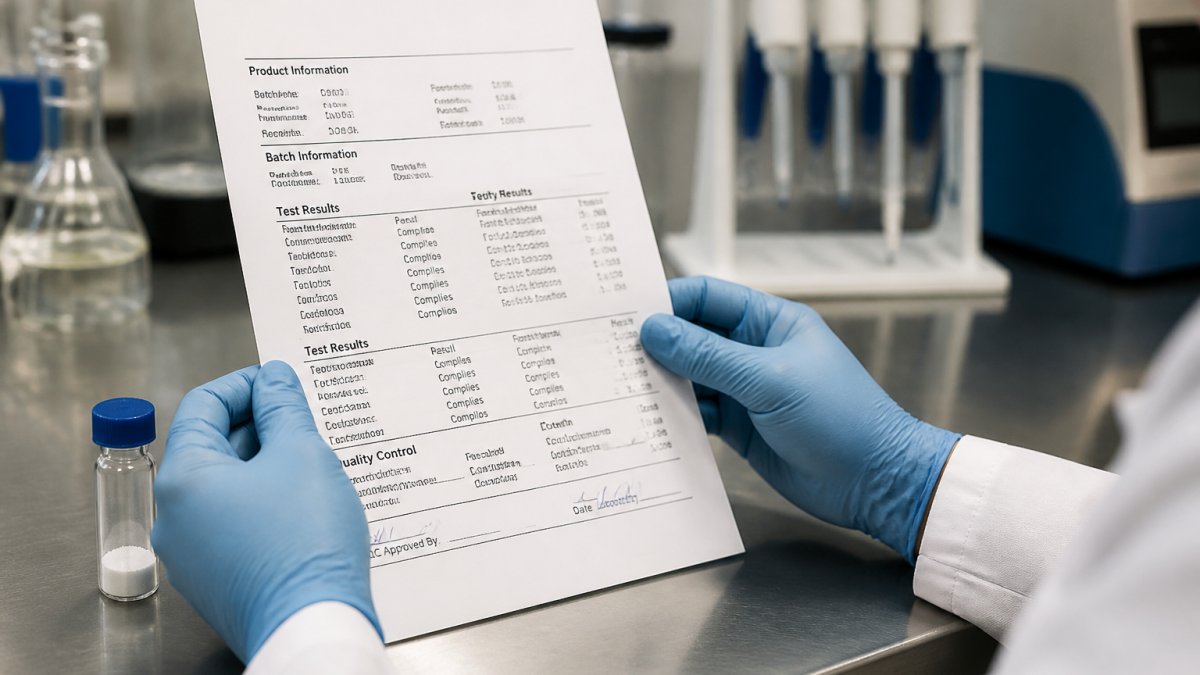
The document typically contains four things:
- The compound name and batch or lot number
- The analytical methods used, such as HPLC and mass spectrometry
- The measured results, including purity percentage and observed mass
- The manufacturing or testing date, plus a signature or approval line
That last point matters more than people expect. A COA without a batch number is a brochure, not a record.
Batch Number, Lot Traceability, and Manufacturing Date
The batch number is the spine of the whole document. It links the vial in your hand to a specific manufacturing run and a specific set of test results.
Lot traceability means you can follow that number backward. You can see when the material was made, when it was tested, and what the results were. If a problem shows up later, the batch number tells you exactly which vials are affected.
A common mistake is accepting a COA that lists a “representative batch” instead of your batch. Representative data describes a typical run. It does not describe the vial you received.
If a supplier sends the same COA PDF for every order, that is a generic certificate, not a batch-specific one. You have no way to know whether your vial was ever tested.
How to Read a Certificate of Analysis Without Missing Red Flags
Learning how to read a certificate of analysis comes down to checking three columns: identity, purity, and method. If any of them is missing or vague, the document is not doing its job.
Start with the compound name and batch number. Confirm they match your order exactly, including any salt form or counterion.
Next, check the stated method. A purity figure means nothing without knowing how it was measured. HPLC and mass spectrometry are the two methods that matter for research peptides.
Then look at the numbers themselves. A purity result should come with the method, the detection wavelength, and the column type. Missing method details are a red flag, not a formatting quirk.
Finally, check the dates. A manufacturing date far in the past, with no retest date, raises questions about storage and stability.
Reading the Purity Column and Chromatogram
The purity column reports the percentage of the main peak relative to all peaks detected. A result of 98% means the main compound accounts for 98% of what the detector saw.
The chromatogram is the graph behind that number. It shows each peak and its area. A clean chromatogram has one dominant peak with small shoulders or minor peaks nearby.
What most guides miss is that a single purity number hides a lot. Two vials can both read 98% while having very different impurity profiles.
Ask for the full chromatogram, not just the purity figure. The peak shape and baseline tell you more about the run than the headline number does.
Peptide Purity Testing Methods Behind the Numbers
Peptide purity testing relies mainly on reversed-phase high-performance liquid chromatography, usually shortened to HPLC. The method separates compounds in a sample based on how they interact with a column and a solvent gradient.
Here is how the process generally works:
- The sample is dissolved and injected onto the column
- A solvent gradient pushes compounds through at different speeds
- A detector measures how much material elutes at each point
- Software converts the peaks into a purity percentage
Mass spectrometry usually runs alongside HPLC. HPLC tells you how pure the sample is. Mass spectrometry tells you whether the compound is the right one.
One method alone leaves a gap.
Mass Spectrometry Peptide Identification: Confirming the Sequence
Mass spectrometry peptide identification works by measuring the mass-to-charge ratio of the compound and comparing it to the expected value. If the observed mass matches the theoretical mass, the identity is confirmed.
The document usually reports two figures: the expected mass and the observed mass. A close match, within the method’s tolerance, supports the identity claim.
This step catches problems that purity testing alone would miss. A sample can be 99% pure and still be the wrong compound. Purity measures how much of the main peak exists. Mass spectrometry confirms what that peak actually is.
For sequence-level work, some labs go further with tandem mass spectrometry, which fragments the peptide and reads the pieces. That level of detail is not always on a standard COA, but it is worth asking about for sensitive assays.
Why a Batch-Specific COA Beats a Generic Certificate
A batch level certificates of analysis documents the actual lot you received. A generic certificate documents a product in the abstract.
The difference shows up the moment something goes wrong. With a batch-specific COA, you can trace a failed assay back to a specific lot and compare it against the test data. With a generic certificate, you have nothing to compare.
Batch-specific documentation also supports batch-to-batch consistency. When every lot is tested and recorded, you can spot drift over time. If purity trends downward across several batches, you know before it affects your work.
At FROPeptides, we run multi-stage HPLC testing and mass spectrometry on every batch, then issue documentation tied to that specific lot.
| Document Type | What It Covers | Traceable to Your Vial | Use in Audits |
|---|---|---|---|
| Batch-specific COA | One production lot | Yes, by batch number | Strong |
| Generic certificate | Product line | No | Weak |
| Representative COA | A typical run | No | Weak |
Matching a COA to the Vial in Your Hand
Matching a COA to your vial takes about two minutes and prevents weeks of wasted work. Check the batch number on the vial label against the batch number on the document. They must match exactly.
Then confirm three more things:
- The compound name and any salt form match your order
- The purity figure matches what was quoted at purchase
- The testing date is recent relative to the manufacturing date
If any item does not line up, stop and contact the supplier before running the material. A mismatch usually means a paperwork error, but it can also mean the wrong vial shipped.
Keep the COA on file with your lab records. If a result looks off months later, the document is your starting point for troubleshooting.
Frequently Asked Questions
What is a batch-level certificate of analysis?
A batch-level certificate of analysis is a document tied to a specific production lot of a compound, such as a research peptide. It records the batch number, test methods, and results for that lot, including purity percentage, molecular weight, and appearance. Unlike a generic certificate, it lets you trace the exact vial in your hand back to the analytical data generated when that lot was manufactured.
What information should a peptide certificate of analysis include?
A complete peptide certificate of analysis typically lists the compound name, batch or lot number, molecular formula and weight, purity percentage, test method (usually HPLC), mass spectrometry confirmation, appearance, storage conditions, and a release date. Some suppliers also include chromatogram and mass spectrum images. If any of these fields are missing, ask the supplier for the full data before using the material in sensitive assays.
How do I match a certificate of analysis to a peptide batch?
Check that the batch or lot number printed on the COA matches the number on the vial label exactly. The compound name, molecular weight, and purity should also align. If the numbers differ, the document does not cover your material. Keep a copy of the COA filed with the batch number so you can retrieve it during audits or when writing up methods sections.
What is the difference between a batch-specific COA and a generic COA?
A batch-specific COA reports results from testing the actual lot you received. A generic COA shows typical or historical values and may not reflect your specific vial. For research where purity variance affects results, batch-specific documentation is the only way to confirm what is in the vial. Ask your supplier whether they test every lot and issue a COA for each one.
Batch-to-batch consistency is the hardest thing to verify in research peptides, and it is where most suppliers quietly fall short. FROPeptides addresses this with multi-stage HPLC testing, mass spectrometry verification, and a batch-specific certificate of analysis for every order, backed by temperature-controlled storage and secure dispatch. If your assays depend on traceable, documented material, get started with FROPeptides and source vials you can actually verify.