CoQ10 vs Ubiquinol Research: HPLC & Stability Data
Table of Contents
- CoQ10 vs Ubiquinol in Research: A Quick Comparison
- Ubiquinone vs. Ubiquinol: The Core Molecular Differences
- HPLC Analysis of CoQ10: Quantifying Both Forms
- Stability of Reduced Coenzyme Q10: Oxidation Risks and Handling
- Bioavailability and Plasma Concentration: What Clinical Trials Show
- Drug-Nutrient Interactions and Formulation Technology
- Personalized Supplementation Logic: Matching Form to Research Goals
- Conclusion: Choosing the Right Form for Your Study
- Frequently Asked Questions
Last Updated: October 4, 2026
CoQ10 vs Ubiquinol in Research: A Quick Comparison
Coenzyme Q10 compared to ubiquinol in research comes down to one key distinction: ubiquinone is the oxidized form that must be converted in the body, while ubiquinol is the reduced, active form that circulates in plasma without conversion. FROPeptides supplies both forms as lyophilized research materials for analytical and molecular work. The choice between them affects your study design, your HPLC method, and how you interpret plasma concentration data. Below, we break down the molecular differences, stability risks, and bioavailability findings that matter for your protocol.
CoQ10 vs ubiquinol is not a question of which is “better.” It is a question of which form fits your research model. A statin-induced deficiency study may call for ubiquinol. A shelf-stability study may call for ubiquinone. Getting this wrong wastes reagents and skews results.
Ubiquinone is the stable, oxidized form. Ubiquinol is the reduced, active form. Your study’s goal determines which one belongs in your protocol.
Ubiquinone vs. Ubiquinol: The Core Molecular Differences
Ubiquinone and ubiquinol differ by two electrons and two hydrogen atoms. That small structural gap drives everything else: solubility, stability, and how each form behaves in mitochondrial function research.
Ubiquinone is the fully oxidized form of CoQ10, featuring a benzoquinone ring. It is lipid-soluble, chemically stable, and the dominant form in most dietary intake and standard supplements.
Ubiquinol is the reduced form, carrying two hydroxyl groups on its ring. It acts as a potent antioxidant, neutralizing free radicals directly. It is also more susceptible to oxidative degradation.
The conversion between forms happens constantly in the body. The enzyme system that reduces ubiquinone to ubiquinol is efficient in younger tissue but declines with age, a point that shapes age-related decline research.
| Property | Ubiquinone | Ubiquinol |
|---|---|---|
| Oxidation state | Oxidized | Reduced |
| Electrons carried | None | Two |
| Primary role | Electron transport chain | Antioxidant, electron carrier |
| Stability | High | Lower |
| Conversion needed | Yes | No |
HPLC Analysis of CoQ10: Quantifying Both Forms
HPLC analysis of CoQ10 requires different detection strategies for each form. Ubiquinone absorbs strongly in the UV range, making UV detection straightforward. Ubiquinol oxidizes readily during sample prep, so electrochemical detection often gives cleaner quantification.
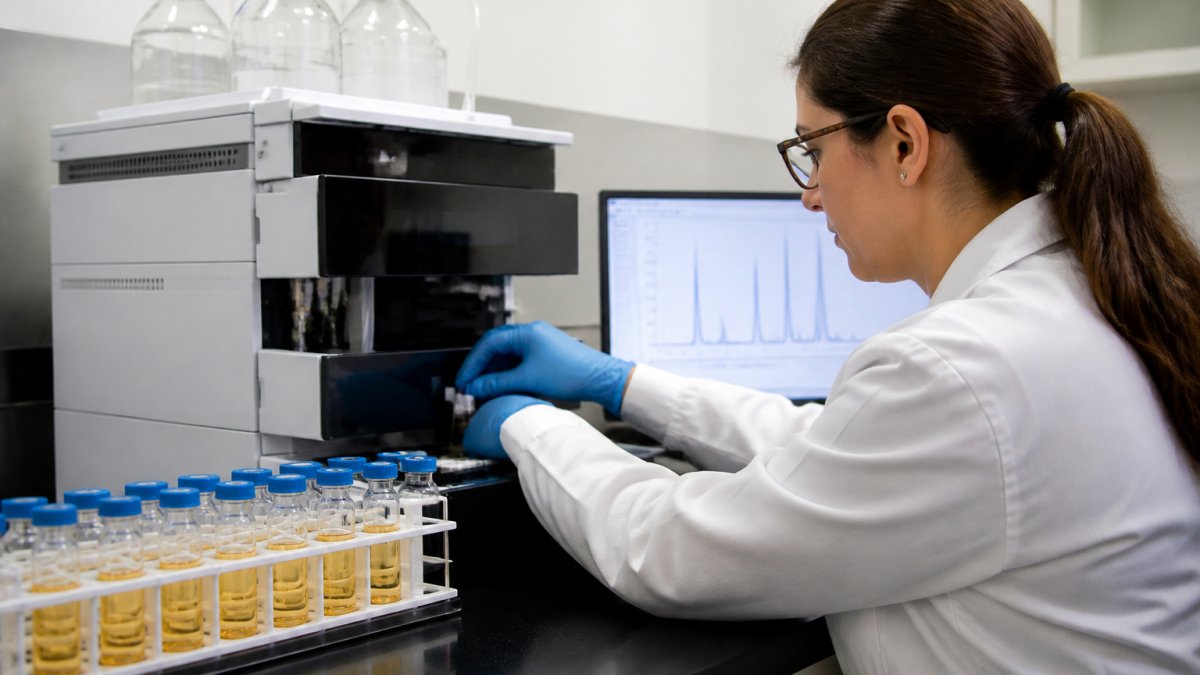
A common mistake is running both forms on the same UV method. Ubiquinol can oxidize to ubiquinone on the column, inflating your ubiquinone peak and deflating your ubiquinol reading. In practice, this means your total CoQ10 looks correct while your form ratio is wrong.
For batch-level verification, multi-stage HPLC testing paired with mass spectrometry is used to confirm both the identity and ratio of each form before dispatch. This matters when your assay depends on accurate form separation.
Stability of Reduced Coenzyme Q10: Oxidation Risks and Handling
The stability of reduced coenzyme Q10 is the single biggest handling challenge in this field. Ubiquinol oxidizes on exposure to light, heat, and oxygen. Every hour at room temperature degrades a measurable fraction of your sample.
Storage guidance that works:
- Keep lyophilized ubiquinol at low temperature, protected from light
- Limit freeze-thaw cycles; aliquot before storage
- Prepare fresh working solutions rather than storing diluted stock
- Use amber glassware and inert atmosphere where possible
Leaving ubiquinol at room temperature during a long sample run degrades your sample. The oxidized fraction reads as ubiquinone, corrupting your form-ratio data.
Oxidative degradation is not just a storage issue. It changes what your instrument measures. Track your handling protocol as carefully as your analytical method.
Bioavailability and Plasma Concentration: What Clinical Trials Show
Bioavailability and plasma concentration data consistently favor ubiquinol for absorption, though the gap narrows in younger subjects. Clinical trials generally report that ubiquinol raises serum levels at lower doses than ubiquinone, particularly in older adults.
The reason ties back to conversion. Older tissue reduces ubiquinone less efficiently, so more of it passes through unabsorbed. Supplying the reduced form skips that bottleneck.
Absorption kinetics also depend on the delivery matrix. Lipid-soluble formulations need dietary fat for uptake. Water-soluble and solubilized formulations can improve plasma concentration in fasting-state studies. For a deeper look at how these compounds are characterized, the NIH Office of Dietary Supplements CoQ10 fact sheet is a solid reference.
Drug-Nutrient Interactions and Formulation Technology
Drug-nutrient interactions are where CoQ10 research moves from biochemistry into clinical relevance, and they are also where most articles stop at a single sentence. The mechanism matters for protocol design, because it determines whether you are measuring a deficiency state, a displacement effect, or a pharmacodynamic interference.
Statins and the mevalonate pathway. Statins inhibit HMG-CoA reductase, the rate-limiting enzyme in the mevalonate pathway. That same pathway produces both cholesterol and the isoprenoid side chain of CoQ10, so statin exposure reduces endogenous CoQ10 synthesis in a dose-dependent manner. This is the mechanistic basis for statin-induced deficiency models.
Warfarin and vitamin K antagonism. CoQ10 shares structural similarity with vitamin K, and case reports describe reduced anticoagulant effect when CoQ10 is co-administered with warfarin. The proposed mechanism is interference with warfarin’s vitamin K epoxide reductase inhibition, not a direct pharmacokinetic interaction. For research protocols, this means anticoagulation endpoints require tighter INR monitoring and a washout design if you are isolating the CoQ10 effect.
Blood pressure medications. CoQ10 has been studied as an adjunct in hypertension research, and additive effects on cardiovascular endpoints are plausible when combined with ACE inhibitors, angiotensin receptor blockers, or calcium channel blockers. The interaction is pharmacodynamic rather than pharmacokinetic, so your control arm should account for baseline antihypertensive regimen.
Chemotherapy agents. The antioxidant properties of ubiquinol raise a legitimate concern in oncology research: antioxidant co-administration may interfere with the oxidative mechanisms of agents like doxorubicin or cisplatin. This is a study-design consideration, not a settled contraindication, and the direction of effect depends on timing relative to the chemotherapeutic agent.
Other interaction points worth documenting:
- Thyroid medications: CoQ10 may affect thyroid hormone metabolism in some models
- Beta-blockers: reported reduction in endogenous CoQ10 levels
- Tricyclic antidepressants: limited but documented case-level interaction reports
Formulation technology is the second half of this equation, and it is where absorption research has advanced most in the last decade. The chemical form, ubiquinone or ubiquinol, is only one variable. The delivery matrix determines how much of that form reaches plasma intact.
| Delivery System | Mechanism | Research Consideration |
|---|---|---|
| Oil-based softgel | Lipid solubilization; requires dietary fat | Standard reference formulation; fasting-state studies show poor uptake |
| Self-emulsifying (SEDDS) | Spontaneous micelle formation in GI fluid | Improves fasting-state absorption; changes control conditions |
| Liposomal | Phospholipid bilayer encapsulation | Protects ubiquinol from oxidation; higher cost per unit |
| Nanoparticle | Reduced particle size, increased surface area | Emerging; limited long-term stability data |
| Water-soluble (solubilized) | Hydrophilic carrier | Useful for fasting-state protocols; may alter tissue distribution |
For research use, the formulation is not a footnote, it is a control variable. If your treatment arm uses a self-emulsifying ubiquinol and your control uses an oil-based ubiquinone, you have confounded chemical form with delivery system. Document both, and if your budget allows, run a formulation-matched control.
A formulation mismatch between treatment and control arms is one of the most common confounds in CoQ10 bioavailability research. Match the delivery matrix before you compare the chemical form.
Personalized Supplementation Logic: Matching Form to Research Goals
Personalized supplementation logic is the angle most competing articles miss. They present ubiquinone and ubiquinol as a binary choice and leave the reader to guess. In practice, the right form depends on three variables: the study population, the endpoint, and the handling capacity of your lab. This section gives you a decision framework you can defend in a methods section.
Step 1: Define your population.
Age is the strongest single predictor of conversion efficiency. The enzyme system that reduces ubiquinone to ubiquinol, primarily located in the inner mitochondrial membrane, declines with age. In younger subjects, ubiquinone supplementation typically raises plasma ubiquinol levels effectively because endogenous conversion is intact. In older subjects, or in models of age-related decline, supplying the reduced form skips that bottleneck.
- Subjects under 40, healthy: ubiquinone is usually sufficient; conversion is efficient
- Subjects over 60, or frailty models: ubiquinol fits the mechanism under study
- Statin-treated populations: ubiquinol is the mechanistically aligned choice, since statins reduce both synthesis and conversion capacity
- Fertility research (sperm motility, oocyte quality): ubiquinol is the more studied form in this context, though ubiquinone also appears in the literature
Step 2: Define your endpoint.
| Endpoint | Recommended Form | Rationale |
|---|---|---|
| Plasma CoQ10 concentration | Either; match formulation | Form ratio is the secondary readout |
| Mitochondrial electron transport | Ubiquinone | Direct substrate for Complex I and II |
| Antioxidant capacity (free radical neutralization) | Ubiquinol | Direct radical scavenging; no conversion needed |
| Shelf-stability or degradation kinetics | Ubiquinone | Stable baseline; ubiquinol oxidizes during study |
| Form-ratio dynamics | Both, with electrochemical detection | UV detection risks on-column oxidation |
| Cardiovascular endpoints | Either; ubiquinol more common in clinical trials | Absorption advantage in older cohorts |
Step 3: Match to handling capacity and budget.
This is the trade-off most articles avoid. Ubiquinol costs more per gram, degrades faster, and requires cold-chain handling, amber glassware, and inert atmosphere for long-term storage. Ubiquinone is cheaper, more stable, and easier to ship and store. For a large-cohort study where the primary endpoint is electron transport chain activity, ubiquinone stretches the budget without changing the mechanistic readout. For a small, mechanism-focused study where form ratio is the endpoint, ubiquinol is worth the handling burden.
A practical decision tree:
- Is your endpoint form-specific (ratio, antioxidant capacity)? → Ubiquinol
- Is your population conversion-compromised (age, statins)? → Ubiquinol
- Is your endpoint total CoQ10 or electron transport? → Ubiquinone is defensible
- Is your study large, cost-sensitive, or logistically constrained? → Ubiquinone
- Is your study small, mechanism-focused, and well-resourced? → Ubiquinol
Document your form choice, your formulation, and your handling protocol in the methods section. Reviewers increasingly ask for form-specific justification, and batch traceability from your supplier strengthens that response. If you switch forms mid-study, treat it as a protocol amendment, not a minor adjustment.
Research-grade coenzymes ship with Certificate of Analysis documentation and batch-level traceability, so your methods section has the sourcing detail it needs.
Conclusion: Choosing the Right Form for Your Study
The CoQ10 vs ubiquinol decision is a study-design decision, not a quality ranking. Ubiquinone brings stability and lower cost; ubiquinol brings direct bioavailability and antioxidant relevance. Match the form to your population, your endpoint, and your handling capacity.
FROPeptides supplies both forms as high-purity lyophilized coenzymes with multi-stage HPLC testing, mass spectrometry verification, and Certificate of Analysis documentation for every batch. If your assay depends on accurate form separation and batch-to-batch consistency, FROPeptides is built for that work.
Get started with FROPeptides and source research-grade coenzymes with the traceability your protocol demands.
Frequently Asked Questions
Is it better to take coenzyme Q10 or ubiquinol?
It depends on age and health status. Younger adults generally convert ubiquinone to ubiquinol efficiently, so ubiquinone may suffice. Adults over 65 or those with conditions affecting conversion may benefit from ubiquinol, which is the reduced form. Research shows ubiquinol yields higher plasma concentration in these groups, but ubiquinone remains more stable and cost-effective for general use.
What are the primary structural differences between ubiquinone and ubiquinol?
Ubiquinone (oxidized form) has two ketone groups on its quinone ring, while ubiquinol (reduced form) has two hydroxyl groups. This difference makes ubiquinol more lipid-soluble and reactive, but also more prone to oxidation. In research, ubiquinone is often preferred for its molecular stability during storage and HPLC analysis, whereas ubiquinol requires careful handling to prevent degradation.
How does the redox state of CoQ10 affect its stability in laboratory assays?
The reduced form, ubiquinol, is highly sensitive to oxidation, especially when exposed to light, heat, or oxygen. This can lead to inaccurate quantification. Ubiquinone is more stable, making it easier to handle in assays. For HPLC analysis of CoQ10, researchers often derivatize or use antioxidant buffers to preserve ubiquinol and prevent conversion during sample preparation.
Why is high-purity ubiquinol often preferred in specific molecular research?
High-purity ubiquinol is used in studies examining mitochondrial function, oxidative stress, and antioxidant properties because it directly participates in electron transport and free radical neutralization. Its reduced state allows researchers to measure conversion rates and endogenous production without confounding factors from impurities. Purity above 98% ensures reliable results in sensitive assays like ATP synthesis measurements.
How do plasma concentration studies differentiate between ubiquinone and ubiquinol efficacy?
Clinical trials measure serum levels of both forms after supplementation. Studies show ubiquinol raises plasma CoQ10 more effectively in older adults, while ubiquinone requires higher doses for similar effects. Absorption kinetics vary: ubiquinol peaks faster but is cleared quicker, whereas ubiquinone has a slower, sustained release. These differences inform dosage recommendations for cardiovascular support and statin-induced deficiency.