
Is CoQ10 Stability in Aqueous Solution Sufficient?
Table of Contents
- Why CoQ10 Stability in Aqueous Solution Falls Short
- CoQ10 HPLC Analysis Troubleshooting: When Instability Skews Results
- Lyophilized CoQ10 Reconstitution Protocols: Best Practices for Aqueous Systems
- CoQ10 Storage Requirements for Research: Protecting Compound Integrity
- Formulation Strategies That Improve CoQ10 Stability in Aqueous Solution
- Comparison of CoQ10 Delivery Systems for Aqueous Stability
- Conclusion: Matching Your Formulation to the Research Question
- Frequently Asked Questions
Last Updated: September 29, 2026
Why CoQ10 Stability in Aqueous Solution Falls Short
The short answer is no: coenzyme Q10 stability in aqueous solution is not sufficient for most research and formulation purposes without deliberate intervention. CoQ10 is a lipophilic molecule with a long isoprenoid tail, and water is simply the wrong solvent for it. This guide from FROPeptides examines why aqueous instability happens, how it corrupts HPLC data, and which formulation strategies actually hold up.
The Hydrophobic Problem: Lipophilic Molecules in Water
Aqueous solubility is the maximum concentration of a substance that can remain dissolved in water at a given temperature. For CoQ10, that figure sits in the low nanomolar range, which is functionally zero for most assays.
Degradation Pathways: Oxidation, Hydrolysis, and Light Exposure
Once dispersed in an aqueous phase, CoQ10 faces three primary degradation routes. Oxidation is the fastest: the quinone ring is an active electron carrier, and dissolved oxygen readily attacks it, especially under light or heat. Hydrolysis is slower but accelerates at extreme pH. Photodegradation from UV exposure compounds both.
CoQ10 HPLC Analysis Troubleshooting: When Instability Skews Results
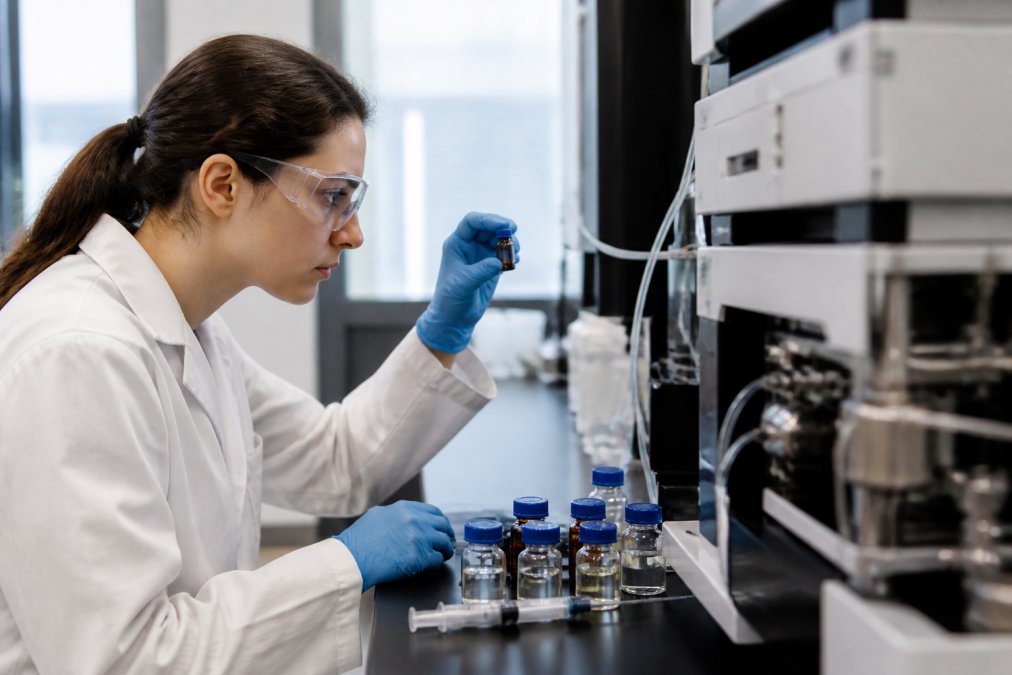
CoQ10 HPLC analysis troubleshooting almost always starts with the sample, not the instrument. Degraded or precipitated analyte produces chromatographic artifacts that mimic column failure, so analysts chase the wrong problem for hours.
Common Chromatographic Artifacts from Degraded Samples
A common mistake is assuming a drifting baseline means the column is failing. In practice, oxidized CoQ10 elutes as split or broadened peaks because the degradation products have different retention behavior. Precipitated material can also clog the guard column, producing pressure spikes that look like a hardware fault.
Mobile Phase and Column Considerations for CoQ10
CoQ10 requires a reverse-phase column with a nonpolar stationary phase, typically C18, and a mobile phase with enough organic content to keep the analyte in solution. Methanol or acetonitrile blends work because they maintain the dissolution rate and prevent on-column precipitation.
Add a small percentage of a weak acid to the mobile phase if you see peak tailing. CoQ10’s quinone group ionizes at higher pH, and suppressing that ionization sharpens the peak without altering retention time.
Lyophilized CoQ10 Reconstitution Protocols: Best Practices for Aqueous Systems
Lyophilized CoQ10 reconstitution protocols determine whether your working solution is genuinely dissolved or merely suspended. The distinction matters because a suspension will test inconsistently across replicates.
Solvent Selection and Reconstitution Technique
CoQ10 will not reconstitute in water alone. Start with a small volume of an organic solvent such as ethanol or DMSO to dissolve the lyophilized powder completely, then dilute into aqueous buffer while stirring. Add the organic phase slowly; rapid addition shocks the system and forces precipitation.
Avoiding Precipitation and Aggregation Post-Reconstitution
Even a correctly prepared solution can crash out over hours. Particle size distribution shifts as molecules aggregate, and once aggregation starts it rarely reverses. Keep working solutions cold, protect them from light, and prepare fresh batches rather than storing dilute aqueous stocks.
Never freeze a reconstituted aqueous CoQ10 solution to extend its life. Ice crystal formation concentrates the organic cosolvent and forces the compound out of solution, so the thawed sample is less stable than the one you started with.
CoQ10 Storage Requirements for Research: Protecting Compound Integrity
CoQ10 storage requirements for research come down to three variables: temperature, light, and humidity. Get all three right and lyophilized powder holds its integrity for extended periods. Get them wrong and no amount of careful reconstitution will recover the loss.
Temperature, Light, and Humidity Controls
Store lyophilized CoQ10 at low temperature, freezer storage is standard for long-term holding, with short-term working aliquots kept refrigerated, in amber or foil-wrapped vials, in a desiccated environment. Each control addresses a specific degradation pathway. Cold slows oxidation kinetics, amber glass blocks the UV wavelengths that drive photodegradation, and desiccant prevents moisture uptake that would seed hydrolysis.
Shelf-Life Monitoring and Stability Testing Protocols
This is the gap most labs leave open, and it is the single biggest opportunity to improve CoQ10 research reliability. There is no universally adopted gold-standard protocol for measuring CoQ10 degradation in water-based solutions, which means results are only comparable when you define and document your own method.
A workable protocol has four parts:
- Baseline characterization at receipt. Run HPLC purity, confirm identity by mass spectrometry, and record appearance and moisture content. This is your reference point for every later comparison.
- Fixed-interval re-testing. Re-run the same HPLC method at defined intervals, monthly is common for working stocks, quarterly for sealed lyophilized powder, under your actual storage conditions, not idealized ones.
- Multi-attribute tracking. Monitor purity, appearance, and reconstitution behavior together. A compound can pass a single purity check while its shelf-life is quietly eroding, because early degradation products may co-elute or fall below the detection threshold.
- Forced-degradation controls. Deliberately stress a small sample with heat, light, or oxygen to confirm your method actually detects degradation when it occurs. A method that cannot resolve a stressed sample cannot be trusted to certify a stable one.
Do not rely on a single purity number as proof of stability. A CoQ10 sample that reads 98% pure today can still be degrading in ways your method does not capture. Track trends across multiple time points, not isolated readings.
Reconstituted Solutions: The Weakest Link
Lyophilized powder is forgiving. Reconstituted aqueous solutions are not. Once CoQ10 is in an aqueous system, oxidation and aggregation proceed far faster, and storage recommendations that work for powder can actively harm a solution. Keep working solutions cold, protect them from light, prepare fresh batches rather than storing dilute aqueous stocks, and never freeze a reconstituted aqueous solution, ice crystal formation concentrates the organic cosolvent and forces the compound out of solution, so the thawed sample is less stable than the one you started with.
Documenting Stability for Reproducibility
Because no standardized aqueous-stability protocol exists, the burden falls on the researcher to document method, conditions, and acceptance criteria clearly enough that another lab could reproduce the result. Record the HPLC method, column, mobile phase composition, detection wavelength, storage temperature, light exposure, and container type alongside every stability reading. That documentation is what turns a single lab’s observation into a usable data point for the field.
Formulation Strategies That Improve CoQ10 Stability in Aqueous Solution
Formulation is where aqueous instability gets solved, and the goal is always the same: keep CoQ10 dispersed at a particle scale small enough that it behaves like a solution rather than a suspension. The mechanism matters more than the label on the system, because two products both marketed as “liposomal CoQ10” can differ by an order of magnitude in how long they hold up in water.
Emulsions, Liposomes, and Colloidal Delivery Systems
An oil-in-water emulsion traps CoQ10 in a lipid droplet stabilized by a surfactant monolayer, keeping the hydrophobic compound out of bulk water. Droplet size is the controlling variable: conventional emulsions sit in the 200-500 nm range and separate over weeks, while nanoemulsions pushed below roughly 100 nm resist creaming and coalescence far longer because Brownian motion keeps the droplets suspended.
Encapsulation and Surfactant Approaches
Encapsulation in a solid or gel matrix protects CoQ10 through processing and storage, then releases it on consumption or assay. Spray-drying into a starch or protein wall material is the most common industrial route, and the wall material choice drives stability: a well-formed wall excludes oxygen and moisture, while a cracked or porous wall does neither.
Match the delivery system to the dose and the format. Clear, low-dose beverages favor micelles or cyclodextrin complexes. High-dose research stocks and clinical formulations justify the cost of liposomes. Dry mixes and capsules are best served by encapsulated powder that reconstitutes cleanly.
The Shelf-Life Gap Most Formulations Ignore
Here is the angle most published work skips: nearly all CoQ10 stability data comes from lab-scale emulsions tested over days or weeks, not from consumer-grade aqueous beverages tracked over months on a shelf. A formulation that looks stable in a 30-day accelerated study can still fail commercially if it separates, clouds, or loses potency by month six.
Comparison of CoQ10 Delivery Systems for Aqueous Stability
| Delivery System | Aqueous Stability | Key Limitation | Best For |
|---|---|---|---|
| Oil-in-water emulsion | Moderate | Separates over time | Fortified beverages |
| Liposomal | High | Higher cost | Clinical-grade research |
| Micellar | Moderate | Low loading capacity | Clear liquid formats |
| Encapsulated powder | High | Requires rehydration | Dry mixes, capsules |
| Cyclodextrin complex | Moderate | Ratio-sensitive | Analytical standards |
Conclusion: Matching Your Formulation to the Research Question
Aqueous CoQ10 stability is a formulation problem, not a fixed property, and the right delivery system depends entirely on what your assay or product needs to measure. FROPeptides supplies research-grade lyophilized coenzymes with multi-stage HPLC testing, mass spectrometry verification, and batch-level Certificates of Analysis, so your starting material is never the variable you have to troubleshoot.
Frequently Asked Questions
Is CoQ10 water soluble?
No. CoQ10 is a lipophilic molecule with a long isoprenoid tail, making it practically insoluble in water. Its aqueous solubility is estimated in the low nanomolar range, which is why formulating stable aqueous solutions is difficult. In practice, researchers must use surfactants, emulsifiers, or colloidal carriers such as liposomes to disperse CoQ10 in water. Without these strategies, CoQ10 precipitates or adsorbs to container surfaces, leading to inaccurate concentration measurements and unreliable assay results.
Why is CoQ10 stability a challenge in aqueous buffers?
CoQ10 degrades in aqueous buffers through several pathways. Oxidation of the quinone ring is accelerated by dissolved oxygen, light, and trace metal ions. Hydrolysis can occur under extreme pH conditions. The hydrophobic molecule also tends to aggregate, reducing its effective concentration in solution. These factors mean that even a freshly prepared aqueous CoQ10 sample can lose measurable potency within hours. Proper storage, antioxidant additives, and protected handling are essential for maintaining integrity during analysis.
What are the best solvents for maintaining CoQ10 integrity in research?
For stock solutions, ethanol, methanol, chloroform, and hexane are commonly used because CoQ10 dissolves readily in organic solvents. For aqueous working solutions, a small volume of organic stock is typically diluted into buffer containing a surfactant such as Tween 80 or a carrier like cyclodextrin. Always prepare fresh dilutions and avoid prolonged storage in aqueous media. Lyophilized CoQ10 reconstituted in appropriate solvent systems offers better long-term stability than pre-dissolved aqueous stocks.
Should CoQ10 be stored in the refrigerator for analytical use?
Yes. For analytical use, store lyophilized CoQ10 powder at -20°C or lower, protected from light and moisture. Once reconstituted, aqueous solutions should be kept at 4°C and used within 24 to 48 hours, as refrigeration slows but does not stop degradation. Organic stock solutions can be stored at -20°C for longer periods. Always verify stability with HPLC analysis before using stored material in critical experiments. Batch-level Certificates of Analysis help confirm purity and storage recommendations.