99PurityPeptides vs ProtideHealth: Lab Testing Compared
Last Updated: October 22, 2026
Quick Summary
Both 99PurityPeptides and ProtideHealth advertise third-party peptide lab testing and reference certificates of analysis, but the documentation you can actually inspect differs. The decisive factors are report recency, lot-specific COAs, and whether the named testing lab can be independently verified. Where evidence is unavailable, the honest verdict is unverified, not better.
- A purity percentage on a product page costs nothing; a dated, lot-specific COA with a chromatogram costs real money.
- A generic sample COA proves a lab exists, while a lot-specific report proves your vial was tested.
- An unnamed lab on a report is a red flag because independent verification requires a traceable lab identity.
- A 99% purity result still leaves room for unidentified impurities, so separate contaminant testing is needed.
- Request reports for two or three lots from each vendor and compare dates, methods, and peak profiles.
Table of Contents
- How do 99PurityPeptides and ProtideHealth compare in terms of transparency and independent lab testing?
- Transparency Compared: What Each Vendor Publishes
- Third-Party Peptide Lab Testing: Independence and Conflicts of Interest
- What a Peptide Certificate of Analysis Should Contain
- How to Verify a Peptide COA: A Practical Checklist
- HPLC, Mass Spectrometry, and the Limits of Purity Claims
- Which Vendor Is More Transparent? A Documented-Evidence Verdict
- Frequently Asked Questions
How do 99PurityPeptides and ProtideHealth compare in terms of transparency and independent lab testing?
Peptide lab testing is the analytical process of verifying a compound’s identity, purity, and safety profile using methods such as HPLC and mass spectrometry. At FROPeptides, we track how vendors publish this data because it is the clearest signal of supplier credibility.
The core tension: a purity percentage printed on a product page costs nothing to produce. A dated, lot-specific certificate of analysis with a chromatogram attached costs real money. That gap is where vendor transparency lives or dies.
Transparency Compared: What Each Vendor Publishes
Transparency in this market means publishing batch-specific reports that anyone can check, not just stating that testing happens. Both 99PurityPeptides and ProtideHealth advertise third-party testing and reference certificates of analysis on their sites.
Most vendor comparisons stop there, with a vague nod that “both provide COAs.” That is not a comparison; it is a restatement of marketing copy. The useful version is a documented audit: what was checked, when it was checked, and what evidence could not be obtained.
The five access questions that decide the comparison
- Is the COA gated? A report behind an account login, an email request, or a “contact us” form is not the same as a PDF linked directly from the product page. Gating is not automatically disqualifying, but it slows independent checking and makes it harder to confirm the report matches current stock.
- Does the report identify the lot? Look for a batch or lot number printed on the COA that matches the number on the vial label. A report without a lot identifier cannot be tied to the material you receive.
- Is the report dated? An undated COA could describe a batch from years ago. A report date lets you judge whether the results reflect the stock currently shipping.
- Is the testing lab named? An anonymized lab (“a third-party laboratory”) is a claim, not evidence. A named lab can be checked against its own published records and accreditation listings.
- Is raw data available? Chromatograms and spectra attached to the report, or raw instrument files available on request, let a reader audit the integration and peak profile rather than trust a summary number.
What to record when you check each vendor
A common mistake buyers make is accepting a generic sample COA as proof of quality. A sample report proves a lab exists. A lot-specific report proves your vial was tested.
Ask for the COA tied to the exact batch number on your vial before you order. If a vendor can only send a “representative” report, that is a transparency gap, not a paperwork inconvenience. Record the date you asked and what you received; that log is the comparison.
Because vendor pages change, treat any published comparison as a snapshot. The durable skill is the audit method above, not a one-time verdict. If a vendor later adds lot-specific reports with named labs and chromatograms, the score should move; if reports disappear or go stale, the score should fall. That is the difference between a transparency comparison and a popularity contest.
Third-Party Peptide Lab Testing: Independence and Conflicts of Interest
Independent laboratory testing only carries weight when the lab has no financial stake in the result. This is the fault line most vendor comparisons skip. A supplier can run in-house testing, publish the results, and call it verification, but in-house analysis is quality control, not independent verification.
What to check for conflict of interest:
- Is the lab named on the report, or anonymized?
- Does the lab hold accreditation you can verify independently?
- Is the testing laboratory a separate legal entity from the vendor?
- Does the report include the method used and the instrument?
When we review peptide lab testing claims, an unnamed lab is a red flag. Independent verification requires a traceable lab identity, not a logo.
What a Peptide Certificate of Analysis Should Contain
A complete peptide certificate of analysis should include the compound name, batch and lot number, report date, test method, purity percentage, and the analytical results themselves. Anything less is a summary, not a COA.
The essential fields:
- Compound identity and stated quantity per vial
- Batch number and lot number for traceability
- Report date so you can judge recency
- HPLC method with the chromatogram attached
- Mass spectrometry results confirming molecular identity
- Purity percentage derived from the actual analysis, not a catalog claim
What most guides miss is the chromatogram itself. A purity number without the underlying trace is a claim you cannot audit. The chromatogram shows the peak profile; the spectra confirm identity. Without both, a 99% purity claim is unverifiable.
How to Verify a Peptide COA: A Practical Checklist
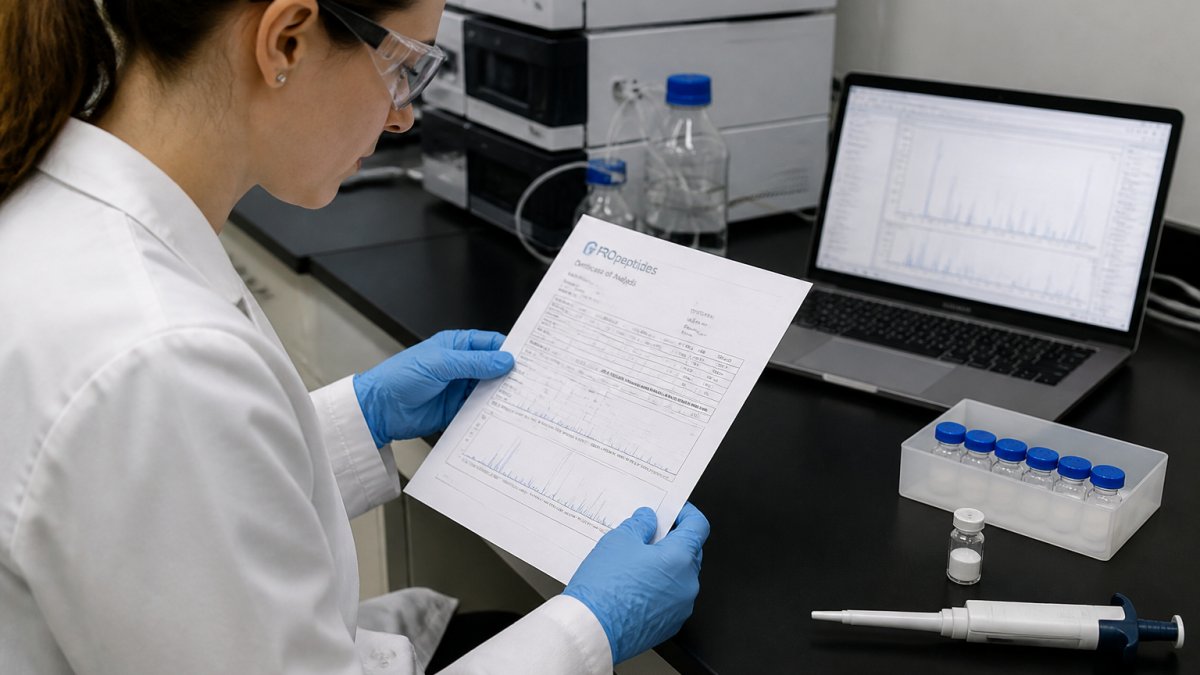
Verifying a peptide COA takes about ten minutes if you know what to look for. Work through this checklist before you trust any purity claim:
- Match the batch number on the COA to the batch number on your vial
- Confirm the report date is recent enough to reflect current stock
- Check that the testing laboratory is named and independently verifiable
- Confirm the lab’s accreditation status through its own published records
- Review the HPLC chromatogram for a clean, single dominant peak
- Confirm mass spectrometry data matches the expected molecular weight
- Check whether raw data files are available on request
- Verify the purity percentage matches the chromatogram integration
If a vendor cannot supply items on this list, treat the purity claim as marketing until proven otherwise. Documentation access is the whole game.
HPLC, Mass Spectrometry, and the Limits of Purity Claims
HPLC and mass spectrometry are the two standard methods behind nearly every purity claim you will see. HPLC separates compounds and measures how much of the sample is the target molecule; mass spectrometry confirms the molecular identity. Together they form the backbone of analytical testing for research peptides.
Here is the limitation nobody advertises: a purity percentage describes the proportion of the sample that is the target compound. It says nothing about what the remaining percentage contains.
That is why testing scope matters as much as the purity number. A COA that reports purity but omits contaminant panels gives you a partial picture.
Do not treat a high purity percentage as a safety clearance. Purity and contaminant testing are different analyses, and a report that shows one without the other leaves the quality question half-answered.
Which Vendor Is More Transparent? A Documented-Evidence Verdict
Neither vendor wins on reputation alone; the verdict depends on what you can verify today.
What most comparisons miss is the verification step itself.
Step 1: Confirm the laboratory is real and independent
Search the lab name exactly as printed on the COA.
Step 2: Check accreditation claims against the lab’s own records
If a COA or vendor page implies accreditation, verify it through the laboratory’s own published records rather than the vendor’s marketing.
Step 3: Compare report recency and consistency across lots
A single dated COA is a data point; a pattern of dated COAs across multiple lots is evidence of a testing program.
Step 4: Score the evidence, not the language
| Verification Factor | What to Look For | Why It Matters |
|---|---|---|
| COA access | Downloadable per batch, not gated | Proves lot-level testing is routine |
| Lab identity | Named lab with independent web presence | Enables independent verification |
| Lab independence | No shared ownership or address with vendor | Distinguishes third-party from in-house |
| Accreditation | Verifiable through the lab’s own records | Confirms the lab is credentialed for the method |
| Report recency | Dated within current stock cycle | Confirms results match what ships |
| Cross-lot consistency | Multiple dated reports, same methods | Shows a program, not a one-off |
| Analytical data | Chromatogram plus spectra attached | Makes purity auditable |
| Raw data | Available on request | Supports full traceability |
| Contaminant panel | Separate heavy metals and related testing | Covers purity’s blind spots |
Step 5: State what could not be verified
A credible comparison names its limits.
A purity result does not establish identity, sterility, endotoxin status, concentration, or suitability for human use. A COA that reports only a purity percentage answers a narrower question than most buyers assume. Score vendors on testing scope as well as testing presence.
Our verdict framework: request the actual documents from both vendors, run the five steps above, and score them against the table. The vendor that supplies dated, lot-specific reports with named, independently verifiable labs and raw data wins on transparency, regardless of marketing language. That standard is also the one we hold ourselves to at FROPeptides: every batch ships with multi-stage HPLC testing, mass spectrometry verification, and certificate of analysis documentation, so researchers can audit the data rather than trust a claim. Batch-level traceability means the report matches the vial in your hand.
Frequently Asked Questions
Do 99PurityPeptides and ProtideHealth publish independent lab reports for each batch?
Both vendors state that they provide batch-specific documentation, but the practical test is whether a lot-specific certificate of analysis (COA) is downloadable before purchase and whether it names the batch number, report date, and testing laboratory. Ask each vendor for the COA tied to the exact lot you will receive, not a representative sample. A report without a batch or lot number cannot be matched to your vial, and a report without a named lab cannot be checked for accreditation. Treat any answer that stops at a general purity claim as incomplete.
How can you tell whether a peptide certificate of analysis is from an independent laboratory?
Look for the laboratory’s name, its accreditation details, and a report number you can verify directly with the lab. Independent peptide lab testing means the analysis was performed by a facility that does not manufacture or sell the peptide. If the COA is issued by the vendor itself, or by a lab with the same ownership, it is in-house testing regardless of how it is labeled. Confirm the lab exists and performs HPLC and mass spectrometry by checking its own website or accreditation record, then ask the vendor to connect the report number to your batch.
What is the difference between in-house and third-party peptide testing?
In-house testing is run by the vendor’s own laboratory, which can be useful for quality control but carries a conflict of interest because the same company selling the product is grading it. Third-party peptide lab testing is performed by an unrelated laboratory, so the result is more difficult to influence. Neither method is automatically reliable: the value depends on the method used, the report’s completeness, and whether the sample was drawn from the finished lot. Ask which party drew the sample, which instruments were used, and whether raw chromatograms and spectra accompany the summary.
What should a peptide certificate of analysis include to be useful for verification?
A useful COA includes the product name, batch or lot number, manufacture and report dates, the testing laboratory’s identity, the analytical methods used (typically HPLC and mass spectrometry), the purity percentage with the method stated, identity confirmation, and any contaminant results. Raw data such as chromatograms and spectra should be available on request. Without a lot number and a report date, you cannot confirm the document applies to the vial in your hand, and without method details you cannot judge whether the purity figure means what it appears to mean.
Transparency in research peptides is not a slogan; it is a stack of dated documents you can check. If your current supplier cannot produce lot-specific certificates with named labs and raw analytical files, the comparison is already settled. FROPeptides supports your protocols with multi-stage HPLC testing, mass spectrometry verification on every batch, and COA documentation that travels with the order. Get started with FROPeptides and hold your next batch to a standard you can verify.