Best Research-Grade Peptide Suppliers 2026
Table of Contents
- How to Evaluate Research-Grade Peptide Suppliers
- Supplier Comparison Table: Testing, Purity, and Documentation
- Research Peptide Suppliers with Certificates of Analysis
- How to Verify Peptide Purity and Identity
- Research-Grade vs Pharmaceutical-Grade Peptides
- Peptide Storage and Handling for Lab Integrity
- Batch Traceability and Quality Assurance
- Conclusion: Selecting Your Supplier
- Frequently Asked Questions
Last Updated: October 16, 2026
How to Evaluate Research-Grade Peptide Suppliers
Choosing among research-grade peptide suppliers can make or break your lab’s results.
The first question to ask any supplier is simple: Can they prove what they’re selling?
Second, know the difference between catalog peptides and custom synthesis. Catalog peptides are pre-synthesized, tested, and ready to ship, faster and cheaper but limited in scope.
Third, verify that testing is independent or at least transparent. In-house testing is fine if rigorous, but third-party validation adds confidence.
Supplier Comparison Table: Testing, Purity, and Documentation
| Supplier | Testing Method | CoA Availability | Best For | Key Consideration |
|---|---|---|---|---|
| FROPeptides | Multi-stage HPLC + LC-MS per batch | Public library | Academic labs, biotech R&D | Temperature-controlled shipping included |
| Biosynth Peptide Services | Complex synthesis expertise | Quote-based | Custom peptide projects | Turnaround varies by complexity |
| GenScript Custom Peptide Synthesis | Custom synthesis protocols | Per-project documentation | Large-scale custom orders | Competitive turnaround reported |
| Bachem Catalog | Online catalog format | Catalog specifications | Browsing pre-made peptides | Limited batch-level detail in results |
| Peptide Library | Vendor comparison platform | Aggregated listings | Price and vendor research | Independent verification limited |
Most suppliers focus either on catalog availability or custom synthesis; few excel at both. FROPeptides provides rigorous batch-level testing for every vial.
When comparing suppliers, don’t just look at price per milligram. Factor in shipping costs, minimum order quantities, and turnaround time. A cheaper peptide that arrives degraded or with missing documentation costs far more than a slightly pricier option with guaranteed cold-chain integrity.
Research Peptide Suppliers with Certificates of Analysis
Not all suppliers treat Certificates of Analysis the same way. Some provide generic product specs; others publish batch-specific data. The deeper problem is that most buyers never verify the CoA they receive.
A meaningful CoA should include the lot number, synthesis date, purity percentage (ideally by HPLC), molecular weight confirmation (by mass spectrometry), testing methods, acceptance criteria, and storage recommendations.
How to Independently Verify a CoA
Independent verification means confirming the document in front of you corresponds to the vial in your hand and to a real analytical run. Work through these checks:
- Match the lot number three ways. The lot number on the CoA must match the vial label and the packing slip or order confirmation. A mismatch is a documentation error at best and a substitution risk at worst, ask the supplier to reconcile it in writing before use.
- Check the dates for internal consistency. Synthesis should precede analytical testing, which should precede shipping. A CoA dated after your shipment arrived, or a testing date that predates synthesis, indicates the document was generated after the fact rather than pulled from a batch record.
- Confirm the method is described, not just named. “HPLC” alone is not a method. A verifiable CoA names the column chemistry (e.g., C18 reverse-phase), mobile phase, gradient, detection wavelength (commonly 214 nm or 220 nm for peptide bonds), and integration method. LC-MS documentation should state ionization mode and observed versus theoretical mass.
- Look for the raw data trail. Ask whether chromatograms and mass spectra, not just summary percentages, are available for the lot. Reputable suppliers can produce the actual traces on request. A CoA reporting “98.7% purity” with no chromatogram is a claim, not evidence.
- Distinguish in-house from independent testing. Many suppliers run their own HPLC and LC-MS, which is normal and often rigorous. The question is whether the CoA discloses who performed the test. If a supplier claims third-party testing, ask for the lab’s name and whether you can request results directly under the lot number.
- Cross-check batch-to-batch consistency. Pull CoAs for several lots of the same peptide. Identical purity to the decimal is suspicious, real analytical runs vary. If purity swings widely (say, 94% to 99%), ask what changed in synthesis or purification.
Keep a simple verification log for every lot you receive: lot number, CoA date, method described (yes/no), chromatogram available (yes/no), tester identified (in-house/third-party), and any discrepancies. Over a year, this log becomes your own supplier scorecard, and it is far more reliable than any published ranking.
What to Look for in a Public CoA Library
A public CoA library should be searchable by lot number or product code so you can pull testing data without contacting sales, letting you verify consistency over time and spot patterns in purity or degradation.
Good libraries include batch-to-batch variation data and explain what the numbers mean, acceptance criteria, out-of-spec results, and how deviations were resolved.
FROPeptides provides batch-specific Certificates of Analysis for every order and publishes its testing methodology, multi-stage HPLC and mass spectrometry, so you know exactly how purity and identity were verified.
How to Verify Peptide Purity and Identity
Purity verification relies on two main analytical testing methods: HPLC and LC-MS.
HPLC (high-performance liquid chromatography) separates peptide molecules by size and charge, then detects them.
LC-MS (liquid chromatography-mass spectrometry) goes further, combining chromatography with mass spectrometry to confirm molecular weight.
A supplier offering only HPLC is cheaper but less thorough; one offering both demonstrates real commitment to identity verification.
HPLC and LC-MS Testing Standards
HPLC standards are well-established, but not all labs use identical methods, some use gradient elution, others isocratic.
LC-MS adds specificity, confirming molecular weight within a narrow range, typically ±0.5 Da.
When reviewing analytical testing data, check the reference standards used. Good suppliers use traceable reference materials and calibrate instruments regularly.
Temperature-controlled storage during testing also matters, some peptides degrade at room temperature during analysis.
Research-Grade vs Pharmaceutical-Grade Peptides
The distinction between research-grade and pharmaceutical-grade peptides is regulatory, not chemical. Both can be extremely pure and well-characterized.
Pharmaceutical-grade peptides are manufactured under GMP (good manufacturing practice) standards, which involve extensive documentation, validated processes, and regulatory inspections (the FDA).
Research-grade peptides are manufactured to high standards but without GMP certification.
The purity and testing standards for research-grade peptides can be just as rigorous as pharmaceutical-grade. What differs is the regulatory framework.
When evaluating suppliers, don’t assume pharmaceutical-grade is always better.
Never use research-grade peptides for human administration or clinical applications, even if purity is excellent. The regulatory distinction exists for important reasons. If your work moves toward clinical application, you’ll need to transition to GMP-manufactured materials and follow regulatory pathways.
Peptide Storage and Handling for Lab Integrity
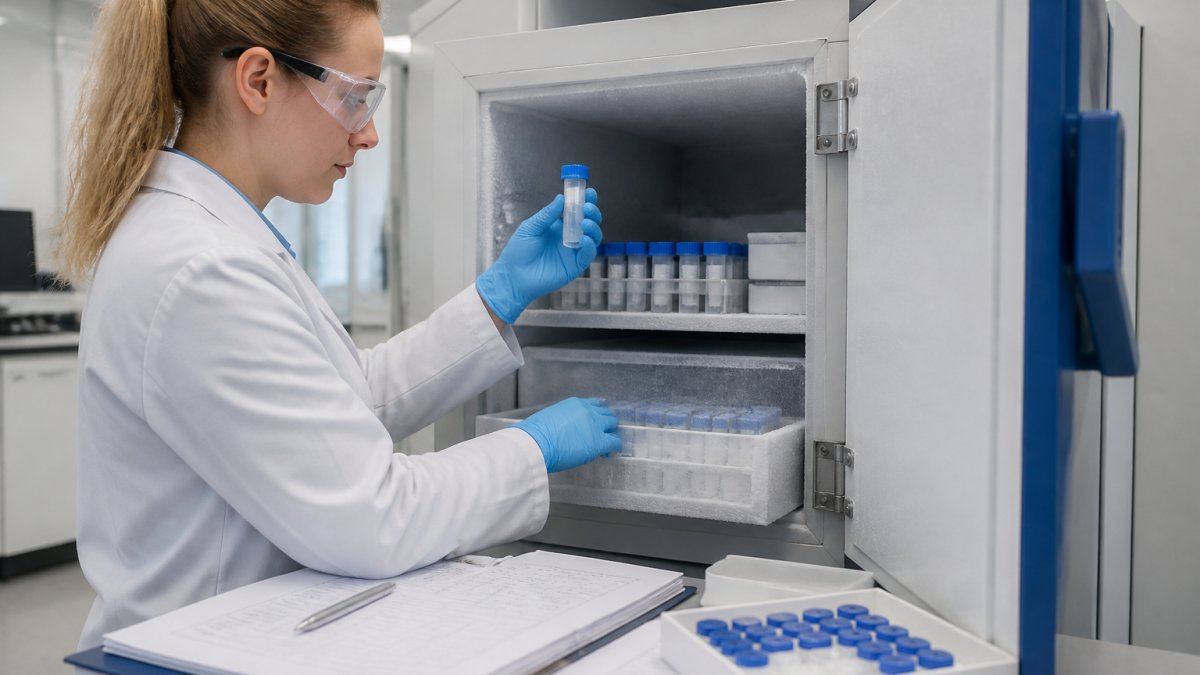
How a peptide is stored and shipped directly affects its usability. Peptides are sensitive molecules, heat, light, moisture, and repeated freeze-thaw cycles degrade them. Poor cold-chain handling can turn a high-purity peptide into a degraded mess before it reaches your lab.
Storage Temperatures and Freeze-Thaw Discipline
Most lyophilized research peptides should be stored at -20°C or colder; some require -80°C. Suppliers should specify the recommended temperature on the CoA, and you should follow it rather than defaulting to whatever freezer space is available. Two handling rules matter more than the setpoint itself:
- Aliquot before first use. Reconstitute only the amount you need for a given experiment, and split stock solutions into single-use aliquots before freezing. Repeated freeze-thaw of a single tube is one of the most common causes of unexplained degradation.
- Control moisture and light. Lyophilized powder is hygroscopic; let vials equilibrate to room temperature before opening to prevent condensation, and store protected from light. Reconstituted solutions are typically less stable than powder and should be used within the supplier’s stated window.
A shared, frequently opened lab freezer is a risk: temperature excursions during door openings are real, and frost-free cycles introduce warming periods. If you are ordering in quantity, dedicate freezer space and log temperatures.
Cold-Chain Shipping: What to Ask Before You Order
Shipping is where cold-chain integrity is most often lost, and it is rarely discussed in supplier comparisons. Ask these questions before placing an order:
- Packaging format. Standard insulated boxes with ice packs are adequate for short transit in cool weather but not for multi-day shipments or warm seasons. Dry ice is required for frozen shipments that must stay at -20°C or below in transit; ambient or gel-pack formats suit lyophilized powder shipped short distances. Ask which format the supplier uses for your destination and season.
- Temperature monitoring. Does the shipment include a temperature indicator or data logger? A logger that you can read on arrival converts “we ship cold” from a claim into evidence. If there is no monitoring, you have no way to know whether the cold chain held.
- Transit time and cutoffs. Ask for the shipping method, the expected transit time, and the day-of-week cutoff so a shipment does not sit in a depot over a weekend. Overnight or two-day service is common for temperature-sensitive material; ground service in summer is a gamble.
If a shipment arrives warm, damaged, or with a temperature indicator out of range, do not assume the material is fine because the powder looks normal. Degradation is often invisible. Quarantine the lot, document the excursion, and request replacement or analytical re-testing before using it in an experiment.
Shipping Guarantees and Complaint Handling
Ask what happens if a shipment arrives degraded or out of temperature spec. Does the supplier replace it, and how quickly? Do they cover return shipping? Reliable suppliers stand behind their cold-chain process because they know it works, and they can usually produce temperature-monitoring data for the shipment.
FROPeptides uses temperature-controlled shipping designed to maintain the cold chain from its facility to your lab, and each vial is labeled with its lot number and expiration date so receiving inspection is straightforward.
Batch Traceability and Quality Assurance
A good supplier assigns each batch a unique lot number.
Quality assurance goes beyond testing. It includes documenting any deviations, customer complaints, or corrective actions.
FROPeptides maintains batch-level documentation for every order. Each vial is labeled with its lot number and expiration date.
Ask suppliers about their complaint-handling process. What happens if you receive a peptide that doesn’t meet your expectations?
Conclusion: Selecting Your Supplier
Finding the right research-grade peptide supplier comes down to three fundamentals: batch-level documentation, analytical transparency, and reliable cold-chain handling. Any supplier claiming to be research-grade should provide detailed Certificates of Analysis with HPLC and LC-MS data for every batch, and guarantee temperature-controlled shipping and storage.
Frequently Asked Questions
What documentation should a research-grade peptide supplier provide?
A credible research-grade peptide supplier must provide batch-specific certificates of analysis (CoA) that include identity confirmation via mass spectrometry, purity data from HPLC testing, lot traceability numbers, and manufacturing dates. The CoA should detail the analytical methods used and reference standards applied. This documentation ensures your research meets publication standards and regulatory compliance for laboratory use.
How do you verify peptide purity and identity?
Verify peptide purity through high-performance liquid chromatography (HPLC) and liquid chromatography-mass spectrometry (LC-MS) testing. HPLC separates peptide components and quantifies purity percentage, while LC-MS confirms molecular weight and structure identity. Request batch-level test results from your supplier before purchase. Cross-check the reported purity against your assay sensitivity requirements, even small variance can compromise molecular analysis. Independent third-party testing adds confidence, and comparing results across suppliers helps identify consistency patterns that signal manufacturing reliability.
What is the difference between research-grade and pharmaceutical-grade peptides?
Research-grade peptides are synthesized and tested for laboratory and analytical use, with purity typically 80-98% and documented through batch-specific certificates of analysis. Pharmaceutical-grade peptides meet stricter regulatory standards (often >99% purity), require GMP manufacturing certification, and comply with FDA or equivalent oversight for active pharmaceutical ingredient (API) standards. Research-grade materials are appropriate for discovery, optimization, and analytical protocols; pharmaceutical-grade is required for clinical development or regulated manufacturing. Verify your intended use before sourcing to avoid costly compliance issues.
How should research peptides be stored and handled?
Store research peptides in temperature-controlled conditions, typically 2-8°C (refrigerated) or -20°C (frozen), depending on supplier recommendations. Use sterile, sealed vials and maintain batch documentation for traceability. During shipping, confirm your supplier uses cold-chain logistics with temperature monitoring to prevent degradation. Upon receipt, inspect vials for integrity and compare lot numbers to your order. Limit exposure to light and humidity, and follow the supplier’s reconstitution guidance. Proper handling preserves purity and ensures your analytical results remain valid across experiments.
How can you evaluate a research-grade peptide supplier?
Assess suppliers on five criteria: (1) batch-level testing transparency, verify HPLC and LC-MS results are provided per lot, not just product averages; (2) certificate of analysis accessibility, confirm CoAs are available before purchase; (3) manufacturing capability, confirm they perform synthesis and analytical testing in-house or document third-party verification; (4) cold-chain reliability, confirm temperature-controlled shipping extends to your facility; (5) batch-to-batch consistency, request historical purity data across multiple lots to identify manufacturing stability. Request references from similar labs and compare pricing against catalog size and testing depth.
FROPeptides delivers all three. Our multi-stage HPLC testing and mass spectrometry verification confirm every batch meets strict purity benchmarks. We publish batch-specific Certificates of Analysis in our public library so you can verify exactly what you’re ordering before committing. And our temperature-controlled storage and fast, secure dispatch ensure your peptides arrive ready for your analytical research. Shop Now and experience the difference that genuine quality control makes.