
How to Store Lyophilized Coenzymes: A Lab Guide
Table of Contents
- Understanding Lyophilized Coenzyme Stability
- Lyophilized Coenzyme Storage Temperature Requirements
- Moisture Protection for Lyophilized Powder
- Coenzyme Storage Shelf Life and Degradation Prevention
- Reconstituted Coenzyme Storage and Handling
- Step-by-Step Storage Protocol for Your Lab
- Common Storage Mistakes and How to Avoid Them
- Conclusion
- Frequently Asked Questions
Last Updated: October 15, 2026
Understanding Lyophilized Coenzyme Stability
Lyophilized coenzymes are freeze-dried biological compounds that require precise storage to maintain integrity and potency.
Stability depends entirely on how you store them after receipt. Temperature fluctuations, humidity, and improper handling accelerate degradation and compromise results, so understanding what makes these compounds vulnerable is the first step toward preserving them.
At FROPeptides, every vial of lyophilized coenzymes leaves our facility in optimal condition, with multi-stage HPLC testing and mass spectrometry verification confirming batch-level purity. But that quality depends on how you store and handle the material in your lab.
Store lyophilized coenzymes immediately upon arrival. Do not leave vials at room temperature while unpacking or organizing your workspace. Even brief exposure to ambient conditions can begin the degradation process.
Lyophilized Coenzyme Storage Temperature Requirements
Temperature is the single most critical factor in preserving lyophilized coenzymes. Different temperatures offer different stability windows, so your choice depends on how long you need to keep the material viable.
Freezer Storage at -20°C and -80°C
The coldest option lasts longest. At -80°C, molecular degradation slows dramatically, extending shelf life to several years when combined with proper moisture protection.
A standard -20°C freezer offers moderate long-term stability. Many coenzymes remain viable for 1-2 years at this temperature, though some compounds degrade faster. The difference between -20°C and -80°C matters more for sensitive coenzymes like NAD+ derivatives and certain electron transport compounds.
Ultra-low freezers (-80°C) require more energy and maintenance, while -20°C units are common in most labs. If you’ll use coenzymes within 12-18 months, -20°C usually suffices; for longer-term storage or maximum stability, choose -80°C.
Never store lyophilized coenzymes in a standard kitchen freezer. Frost cycles and temperature fluctuations in household freezers cause repeated freeze-thaw damage that degrades compounds rapidly.
Refrigeration Between 2-8°C
Refrigeration extends stability versus room temperature but preserves far less than freezing. Lyophilized coenzymes stored at 2-8°C typically remain stable for 3-6 months, depending on the compound and packaging quality.
Use refrigeration only when you’ll use the material within a few months. It suits active projects where vials are opened regularly, since refrigerators are more accessible than freezers and reduce handling time.
Keep refrigerated vials in the back of the unit, away from the door. Temperature swings near the door accelerate degradation. Ensure your refrigerator maintains consistent temperature without frost buildup.
Room-Temperature Storage Limitations
Room-temperature storage is the least stable option and should be avoided for most lyophilized coenzymes. At 20-25°C, thermal degradation accelerates significantly. Stability windows shrink to weeks or months rather than years.
Some specialized formulations may tolerate room temperature briefly. Check your Certificate of Analysis for guidance, and limit exposure to a few weeks at most.
Room temperature creates additional risk: humidity fluctuations are larger at ambient conditions than in refrigerated or frozen environments. Moisture absorption becomes a serious threat.
For maximum stability, store lyophilized coenzymes at -80°C. If that’s not available, -20°C is acceptable for medium-term use. Refrigeration works for active projects. Avoid room temperature entirely.
Moisture Protection for Lyophilized Powder
Water is the enemy of lyophilized coenzymes. Even small amounts of moisture trigger hydrolysis and accelerate degradation. Protecting your vials from humidity is as important as maintaining cold temperature.
Airtight and Vacuum-Sealed Containers
The original supplier packaging should be airtight and sealed.
If you must repackage, use airtight glass vials with inert seals and avoid plastic, which can absorb moisture and release compounds over time. Seal containers immediately after opening.
Vacuum-sealed packaging offers superior protection compared to standard airtight seals. When vials arrive vacuum-sealed, keep them that way until you’re ready to use the contents.
For long-term storage, consider vacuum-sealing individual aliquots before freezing. This approach prevents repeated moisture exposure when you open the main vial.
Desiccant Packaging and Humidity Control
Quality suppliers include desiccant packets inside vials or the shipping box. These absorb moisture and maintain a dry environment around the powder, so never discard them.
Check desiccant condition periodically.
Store vials in a low-humidity environment whenever possible. A desiccating cabinet or dry box maintains very low humidity, reducing moisture absorption through microscopic gaps in seals.
If your lab lacks specialized storage, place vials in an airtight container with fresh desiccant packets. Replace desiccant monthly to maintain protection.
Coenzyme Storage Shelf Life and Degradation Prevention
Different coenzymes degrade at different rates. NAD+ and NADH are more sensitive to thermal degradation, while Coenzyme Q10 (ubiquinone) is particularly susceptible to oxidative damage. Knowing your coenzyme’s vulnerabilities helps you choose the right storage approach.
Thermal Degradation and Temperature Cycling
Temperature cycling, repeated warming and cooling, causes more damage than stable cold storage. Each cycle stresses the molecular structure and accelerates breakdown.
Minimize cycling by reducing how often you open vials. Plan experiments to use multiple aliquots from one opening, keep vials frozen until needed, and return them immediately after use.
Thermal shock, moving a vial directly from -80°C to room temperature, can cause condensation inside the sealed container. Water droplets damage lyophilized powder. Allow vials to reach room temperature slowly before opening. Leave sealed vials at ambient temperature for 10-15 minutes before breaking the seal.
Create a thawing protocol: remove vials from the freezer and place them in a sealed container at room temperature for 15 minutes. This prevents condensation from forming inside the vial when you open it.
Light Exposure and Oxidative Stability
Light triggers oxidative degradation in many coenzymes. UV is most damaging, but even visible light accelerates breakdown over time.
Store vials in opaque containers or dark boxes.
Keep storage freezers and refrigerators in low-light areas of your lab. Minimize the time vials spend on benches under lab lighting. Return them to dark storage immediately after use.
For coenzymes particularly sensitive to light, such as certain flavins and quinones, consider storing them in the dark or wrapping vials in foil.
Reconstituted Coenzyme Storage and Handling
Once you dissolve lyophilized coenzymes in liquid (typically water or buffer), stability changes dramatically. Reconstituted solutions are more vulnerable to degradation and require different storage strategies.
Reconstitution Best Practices
Use sterile, nuclease-free water or the buffer recommended in your product documentation. Reconstitute only what you need for immediate experiments rather than the entire vial if you’ll use it over weeks or months.
Prepare reconstituted solutions in a clean workspace. Contamination with bacteria, enzymes, or dust accelerates degradation. Use sterile pipette tips and tubes.
After reconstitution, work quickly. Liquid solutions exposed to air absorb moisture and exchange gases with the atmosphere. Minimize the time the vial remains open.
Storage Duration for Liquid Solutions
Reconstituted solutions remain stable for much shorter periods than lyophilized powder. Most stay viable for 1-4 weeks at 2-8°C, depending on the coenzyme and buffer conditions.
Some coenzymes degrade more rapidly in liquid form. NAD+ and NADH solutions are notoriously unstable and should be used within days of reconstitution.
Freeze reconstituted solutions to preserve them beyond a few days, thawing only what you need per experiment. Repeated freeze-thaw cycles damage the compound, so divide solutions into small aliquots before freezing.
Label reconstituted vials with the date of preparation. Discard any solution older than the stability window for your specific coenzyme.
Step-by-Step Storage Protocol for Your Lab
A systematic approach prevents mistakes and ensures consistent preservation. Follow this protocol every time you receive or handle lyophilized coenzymes.
Before Opening: Receipt and Inspection
Inspect each shipment immediately for damage: crushed boxes, leaking seals, or condensation inside the packaging.
Open the box in a cool, dry area, don’t leave vials exposed to ambient air longer than necessary, and check that desiccant packets are present and intact.
Verify the vial labels match your order. Confirm that seals are unbroken. If any vial shows signs of moisture (discoloration, clumping inside the container, or damaged desiccant), contact FROPeptides immediately with photos.
Immediate Storage Setup
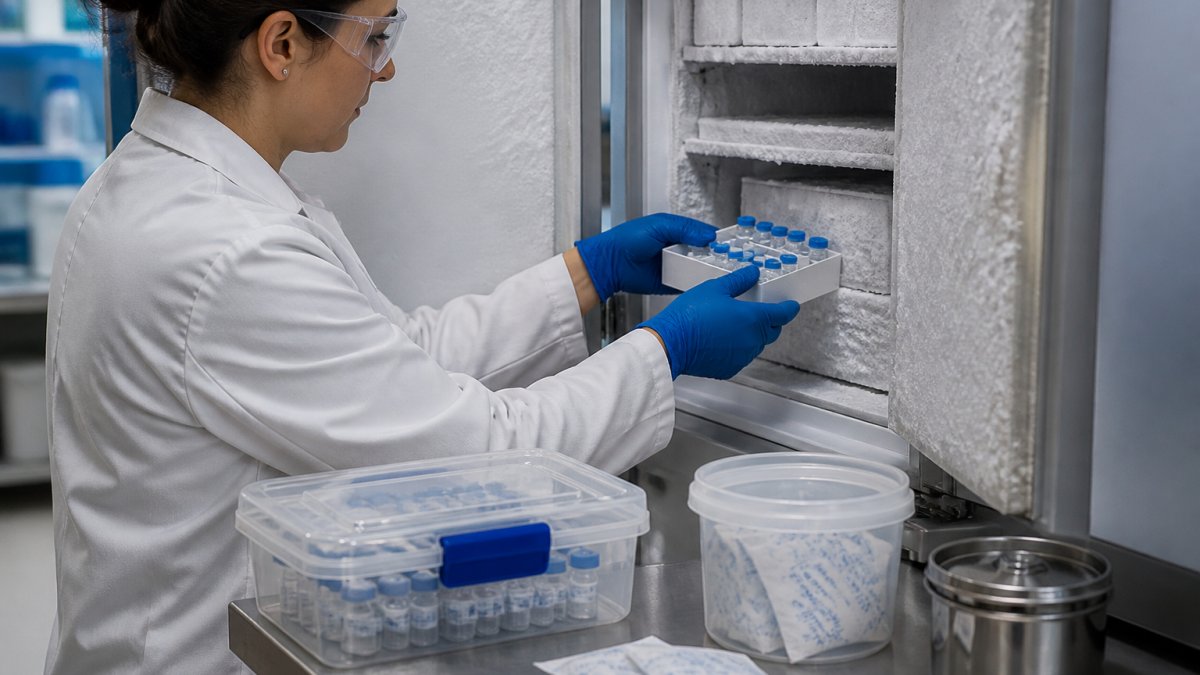
Move vials to your designated freezer or refrigerator within minutes of opening the box. Do not store them on a bench or in a cabinet at room temperature, even briefly.
In a -80°C freezer, place vials in a clearly labeled, freezer-safe box or rack designed for that temperature, since standard plastic can become brittle at ultra-low temperatures.
For -20°C freezers, store vials upright in a sealed container with desiccant. Avoid stacking vials directly on top of each other, which can damage seals.
Document the storage location, date received, and lot number in your lab notebook or inventory system.
Ongoing Handling and Monitoring
Inspect desiccant packets and vial seals monthly, replacing any desiccant that shows color change.
Log every vial opening with the date, amount removed, and intended use to estimate remaining shelf life and predict reorder timing.
When removing a vial from cold storage, plan your work first. Have all equipment ready before you open the seal. Minimize the time the vial remains open.
| Step | Action | Timing |
|---|---|---|
| 1 | Prepare workspace and gather equipment | Before removing vial from storage |
| 2 | Remove vial from freezer/refrigerator | Immediately before use |
| 3 | Allow sealed vial to reach room temperature | 10-15 minutes |
| 4 | Open vial and withdraw needed amount | As quickly as possible |
| 5 | Reseal vial immediately | Within 1 minute of opening |
| 6 | Return to cold storage | Immediately after closing |
Common Storage Mistakes and How to Avoid Them
Most storage failures stem from preventable errors. Recognizing them helps you protect your investment.
Storing at inconsistent temperatures. Freezers cycling between -10°C and -30°C cause repeated freeze-thaw damage.
Opening vials too frequently. Each broken seal lets in moisture and condensation. Consolidate experiments to minimize access.
Transferring to new containers unnecessarily. Original packaging is optimized for protection; transferring adds contamination risk and air exposure.
Ignoring desiccant condition. Spent packets provide no protection.
Thawing vials too quickly. Rapid temperature changes cause condensation inside sealed containers. Always allow vials to equilibrate to room temperature slowly before opening.
Never use a heat source (heat lamp, warm water, or incubator) to thaw vials quickly. This causes thermal shock and condensation that damages the powder.
Conclusion
Proper storage of lyophilized coenzymes protects your research investment and ensures reliable results. Keep vials cold (preferably -80°C or -20°C), dry (sealed with desiccant), and dark (in opaque containers), minimize temperature cycling and moisture exposure, and follow your protocol consistently.
FROPeptides delivers every vial with rigorous HPLC testing and mass spectrometry verification, and batch-level Certificates of Analysis ensure research-grade material. Follow the steps outlined here, monitor your storage conditions, and you’ll preserve compound integrity for months or years. Shop Now and get started with lyophilized coenzymes backed by verified purity and transparent batch documentation.
References & Further Reading:
Storage stability depends on understanding your specific coenzyme’s vulnerabilities. According to NIH guidance on biological sample preservation, freeze-dried compounds maintain integrity when protected from moisture and temperature fluctuation. The American Chemical Society’s guidelines for laboratory chemical storage emphasize the importance of sealed containers and desiccant maintenance for anhydrous powders. For detailed preservation protocols, consult ATCC standards for microbial and biochemical material storage, which documents stability windows across multiple compound classes.
Frequently Asked Questions
Should lyophilized coenzymes be stored in a freezer or refrigerator?
Store lyophilized coenzymes in a freezer at -20°C or -80°C for long-term preservation. -80°C is ideal for storage periods exceeding 6 months, while -20°C is acceptable for shorter durations. Refrigeration at 2-8°C is suitable only for brief periods (days to a few weeks) before use. Room-temperature storage accelerates thermal degradation and should be avoided entirely.
How long do lyophilized coenzymes remain stable in storage?
Coenzyme storage shelf life depends on storage temperature and handling. At -80°C in sealed, anhydrous conditions, most lyophilized coenzymes remain stable for 2-5 years or longer. At -20°C, stability typically extends 1-2 years. At refrigeration temperature (2-8°C), stability drops to weeks or months. Room-temperature storage degrades coenzymes within days. Minimize temperature fluctuations and humidity exposure to maximize shelf life.
What conditions can degrade lyophilized coenzymes?
Moisture exposure is the primary degradation driver; condensation on vials initiates hydrolysis and reduces potency. Temperature cycling between warm and cold environments causes freeze-thaw stress, accelerating breakdown. Light exposure, especially ultraviolet radiation, promotes oxidative degradation. Thermal stress from inconsistent storage temperatures increases degradation rate. Oxygen exposure in non-sealed containers shortens shelf life. Maintaining airtight, vacuum-sealed packaging in a cool, dark, dry environment prevents all five mechanisms.
How should reconstituted coenzymes be stored after opening a vial?
Once reconstituted into liquid form, coenzymes are significantly less stable than freeze-dried powder. Store reconstituted solutions at 2-8°C in the refrigerator in sealed, sterile containers. Most reconstituted coenzymes remain viable for 7-30 days depending on the specific compound and sterility conditions. Minimize exposure to air and light by keeping vials sealed when not in use. If longer storage is necessary, prepare only the volume needed for immediate use and keep the original lyophilized powder in the freezer.