Buy High Purity Research Peptides 2026: A Buyer’s Guide
Table of Contents
- Why Purity Matters: The 2026 Research Peptide Landscape
- How to Read a Certificate of Analysis for Peptides
- HPLC and Mass Spectrometry Peptide Testing Explained
- Best Practices for Peptide Storage and Handling
- Stability and Degradation: What Shortens Peptide Shelf Life
- Evaluating Suppliers: A Framework for Buying High Purity Peptides
- Conclusion
- Frequently Asked Questions
Last Updated: September 11, 2026
Why Purity Matters: The 2026 Research Peptide Landscape
If you plan to buy high purity research peptides 2026, the certificate matters more than the label. Purity determines whether your assay produces clean data or noise, and it is the first thing reviewers question when results look unusual. At FROPeptides, we treat purity as a measurable claim, not a marketing phrase, which is why every batch ships with documentation you can verify independently.
The market has shifted. Suppliers that once competed on catalog size now compete on analytical transparency, and buyers who understand FDA guidance on analytical validation hold the advantage. A peptide labeled “99% pure” means very little without the chromatogram behind it.
How to Read a Certificate of Analysis for Peptides
A certificate of analysis (COA) is a batch-specific document reporting analytical results for one production lot, and it should never be generic or reused across orders. When you buy high purity research peptides, the COA is your primary evidence of identity, purity, and consistency, but only if you know how to interrogate it.
Three things make a COA credible before you even look at the numbers:
- Batch number matching your vial label exactly, character for character
- Method details, including column type (commonly C18 reversed-phase), gradient program, flow rate, and detection wavelength (typically 214 nm or 220 nm for the peptide backbone)
- Raw data access, not just a summary table, the chromatogram and mass spectrum themselves
A COA without an accompanying chromatogram is a claim, not evidence. If a supplier will not release the raw trace, treat the purity number as unverified.
Key Metrics: Purity Percentage, Molecular Weight, and Sequence Verification
Purity percentage reflects the target peptide’s proportion of total peak area in the chromatogram. Molecular weight confirms identity through mass spectrometry. Sequence verification confirms the amino acid chain matches the intended structure.
| Metric | Method | What It Confirms | What to Look For |
|---|---|---|---|
| Purity percentage | HPLC (area %) | Target peak dominance | Single dominant peak; report the integration method |
| Molecular weight | Mass spectrometry (ESI or MALDI) | Correct compound identity | Observed mass within ~0.5 Da of theoretical |
| Sequence verification | MS/MS fragmentation or Edman degradation | Amino acid order | Fragment ion coverage across the chain |
| Endotoxin level | LAL assay | Suitability for sensitive work | Reported in EU/mg, not just pass/fail |
| Sterility | Culture testing | Absence of microbial growth | Method and incubation period stated |
| Counter-ion / salt form | Elemental analysis or ion chromatography | Actual mass of peptide vs. salt | Acetate vs. TFA affects net peptide content |
If a supplier cannot provide all six, that is a signal, not a technicality.
How to Interpret the HPLC Trace Itself
- Baseline quality. A flat, stable baseline means the integration is trustworthy. A drifting or noisy baseline inflates or deflates the area percentage.
- Peak shape. A symmetric Gaussian peak suggests a clean purification. Fronting (leading edge distortion) or tailing (trailing distortion) can indicate column overload or a co-eluting impurity hidden under the main peak.
- Shoulders and satellite peaks. Small peaks eluting just before or after the main peak are the most common impurity signature. Their area is what the purity percentage is subtracting.
- Retention time. Compare it to the method’s expected value. A shift suggests gradient, column, or temperature variation between runs.
- Wavelength. A trace run at 214 nm captures the peptide bond; a trace run at 280 nm captures aromatic residues. Ask which was used and why.
A peptide reported at 98% purity can still carry a 2% impurity profile dominated by a single closely related deletion sequence. For sensitive molecular assays, the identity of that 2% matters more than the headline number.
How to Interpret the Mass Spectrum
Mass spectrometry ionizes the sample and measures mass-to-charge (m/z) ratios. The observed molecular weight should match the theoretical value within a tight tolerance, commonly 0.5 Da, often reported as ppm error.
Three things to check:
- Adducts. Sodium (+22 Da) and potassium (+38 Da) adducts are normal and expected (peer-reviewed research). Their presence is not a purity problem.
- Multiply charged ions. Larger peptides appear as a series of peaks (e.g., [M+2H]²⁺, [M+3H]³⁺). Deconvolute them to confirm the neutral mass.
- Theoretical vs. observed. If the observed mass does not match the theoretical mass of the stated sequence, the compound is not what the label claims, regardless of what the HPLC trace shows.
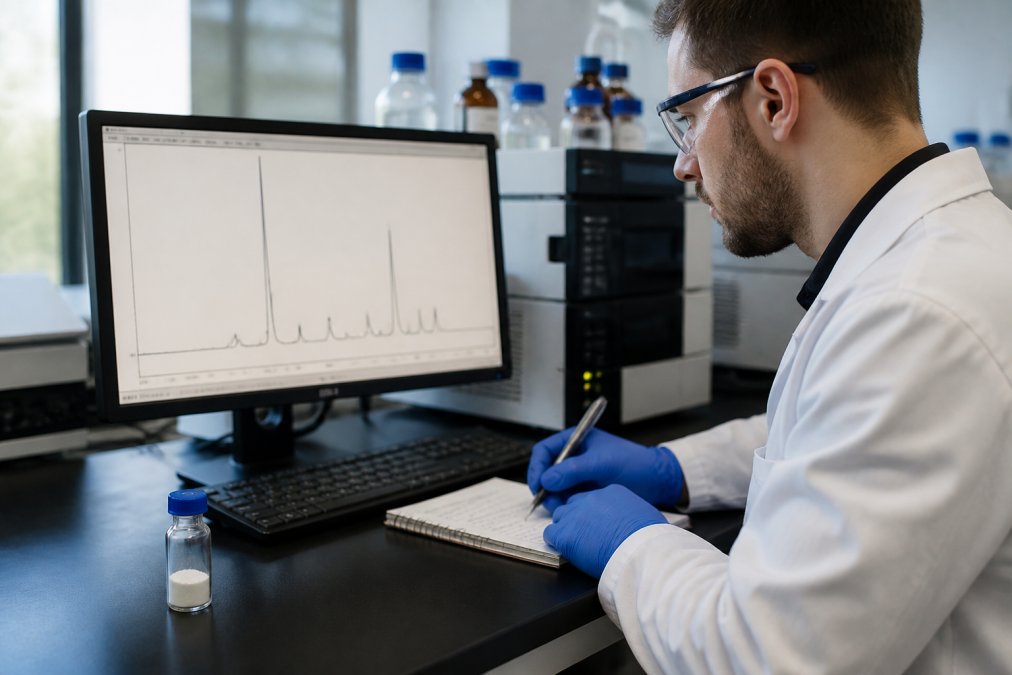
Ask suppliers for overlaid chromatograms from your last three orders, not just the current batch. Consistency across lots tells you more about a supplier’s process control than any single COA. When you overlay them, compare retention time, peak shape, and the impurity profile, not just the purity percentage.
A COA that lists only a purity percentage and a molecular weight, with no chromatogram, no method parameters, and no lot-specific raw data, cannot be independently verified. Treat it as a marketing document, not analytical evidence.
HPLC and Mass Spectrometry Peptide Testing Explained
HPLC separates compounds by retention time, and mass spectrometry confirms what those peaks are. Together they form the backbone of research-grade peptide verification.
High-performance liquid chromatography (HPLC) pushes a dissolved sample through a packed column under pressure. Compounds exit at different times, producing peaks on a chromatogram. A clean single dominant peak suggests high purity; large shoulders suggest impurities or degradation products.
Mass spectrometry then ionizes the sample and measures mass-to-charge ratios. If the observed molecular weight does not match the theoretical value within tolerance, the compound is not what the label claims.
What HPLC Chromatograms Reveal About Batch Consistency
Batch consistency is how separate production lots of the same peptide perform in your assay. Chromatograms expose this directly.
When you overlay chromatograms from two batches, peak shapes, retention times, and impurity profiles should align closely. Retention time drift suggests column or gradient variation; new impurity peaks suggest synthesis or purification problems.
A common mistake is comparing only the headline purity number. Two batches can both read 98% while carrying different impurity profiles, for sensitive assays, that difference matters more than the percentage.
Ask suppliers for overlaid chromatograms from your last three orders, not just the current batch. Consistency across lots tells you more about a supplier’s process control than any single COA.
Best Practices for Peptide Storage and Handling
Proper storage preserves compound integrity, and improper handling degrades peptides faster than most researchers expect.
- Store lyophilized powder at -20°C or lower, desiccated and protected from light
- Aliquot reconstituted peptide to avoid repeated freeze-thaw cycles
- Use sterile technique when reconstituting to limit microbial contamination
- Record reconstitution date and solvent on every vial
- Keep working aliquots at 4°C for short-term use only
Reconstitution solvent matters. Most peptides dissolve in sterile or bacteriostatic water; some require acetic acid or DMSO first. Check solubility notes before assuming water is correct.
A common mistake is reconstituting an entire vial at once. If your protocol only needs a fraction, you have just committed the rest to a shorter usable window.
Repeated freeze-thaw cycles are one of the fastest ways to degrade a peptide (peer-reviewed research). If you thaw a vial more than two or three times, expect measurable purity loss and unreliable assay results.
Stability and Degradation: What Shortens Peptide Shelf Life
Peptide shelf life depends on sequence, storage conditions, and handling, and degradation is rarely visible until your data goes sideways. Understanding the main failure modes helps you prevent them.
Temperature is the biggest factor: every increase accelerates hydrolysis and oxidation. Moisture is second. Lyophilized powder is stable because water has been removed; opening vials in humid environments reintroduces it.
Other degradation drivers include:
- pH extremes during reconstitution
- Light exposure, particularly for peptides with aromatic residues
- Oxidation of methionine, cysteine, and tryptophan residues
- Aggregation at high concentrations
Cold chain logistics matter here. A temperature-controlled shipment that only stays controlled to the airport is not a cold chain. FROPeptides ensures compound integrity through temperature-controlled storage and provides batch-level traceability.
Evaluating Suppliers: A Framework for Buying High Purity Peptides
Supplier evaluation comes down to documentation, consistency, and responsiveness. Use this framework before you buy high purity research peptides 2026 from anyone, and use the templates below to make it repeatable.
The Documentation Audit
Request the full analytical packet for a specific lot, not a sample COA. It should contain:
- Batch-specific COA with a lot number matching the vial label
- HPLC chromatogram with column, gradient, flow rate, and detection wavelength
- Mass spectrometry data with observed vs. theoretical mass and ppm error
- Endotoxin and sterility results where applicable, with units (EU/mg)
- Sequence verification report (MS/MS fragment coverage or Edman result)
- Counter-ion / salt form disclosure, since acetate vs. TFA changes net peptide content
If any item is missing, note it. A supplier that omits one item on a first request will often omit more on a reorder.
The Consistency Check
Request data from multiple recent batches and compare impurity profiles, not just purity percentages. Overlay the chromatograms and look for:
- Retention time drift (suggests method or column variation)
- New shoulder peaks (suggests synthesis or purification drift)
- Changes in the mass spectrum adduct pattern (suggests salt-form inconsistency)
A supplier with genuine process control will produce overlays that look nearly identical batch to batch.
The Responsiveness Test
Submit a technical question before ordering, such as the gradient program for a peptide or the integration method behind a purity figure. How quickly and specifically a supplier answers tells you how they will handle a problem after the sale. Vague answers are a leading indicator.
The Traceability Audit
Confirm the supplier can identify synthesis origin, purification method, and storage history for any lot. Ask for the shipment’s temperature log. A cold-chain claim without a log is a claim, not a record.
A Standardized Supplier Scorecard
Most guides give you a checklist; fewer give you a way to score suppliers consistently. The template below can be copied into a lab notebook or spreadsheet and reused for every new vendor.
| Criterion | Weight | Score (1-5) | Notes |
|---|---|---|---|
| Lot-specific COA with matching batch number | High | ||
| Raw HPLC chromatogram released | High | ||
| Mass spectrum with ppm error | High | ||
| Sequence verification report | Medium | ||
| Endotoxin / sterility data with units | Medium | ||
| Salt form disclosed | Medium | ||
| Multi-batch overlay provided on request | High | ||
| Technical question answered within 48 hours | Medium | ||
| Shipment temperature log provided | Medium | ||
| Written batch-to-batch consistency guarantee | High |
Score each criterion 1 (absent) to 5 (fully documented and independently verifiable). Weight the high-priority rows double. A supplier that scores below a threshold you set in advance is disqualified before price enters the conversation.
Record-Keeping Template for Incoming Lots
Once a supplier passes the scorecard, log every incoming lot the same way. A minimal record includes:
- Supplier name and lot number
- Receipt date and shipment temperature log reference
- COA file location and chromatogram file location
- Reconstitution date, solvent, and concentration
- Storage location and freeze-thaw count
- Assay(s) the lot was used in and observed performance
This record lets you trace a failed assay back to a specific lot, shipment, or handling step.
For labs running sensitive molecular assays, even small purity variance can compromise results. Suppliers who guarantee batch-to-batch consistency in writing, backed by real analytical data, are worth the premium. FROPeptides provides multi-stage HPLC testing and mass spectrometry for every batch, ensuring compound integrity.
The best supplier is not the one with the highest advertised purity number. It is the one that gives you the raw data, answers technical questions fast, shows consistent impurity profiles across batches, and supports a repeatable evaluation process you can document.
Conclusion
Verifying purity takes effort, and cutting corners is how compromised data reaches publication. FROPeptides supports researchers with multi-stage HPLC testing, mass spectrometry verification, and Certificate of Analysis documentation on every order, backed by temperature-controlled storage and batch-level traceability. Shop Now
Frequently Asked Questions
How do I verify the purity of research peptides?
Request a batch-specific Certificate of Analysis (COA) from your supplier. The COA should include HPLC purity percentage, mass spectrometry data confirming molecular weight, and sequence verification. Look for purity above 98% and check that the COA matches the lot number on your vial. Cross-reference the molecular weight with the theoretical value for your peptide sequence.
What documentation should accompany high purity peptides?
Every shipment of high purity peptides should include a Certificate of Analysis with HPLC chromatogram, mass spectrometry results, and purity percentage. Documentation should also cover storage conditions, reconstitution instructions, and a lot number for traceability. Always verify the COA matches your specific batch.
Are high purity peptides legitimate for scientific study?
Yes, high purity research peptides are legitimate for in vitro and animal model studies when sourced from reputable suppliers. The key is verifying purity through third-party testing and ensuring the peptide sequence matches your research needs. For publishable results, use peptides with documented COAs and batch consistency.
What are the best practices for peptide storage and handling?
Store lyophilized peptides at -20°C or lower, protected from light and moisture. Once reconstituted, store at 4°C for short-term use or aliquot and freeze at -80°C for long-term storage. Avoid repeated freeze-thaw cycles, which degrade peptide integrity. Use sterile techniques during reconstitution and handle vials in a laminar flow hood when possible. Keep a cold chain from supplier to lab, and document storage conditions for reproducibility.