Semaglutide Research Labs: A 2026 Supplier Review
Table of Contents
- What Sets Semaglutide Research Labs Apart
- How to Read a Peptide Certificate of Analysis
- Where to Buy High Purity Research Peptides
- Research Peptide Storage and Stability in the Lab
- Reconstitution and Analytical Validation Protocols
- Semaglutide Research Labs Compared: Verdict and Ratings
- Frequently Asked Questions
Last Updated: September 22, 2026
What Sets Semaglutide Research Labs Apart
Semaglutide research labs operate under a different set of standards than clinical or compounding facilities. The distinction matters because your experimental results depend on it.
This guide from FROPeptides breaks down what separates a legitimate research supplier from a repackaging operation, how to verify purity claims, and which questions to ask before you commit budget. Semaglutide research labs that serve the scientific community properly provide batch-level traceability, not just a product listing.
A research-grade peptide is a synthetic compound manufactured for laboratory investigation only, not for human consumption, and typically verified through independent analytical testing. That definition carries real weight.
Research-Grade vs Clinical-Grade Material
The difference comes down to documentation and intended use. Clinical-grade semaglutide follows pharmaceutical manufacturing standards with full regulatory oversight. Research-grade material, by contrast, is synthesized for in vitro and analytical work.
What most guides miss is that “research-grade” is not a regulated term. Any supplier can print it on a label. The real differentiator is whether they back it with third-party testing data.
Why Incretin Signaling Studies Depend on Purity
Glucagon-like peptide-1 receptor agonist research is sensitive to contaminants. Even minor impurities can skew binding affinity readings or alter glucose-dependent insulin secretion curves in your experimental model.
A common mistake is assuming a 95% purity figure tells the whole story.
How to Read a Peptide Certificate of Analysis
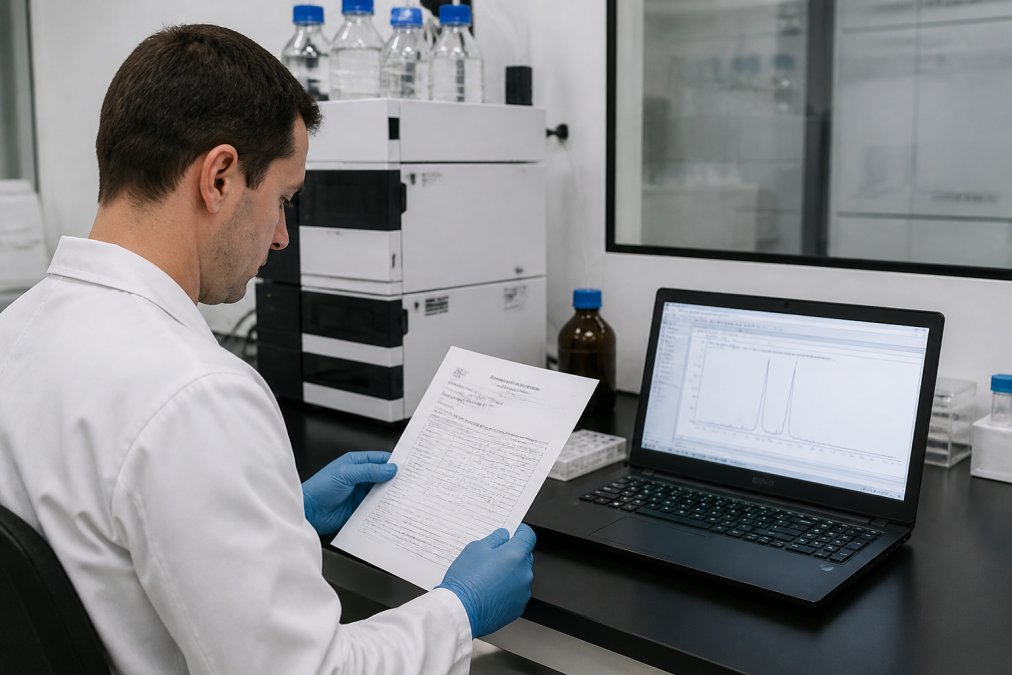
A peptide certificate of analysis is a batch-specific document reporting identity, purity, and testing methods for a given lot. If a supplier cannot produce one for the exact batch you receive, walk away.
Here is what to check, in order:
- Batch number matching your vial label exactly
- Molecular weight consistent with the expected amino acid sequence
- Purity percentage from HPLC, with the method described
- Mass spectrometry confirmation of molecular identity
- Testing date recent enough to reflect current stock
HPLC, Mass Spectrometry, and What Each Column Tells You
High-performance liquid chromatography separates compounds by retention time, revealing purity as a percentage of total peak area. A single sharp peak near the expected retention time is a good sign. Multiple shoulders suggest degradation or synthesis byproducts.
Interpreting the Chromatogram, Not Just the Number
Most researchers read the purity figure and stop. The chromatogram itself carries more information. When you review an HPLC trace, look at peak symmetry, baseline noise, and where the impurity peaks elute relative to the main peak.
Reading a Mass Spectrum for Identity Confirmation
Mass spectrometry reports the mass-to-charge ratio of ionized molecules. For a peptide, you are looking for a peak (or set of peaks) consistent with the calculated molecular weight of the target sequence, accounting for adducts like protons or sodium.
Matching the COA to Your Research Application
Purity requirements depend on what you are doing. Binding affinity assays and receptor signaling studies are sensitive to trace contaminants, so higher purity with a documented impurity profile is worth the premium. Screening work with wide effect sizes can tolerate more variability. Decide your threshold before you order, and hold suppliers to it.
A COA without a batch number, testing date, or method description is effectively worthless. Suppliers that recycle a generic document across all orders are a red flag for inconsistent sourcing.
Request the raw chromatogram and spectrum files, not just the summary page. A supplier confident in their data will share them; one that only sends a formatted PDF may be hiding a weak method.
Where to Buy High Purity Research Peptides
When you buy high purity research peptides, the supplier’s testing pipeline matters more than the marketing copy. Look for multi-stage verification and batch-level documentation as baseline requirements.
Questions to Ask Before You Order
Run every prospective supplier through this checklist:
- Can you provide a batch-specific COA before purchase?
- Which third-party lab performs your testing?
- How do you handle a shipment that arrives compromised?
- What is your cold-chain process from warehouse to delivery?
- Do you offer volume pricing for recurring orders?
- Are your compounds validated in published research?
Ask for the COA for the exact lot number you will receive, not a sample document. Suppliers confident in batch consistency will send it without hesitation.
Research Peptide Storage and Stability in the Lab
Research peptide storage and stability practices determine whether your material survives to the end of a study. Lyophilized peptides are generally more stable than reconstituted solutions, but both degrade under the wrong conditions.
| Storage State | Temperature | Light Protection | Typical Handling |
|---|---|---|---|
| Lyophilized powder | Low temp, freezer | Foil or amber vial | Aliquote before use |
| Reconstituted solution | Refrigerated | Amber vial | Avoid repeat freeze-thaw |
| Diluted working stock | Refrigerated | Amber vial | Use within short window |
Reconstitution and Analytical Validation Protocols
Reconstitution is where many labs introduce avoidable error. The goal is a fully dissolved solution at a known concentration without degrading the peptide. Getting this right is the difference between a clean assay and a mystery result.
Choosing the Right Solvent
Use bacteriostatic water for most applications, and add it slowly down the vial wall rather than directly onto the lyophilized cake. Swirl gently. Do not shake, since agitation can denature the peptide.
Calculating Concentration Correctly
Concentration is mass of peptide divided by final volume of solution. The trap is forgetting the volume the peptide itself contributes, and forgetting that the vial contains more than just peptide. If the COA reports peptide content (the actual peptide mass versus total vial mass including counterions and moisture), use that figure, not the nominal vial weight.
pH and Buffer Considerations
Peptide stability is pH-dependent. Many GLP-1 analogs are most stable near neutral to slightly acidic pH, but the optimal range varies by sequence. If your protocol allows, check the pH of the reconstituted stock and adjust with dilute acid or base if it falls outside the range your assay tolerates. Avoid strong extremes, which accelerate hydrolysis and deamidation.
Aliquoting to Protect Stability
Repeated freeze-thaw cycles degrade peptides. Aliquot the reconstituted stock into single-use volumes immediately after preparation, freeze the aliquots, and thaw only what you need for each experiment. This one habit prevents most of the variability researchers attribute to “bad batches.”
Validating Your Working Stock
For analytical validation, run a baseline HPLC or mass spectrometry check on your reconstituted stock if your protocol allows. This confirms the material in solution matches the COA and catches handling errors early.
Standardized reconstitution and a quick analytical check on your working stock protect months of downstream experimental work. Consistency here is cheaper than repeating a failed assay.
Semaglutide Research Labs Compared: Verdict and Ratings
Not every supplier deserves your budget. The table below compares the criteria that actually affect research outcomes.
| Supplier Type | COA Per Batch | Third-Party Testing | Cold-Chain Shipping | Best For |
|---|---|---|---|---|
| FROPeptides | Yes, every order | HPLC + mass spec | Temperature-controlled | Labs needing traceability |
| Generic repackagers | Often generic | Unclear | Variable | Low-stakes screening only |
| Bulk importers | Sometimes | Rarely disclosed | Minimal | Non-critical work |
FDA guidance on compounding and research materials
NIH guidelines on laboratory chemical safety
ACS analytical chemistry resources
Frequently Asked Questions
What is research-grade semaglutide and how does it differ from clinical-grade?
Research-grade semaglutide is a synthetic peptide manufactured for laboratory study, not for human consumption. It is typically sold as a lyophilized powder with documented purity, usually 98% or higher, verified through HPLC and mass spectrometry. Clinical-grade semaglutide is an FDA-approved pharmaceutical product manufactured under cGMP for patient use, with a fixed dose and delivery device. The two are not interchangeable: research-grade material is intended only for in vitro and experimental model work, and suppliers should provide a certificate of analysis for every batch.
How do you verify the purity of semaglutide from research labs?
Start with the certificate of analysis. A reliable COA shows the batch number, molecular weight, amino acid sequence, HPLC purity percentage, and mass spectrometry confirmation. Cross-check that the COA batch number matches the vial label. Look for a contaminant profile and, where available, third-party testing from an independent lab. If a supplier cannot provide batch-specific documentation or only offers a generic COA, treat that as a red flag and source elsewhere.
What should be included in a Certificate of Analysis for semaglutide?
A complete COA should list the compound name, batch or lot number, molecular weight, amino acid sequence, appearance, and purity percentage determined by HPLC. It should also include mass spectrometry results confirming identity, a contaminant profile, and the date of testing. Many buyers also want third-party tested documentation and a statement of storage conditions. If you are learning how to read a peptide certificate of analysis, the batch number and purity figure are the two fields to check first.
How should semaglutide research peptides be stored for stability?
Unreconstituted lyophilized semaglutide should be stored at -20°C or lower, protected from light and moisture. Once reconstituted with bacteriostatic water, keep it refrigerated at 2-8°C and use it within the timeframe the supplier specifies, often a few weeks. Avoid repeated freeze-thaw cycles, which degrade the peptide. Research peptide storage and stability depend on a controlled environment: consistent temperature, minimal handling, and sealed vials. Always follow the supplier’s storage guidance for the specific batch.
Are there differences between clinical-grade and research-grade semaglutide for lab work?
Yes. Clinical-grade semaglutide is formulated for human use under FDA oversight, with excipients and a delivery pen that are not suited to most bench assays. Research-grade semaglutide is a synthetic peptide supplied as a lyophilized powder, which lets you reconstitute it to the exact concentration your protocol requires. For in vitro and metabolic pathway research, research-grade material with a documented COA and high purity is the appropriate choice, provided your institution permits its use.
The real challenge in semaglutide research is not finding material, it is finding material you can trust across every batch. FROPeptides addresses that with multi-stage HPLC testing, mass spectrometry verification, and a certificate of analysis for every order, all backed by temperature-controlled storage and batch-level traceability. Get started with FROPeptides and source research-grade peptides you can document, cite, and build on.