
Elamipretide Peptide Buy: SS-31 Supplier Review Guide
Table of Contents
- Elamipretide Peptide Buy: What You’re Actually Ordering
- Elamipretide Supplier Comparison: What the Listings Actually Show
- Elamipretide Price: Normalizing Cost Per Milligram Across Vial Sizes
- Elamipretide Certificate of Analysis: How to Verify Purity Claims
- Elamipretide Storage and Handling After Delivery
- Supplier Due Diligence: Questions to Ask Before You Buy
- Conclusion: Choosing an Elamipretide Peptide Supplier
- Frequently Asked Questions
Last Updated: October 8, 2026
Elamipretide Peptide Buy: What You’re Actually Ordering
If you’re searching for an elamipretide peptide buy, the compound you’re after is a synthetic tetrapeptide studied for its interaction with mitochondrial membranes. At FROPeptides, we supply research-grade material for laboratory investigation, and we’ve watched the supplier landscape shift as listings multiply and documentation quality varies wildly. This guide breaks down what you’re actually ordering, how to compare suppliers fairly, and what to verify before you commit. Below, we’ll show you exactly what separates a well-documented vial from an anonymous one.
SS-31, MTP-131, Elamipretide: One Compound, Three Names
Elamipretide is a mitochondria-targeting synthetic tetrapeptide that also appears in the literature and product listings as SS-31 and MTP-131. All three names refer to the same sequence.
That naming overlap causes real confusion. A researcher searching for one alias may miss a listing filed under another. When you compare suppliers, confirm the CAS number and sequence match rather than trusting the label alone.
Research-Use-Only Status and Legal Boundaries
Elamipretide peptide listings carry a research-use-only designation. That means the material is sold for laboratory investigation, not for human use, and not as a drug or supplement.
The regulatory picture matters here. In the United States, the FDA guidance on research-use-only products frames how these materials are labeled and sold. Vendors that blur that line are a warning sign. If a listing implies therapeutic use, walk away.
Buying a research peptide marketed for human consumption exposes you to legal and safety risk. Legitimate suppliers state research-use-only status plainly and never suggest dosing or clinical use.
Elamipretide Supplier Comparison: What the Listings Actually Show
An elamipretide supplier comparison only works if you score every listing against the same criteria. Most product pages omit price, vial size, or testing data, which makes like-for-like comparison harder than it should be. Instead of a table full of blanks, use a fixed scorecard and record what each listing actually discloses.
The Six Criteria That Matter
Score every listing on these, and note the date you checked, because listings change:
- Identity confirmation, Does the page state the CAS number and full sequence, or only a trade name?
- Stated quantity, Is the milligram fill shown, or must you request it?
- Purity basis, Is the purity figure tied to a batch-specific test, or is it a generic “≥99%” claim?
- Documentation, Is a batch-specific certificate of analysis available before purchase?
- Cost per milligram, Price divided by stated milligrams, not the sticker price.
- Cold chain and shipping, Is temperature control described, and does it extend to your facility?
What a Typical Scan Reveals
When you apply those six criteria to publicly visible listings, a pattern emerges. Some pages show a purity figure but no quantity. Others show a price but no testing documentation. A few show a batch-specific COA but no shipping detail. Almost none show all six at once. That gap is exactly where careful buyers get burned, because a listing that looks complete on one axis is often silent on the axis that matters most to your experiment.
How to Run the Comparison Yourself
- Open each candidate listing in a separate tab and record the six criteria in a spreadsheet.
- For any blank cell, send the vendor a written request and note the response time.
- Normalize price to cost per milligram using the stated fill.
- Flag any listing that will not confirm quantity or documentation in writing.
- Re-check the listings before you order, since stock and pricing shift.
A vendor that answers documentation questions in writing within a business day is usually the same vendor that ships with proper cold-chain handling. Slow, vague answers on paperwork often predict slow, vague answers on logistics.
Reading the Results
The scorecard does not tell you which vendor is cheapest. It tells you which vendors are transparent. A listing that scores well on identity, quantity, purity basis, and documentation but costs more per milligram is often the better research purchase, because you can verify what you received. A listing that scores well only on price is an unknown quantity until you test it yourself.
Keep the dated scorecard with your lab records. If a shipment later fails a purity check, the scorecard shows whether the vendor disclosed the relevant information up front or whether you were working from assumptions.
Elamipretide Price: Normalizing Cost Per Milligram Across Vial Sizes
Elamipretide price means nothing until you normalize it to cost per milligram. A 50 mg vial at $103.95 works out to roughly $2.08 per milligram, but you can only call that good or bad after checking purity and documentation.
Here’s how we’d compare any two listings:
- Divide listed price by stated milligrams to get cost per milligram
- Confirm the purity figure comes from a batch-specific test
- Check whether shipping and cold-chain handling are included
- Factor in bundle savings if you order multiple vials
A cheaper vial with no COA is not a bargain. It’s an unknown quantity.
When a listing shows price but not quantity, request the vial size in writing before ordering. Vendors that won’t confirm milligram amounts in a quote are usually hiding a small fill.
Elamipretide Certificate of Analysis: How to Verify Purity Claims
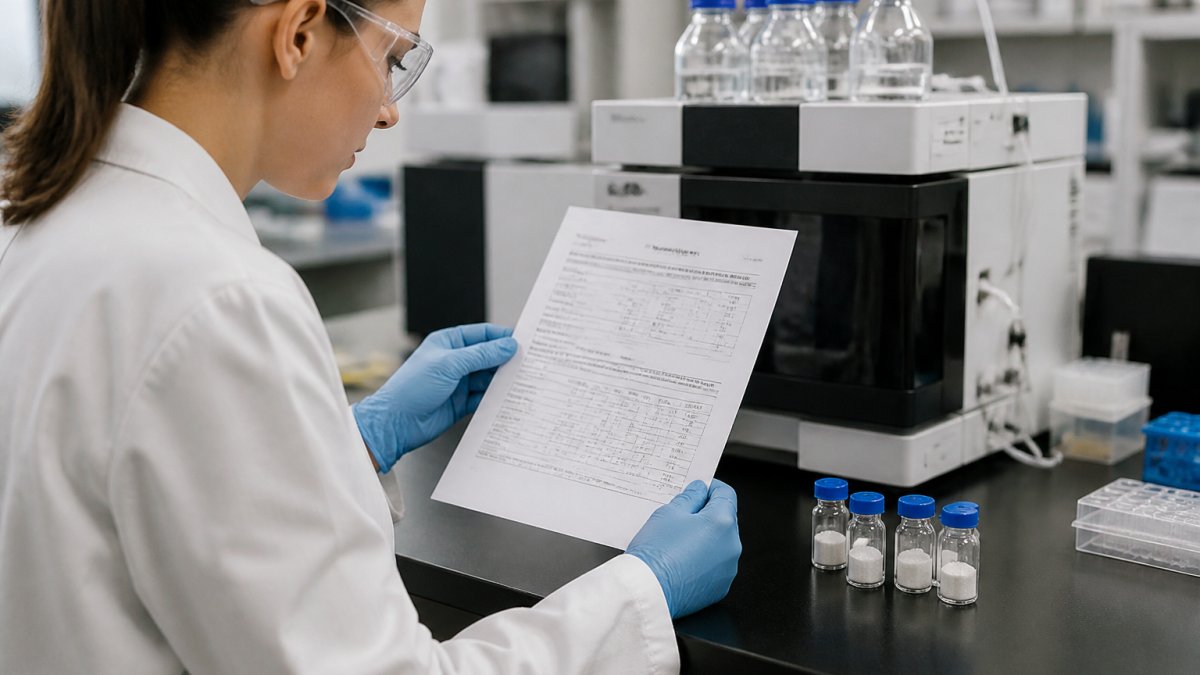
An elamipretide certificate of analysis is the document that separates a verifiable supplier from a hopeful one. But a COA is only useful if you know how to read it and whether it can be independently checked. Most buyers accept a PDF at face value. That is the mistake this section is meant to prevent.
What a Batch-Specific COA Must Contain
A COA that actually supports a purity claim should name the specific batch or lot number, the analytical method used, the result, and the date of testing. If the document shows only a generic purity figure with no lot number, it cannot be tied to the vial in your hand. Treat it as a marketing claim, not a test result.
At minimum, look for:
- Lot or batch identifier that matches the vial label
- Test method named explicitly, such as reverse-phase HPLC
- Purity result as a percentage, with the chromatogram or a reference to it
- Mass confirmation from mass spectrometry, with the observed mass
- Testing date and the name of the testing party
HPLC and Mass Spectrometry: Reading the Data
HPLC separates and quantifies the compound, giving you a purity percentage. The chromatogram shows peaks; the main peak should correspond to elamipretide, and impurity peaks should be small and accounted for. A purity number without the chromatogram is only half the story.
Mass spectrometry confirms the molecular weight matches elamipretide’s expected mass. This catches mislabeled or degraded material that HPLC alone might miss, because a degraded peptide can still elute as a single peak while having the wrong mass. Look for both methods on the same COA, tied to the same lot.
How to Independently Verify a COA
A COA is a claim until you can check it. Independent verification means confirming that the document is internally consistent and, where possible, that the testing party is real and reachable.
- Check internal consistency, Does the lot number on the COA match the lot number on the vial label and the packing slip?
- Check the math, Do the stated purity and impurity figures add up to a coherent total?
- Check the testing party, Is the lab named, and can you find it independently? A COA with no identifiable testing party is weaker than one that names a lab you can look up.
- Check the date, A COA dated years before your batch was produced does not describe your batch.
- Request the raw data, Ask whether the chromatogram and mass spectrum are available, not just the summary line.
A COA that cannot be tied to a lot number, or that names no testing party, should not be treated as verification. It is a document, not proof. If a vendor will not provide batch-level documentation before purchase, that is a signal to look elsewhere.
What Independent Verification Cannot Do
Even a well-formed COA has limits. It describes the sample that was tested, not necessarily the vial you receive, unless the lot numbers match. It does not tell you how the material was stored after testing or during transit. And it does not establish that the compound is safe or appropriate for any use outside laboratory investigation. Verification reduces uncertainty; it does not eliminate it.
Ask for the COA before you order, not after. The best vendors provide batch-level documentation as standard, which is how we operate at FROPeptides through multi-stage HPLC testing and mass spectrometry on every batch.
Elamipretide Storage and Handling After Delivery
Elamipretide storage and handling decisions start the moment a shipment arrives. Lyophilized peptide is more stable than reconstituted material, but temperature exposure during transit still matters.
- Store lyophilized vials at the temperature the supplier specifies, typically frozen for long-term holding
- Keep vials sealed and protected from light until use
- Reconstitute only what you need for a given experiment
- Aliquot before freezing to avoid repeated freeze-thaw cycles
If a shipment arrives warm or compromised, document it immediately. Reputable suppliers treat cold-chain failure as their problem to fix.
Supplier Due Diligence: Questions to Ask Before You Buy
Due diligence is the step most buyers skip, and it’s the one that protects your results. A short list of questions filters out weak suppliers fast.
- Can you send the batch-specific COA before purchase?
- What is the exact milligram quantity per vial?
- How is the shipment temperature-controlled, and does that extend to my facility?
- What is your policy if a shipment arrives degraded?
- Do you offer aliquoting for larger orders?
The suppliers worth your budget answer documentation questions in writing and without delay. Vague answers about testing or cold chain are the clearest signal to look elsewhere.
Conclusion: Choosing an Elamipretide Peptide Supplier
The hardest part of an elamipretide peptide buy isn’t finding a listing. It’s finding one that shows its testing data and stands behind its cold chain.
FROPeptides supplies research-grade elamipretide with multi-stage HPLC testing, mass spectrometry verification, and a certificate of analysis for every batch. Our temperature-controlled storage and batch-level traceability keep your material intact from dispatch to bench. Get started with FROPeptides and order research material you can actually verify.
Frequently Asked Questions
How much does elamipretide cost?
Pricing varies by supplier, vial size, and quantity ordered. Cost per milligram often drops as vial size increases, so compare the same quantity across suppliers. For current elamipretide peptide pricing, check the supplier’s product page directly, since listed prices change with stock and promotions.
What is the difference between elamipretide, SS-31, and MTP-131?
They are the same compound under three names. SS-31 was the original research designation, MTP-131 is the alternate code, and elamipretide is the international nonproprietary name. Listings that identify all three names make verification easier. A supplier that only uses one name without cross-referencing the others may leave you guessing whether the product matches your protocol. Always confirm the CAS number and molecular formula on the certificate of analysis before ordering.
What purity and testing documentation should I look for when buying elamipretide?
Look for a batch-specific certificate of analysis that reports HPLC purity and mass spectrometry confirmation. Purity figures below 98% can introduce variance that may affect sensitive assays. Request the COA for the exact lot you will receive, not a representative sample, and verify that the document includes the testing method, column type, and retention time.
How should research-grade elamipretide be stored after delivery?
Store lyophilized elamipretide at -20°C or lower, protected from light and moisture. Once reconstituted, aliquot into single-use volumes to avoid repeated freeze-thaw cycles, which degrade the peptide. Use sterile technique and keep working solutions at 4°C for short-term use only. If your facility runs at high ambient temperatures, verify that cold-chain shipping extends to your receiving dock, not just the airport, and inspect vials for condensation or damage before placing them in storage.
Where can I purchase peptides legally?
Research peptides are legal to purchase for laboratory investigation in most U.S. jurisdictions when labeled and sold for research use only, not for human use. Regulatory status varies by state and by intended application. Elamipretide is not approved for general consumer use, though it has been studied under specific clinical programs. Buy from suppliers that state research-use-only restrictions clearly and provide batch documentation. Consult your institution’s compliance office before importing or using any research chemical in regulated work.