Buy Research Grade Peptides Online: 2026 Lab Guide
Table of Contents
- Quick Comparison: 10 Research Peptide Suppliers
- How to Buy Research Grade Peptides Online Without Getting Burned
- Third-Party Testing for Research Peptides: What to Look For
- How to Read a Certificate of Analysis for Peptides
- Lyophilized Peptide Storage Best Practices
- Top 10 Suppliers to Buy Research Grade Peptides Online
- 1. AminoVault: Domestic Manufacturing with Verifiable COAs
- 2. PSPeptides: Third-Party Testing Focus with Free Shipping Over $200
- 3. American Peptides: Lot-Specific Documentation for Consistency
- 4. GenScript: Custom Synthesis and High-Volume Catalog
- 5. Phoenix Pharmaceuticals: mg to kg Scale Custom Orders
- 6. Bachem: Industry-Standard Quality for Clinical Research
- 7. Cosmic Peptides: Same-Day Shipping for Time-Sensitive Experiments
- 8. Pure Lab Peptides: 99% Purity with Responsive Support
- 9. RPeptide: Specialized Neurodegenerative Research Compounds
- 10. Biosynth: Integrated Ordering for Custom Synthesis
- Pricing, Shipping, and Regulatory Compliance
- Frequently Asked Questions
Last Updated: September 17, 2026
Quick Comparison: 10 Research Peptide Suppliers
If you want to buy research grade peptides online, start with what each lab verifies before a vial ships. This FROPeptides guide covers purity thresholds, COA reading, cold chain logistics, and compliance.
| Supplier | Purity Claim | Testing Model | Best For |
|---|---|---|---|
| AminoVault | ≥99% | In-house + COA | Domestic manufacturing |
| PSPeptides | 99%+ | Third-party | Fast shipping, transparency |
| American Peptides | Lot-verified | Third-party, lot-specific | Batch consistency |
| GenScript | Catalog-grade | In-house QC | Custom synthesis, volume |
| Phoenix Pharmaceuticals | Research-grade | In-house + assay kits | mg to kg scale orders |
| Bachem | Clinical-grade | Full QC suite | Institutional research |
| Cosmic Peptides | 99%+ | Third-party | Same-day dispatch |
| Pure Lab Peptides | 99%+ | Third-party | Standard lab protocols |
| RPeptide | Research-grade | In-house + specs | Neurodegenerative research |
| Biosynth | Research-grade | In-house QC | Integrated ordering |
How to Buy Research Grade Peptides Online Without Getting Burned
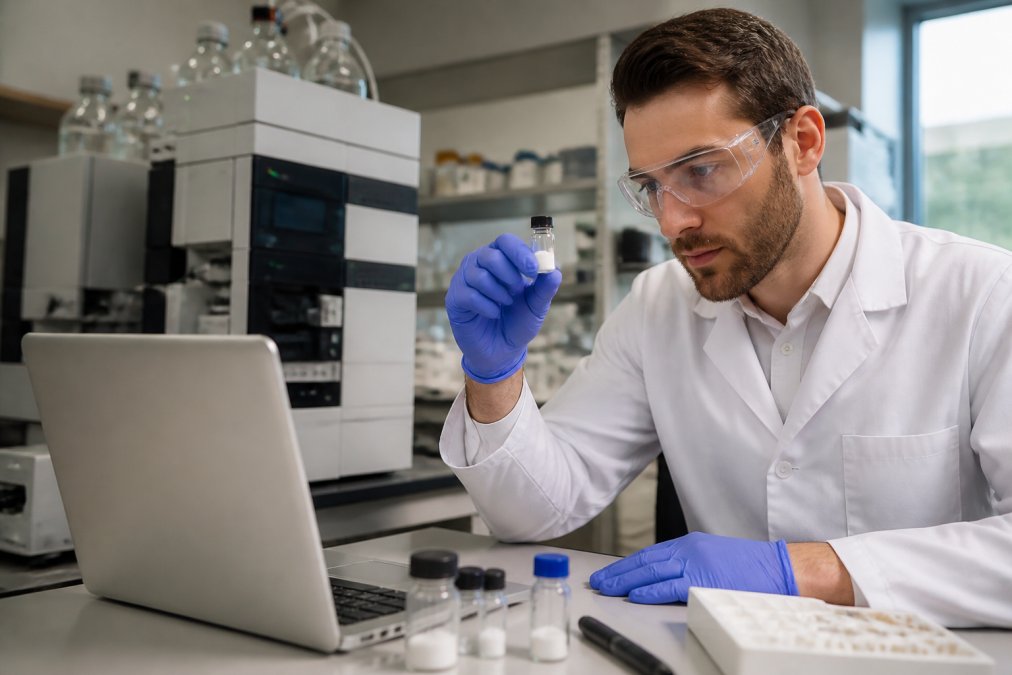
The biggest mistake buyers make is treating purity percentage as a marketing number rather than a verifiable specification. A supplier that cannot produce batch-level documentation for your exact lot is asking you to trust a label, not a result.
Purity Thresholds That Actually Matter
For most biochemical research, 95% purity is the floor and 98%+ is the working standard. Anything below 95% for a biologically active peptide should raise questions about assay suitability.
Red Flags in Supplier Listings
- No lot number tied to a specific COA
- Purity claims without a stated analytical method
- “Research-grade” used as a substitute for an actual specification
- No storage or shipping temperature guidance
- Pricing that undercuts every competitor with no explanation
A common mistake is ordering from a listing showing a generic COA image rather than documentation for the batch in stock. Ask for the lot-specific document before you commit.
Third-Party Testing for Research Peptides: What to Look For
Third-party testing for research peptides means an independent lab verifies purity, identity, and composition. That separation is what makes the result meaningful, a supplier testing its own material is grading its own homework.
In-House QC vs. True Third-Party Verification
The phrase “third-party tested” gets used loosely. What matters is who controls the sample chain and who signs the result.
- True third-party: the supplier ships a sample (or the testing lab draws from the production lot) to an independent lab, and that lab issues the COA under its own name and accreditation.
- In-house QC: the supplier runs its own HPLC and mass spec and reports the result on its own letterhead. This can be perfectly valid, but it is not independent verification.
- Relabeled in-house: the weakest case, a supplier’s own result presented with language implying outside review. If the testing lab is not named, assume it is in-house.
Ask whether the third-party lab is named on the COA. Suppliers that hide the testing lab behind “independent analysis” are usually the ones with something to obscure.
How to Verify the Testing Lab Is Real
A named lab is a start, not a finish. Three checks separate a genuine analytical partner from a name on a template:
- Accreditation. Look for ISO/IEC 17025 accreditation. An accredited lab can show a scope document listing its accredited methods, if peptide purity by HPLC is not in that scope, the accreditation does not cover the test you care about.
- Method specificity. The COA should state the HPLC column type, mobile phase, gradient, and detection wavelength, plus the mass spec ionization mode. “HPLC: 99%” with no method detail is not reproducible.
- Lot traceability. The lot number on the COA must match the lot number on your vial. A COA for a different lot tells you nothing about the material you received.
What Third-Party Testing Can and Cannot Prove
Independent testing is powerful but has limits:
- It can confirm identity (the sequence matches the expected molecular weight), purity (the percentage of target peptide in the sample), and the presence of common impurities.
- It cannot confirm sterility, endotoxin levels, or biological activity unless those specific assays are run and reported. A purity COA is not a safety or efficacy document.
- It is a snapshot. The result applies to the sample tested, not to every vial in the lot. Consistent lot-to-lot testing gives more confidence than a single historical COA.
Questions to Ask Before You Trust a Testing Claim
- Which lab ran the test, and is it named on the COA?
- Is the lab ISO/IEC 17025 accredited for the specific method used?
- Does the COA show the method, instrument, and detection wavelength?
- Does the lot number on the COA match the lot number on the vial you will receive?
- How often does the supplier test, every lot, or periodically?
A supplier that answers all five without hesitation gives you what a purity percentage cannot: a verifiable chain from synthesis to your bench.
How to Read a Certificate of Analysis for Peptides
A Certificate of Analysis is a batch-specific document reporting purity, molecular weight, and appearance for one lot. Start with the lot number and match it to the vial label, confirm the sequence and molecular weight against expected values, then review the HPLC trace and mass spec data.
HPLC and Mass Spectrometry Data Explained
HPLC separates the peptide from impurities and reports the main peak percentage, but the shape of the trace matters as much as the number printed next to it.
- Single sharp peak, flat baseline: the expected result for a well-purified compound.
- Shoulder on the main peak: a closely related impurity, often a deletion or truncation sequence, co-eluting with the target. A 98% purity figure can still hide a shoulder that interferes with sensitive assays.
- Multiple distinct peaks: incomplete synthesis or degradation. Treat the stated purity with suspicion.
- Rising or drifting baseline: gradient or column issues during the run, which can inflate the apparent main-peak percentage.
What Purity Percentage Actually Means for Your Assay
The purity number measures how much detected material is target peptide, not how well the compound will perform. The practical difference between tiers is real:
| Purity Tier | Typical Use Case | What to Watch For |
|---|---|---|
| ~95% | Screening, non-quantitative work, method development | Impurity peaks can shift dose-response curves |
| ~98% | Standard biochemical and cell-based assays | Acceptable for most protocols; verify the trace shape |
| 99%+ | Quantitative assays, structural work, sensitive receptor studies | Confirm the method and wavelength used to claim it |
COA Fields and What Each One Confirms
| COA Field | What It Confirms | Red Flag If Missing |
|---|---|---|
| Lot number | Batch traceability | Cannot verify your vial |
| HPLC purity % | Impurity profile | No stated method or wavelength |
| Mass spec result | Sequence identity | No molecular weight |
| Appearance | Physical integrity | No description |
| Storage guidance | Stability conditions | No temperature range |
| Test method / instrument | Reproducibility | Vague or absent methodology |
Ask for the COA for the exact lot in stock before you order, not a sample COA from a previous batch. A supplier that can only produce a generic example document is telling you something about its documentation process.
Reconstitution and Handling Notes That Belong With the COA
A COA tells you what is in the vial, not how to keep it that way. Once identity and purity are confirmed, these handling steps protect that result:
- Reconstitute with the solvent the supplier specifies for that sequence, most peptides dissolve in sterile water or a dilute buffer, but hydrophobic sequences often need a small amount of acetonitrile or DMSO first.
- Add solvent gently down the vial wall rather than pipetting directly onto the powder, which can cause foaming and denaturation.
- Aliquot before freezing. A single vial thawed repeatedly will degrade faster than the COA purity suggests.
- Record the reconstitution date and solvent on the vial label so a later result can be traced back to its preparation.
Lyophilized Peptide Storage Best Practices
Lyophilized peptides are stable for extended periods when stored cold and dry, but stability collapses fast with moisture or heat. Store powder at -20°C for routine work and -80°C for long-term archival, keeping vials sealed until use.
Freeze-thaw cycling is the most common cause of unexplained assay drift. If your results shift between runs using the same lot, repeated thawing of a single vial is the first thing to check.
Top 10 Suppliers to Buy Research Grade Peptides Online
Each supplier below earns its place for documentation depth, synthesis capability, or dispatch speed. Match the supplier to your protocol rather than chasing the lowest listed purity.
1. AminoVault: Domestic Manufacturing with Verifiable COAs
AminoVault manufactures research peptides domestically and backs each batch with a verifiable Certificate of Analysis, hard to beat for labs needing documented sourcing without overseas lead times. The tradeoff is pricing transparency: AminoVault requires a direct inquiry rather than publishing rates, which slows budget planning for smaller labs.
2. PSPeptides: Third-Party Testing Focus with Free Shipping Over $200
PSPeptides leans hard into third-party testing and transparent purity reporting, with free shipping over $200, a strong fit for academic and independent researchers prioritizing documentation and delivery speed.
3. American Peptides: Lot-Specific Documentation for Consistency
American Peptides provides lot-specific Certificates of Analysis and secure payment processing, with bonus incentives on larger orders, ideal for labs locking a single lot across a multi-week study.
4. GenScript: Custom Synthesis and High-Volume Catalog
GenScript is a global biotech supplier with a large catalog, custom synthesis, a 24/7 ordering portal, and instant quotes, best for institutional researchers needing standardized catalog items or scaled custom work.
5. Phoenix Pharmaceuticals: mg to kg Scale Custom Orders
Phoenix Pharmaceuticals specializes in custom peptide synthesis and assay kits, scaling from milligrams to kilograms with a typical two-to-three-week delivery window, a first look for large-scale or specialized assay development.
6. Bachem: Industry-Standard Quality for Clinical Research
Bachem carries thousands of biologically active peptides and amino acid derivatives with full technical documentation and clinical-grade research support, a mainstay for professional institutions and pharmaceutical developers.
7. Cosmic Peptides: Same-Day Shipping for Time-Sensitive Experiments
Cosmic Peptides emphasizes rapid dispatch with guaranteed same-day shipping and 99%+ verified purity, the deciding factor when an experiment cannot wait for a standard fulfillment cycle.
8. Pure Lab Peptides: 99% Purity with Responsive Support
Pure Lab Peptides guarantees over 99% purity with fast shipping and dedicated researcher support, consistent purity and responsive service cover most standard laboratory protocols.
9. RPeptide: Specialized Neurodegenerative Research Compounds
RPeptide focuses on complex sequences, including amyloid-beta and related neurodegenerative research peptides, with detailed specifications and clear price ranges, expertise generalist suppliers cannot match.
10. Biosynth: Integrated Ordering for Custom Synthesis
Biosynth offers an integrated online portal for custom peptide synthesis plus a broad catalog of biologically active peptides and chemical reagents, best for researchers sourcing multiple reagent types from one supplier.
Pricing, Shipping, and Regulatory Compliance
Cost, cold chain, and compliance decide whether a purchase works in practice.
What Affects Peptide Pricing
Pricing depends on quantity, synthesis complexity, purity level, and documentation depth. Longer chains, modified amino acid derivatives, and custom sequences cost more than short catalog compounds. Request a current quote, rates shift with batch and volume.
Cold Chain and Shipping Stability
Temperature-controlled shipping protects peptide integrity from dispatch to delivery. Lyophilized powder tolerates short ambient exposure better than reconstituted solution, but extended heat degrades both. Confirm shipping method, packaging, and replacement policy before ordering, especially for warm-climate destinations.
Laboratory Use Only: Compliance Basics
Research-grade peptides are sold for laboratory use only, not for human or veterinary use. Suppliers label compounds accordingly, and buyers are responsible for using them within the scope of their institutional and regulatory requirements. NIH guidelines on research reagent use provides useful context on documentation expectations in funded research.
Frequently Asked Questions
What is the best website to buy research peptides in the USA?
There is no single best website, but the strongest options share key traits: verifiable third-party testing, batch-specific Certificates of Analysis, and clear purity documentation. AminoVault offers US-manufactured compounds with verifiable COAs. PSPeptides emphasizes third-party testing transparency. American Peptides provides lot-specific documentation. Compare suppliers based on your specific needs: purity requirements, documentation depth, shipping speed, and whether you need custom synthesis. Always request a sample COA before committing to a large order.
Why is third-party testing for research peptides so important?
Third-party testing for research peptides verifies what the supplier claims. In-house testing can be manipulated or inconsistent. Independent labs run HPLC analysis to confirm purity percentage and mass spectrometry to verify molecular weight and sequence integrity. Without third-party verification, you cannot confirm the peptide chain matches the label or that purity meets your assay requirements. Reputable suppliers like PSPeptides and American Peptides publish third-party results for every batch, giving you traceable documentation for your research records.
How do I read a certificate of analysis for peptides?
A COA should include the lot number, peptide sequence, molecular weight, purity percentage from HPLC analysis, and mass spectrometry confirmation. Check that the observed molecular weight matches the theoretical value within acceptable tolerance. Look for the HPLC chromatogram showing a single sharp peak, which indicates high purity. The purity level should be 95% or higher for most research applications, with 98-99% preferred for sensitive assays. Verify the COA is batch-specific, not a generic document, and that the testing lab is independent.
What are the standard storage requirements for lyophilized research peptides?
Lyophilized peptides should be stored at -20°C for short-term use or -80°C for long-term storage. Keep vials sealed and protected from light and moisture. Before reconstitution, allow the vial to reach room temperature to prevent condensation. After reconstitution, store at 4°C for immediate use or aliquot and freeze at -20°C to avoid repeated freeze-thaw cycles. Use sterile buffers and handle with gloves to prevent contamination. Proper storage temperature and handling preserve peptide stability and ensure reproducible experimental results.
Are there regulatory considerations for buying research chemicals online?
Research peptides are sold for laboratory use only, not for human or veterinary consumption. Suppliers should clearly label products as research-grade and include disclaimers. Researchers must comply with institutional policies and applicable regulations governing chemical procurement. Verify that your supplier provides proper documentation, including safety data sheets and Certificates of Analysis. Some compounds may require additional permits or institutional approval. Always confirm that your intended use aligns with laboratory research purposes and that you have appropriate storage and handling protocols in place.