Is Mass Spectrometry Verification Necessary for Peptides?
Last Updated: October 23, 2026
Quick Summary
Mass spectrometry verification is necessary for peptides because it confirms molecular identity by matching measured mass to the expected mass for the stated sequence. It does not confirm purity, sterility, or biological activity, so pair every MS result with an HPLC purity trace before trusting a batch.
- A vial can be 98% pure by HPLC and still contain the wrong peptide entirely.
- Tandem mass spectrometry fragments a precursor ion and maps fragment patterns back to the amino acid sequence.
- Peptide LC-MS testing combines liquid chromatography separation with mass spectrometry identification in one run.
- Check that a Certificate of Analysis states expected mass, observed mass, mass error, and the method used.
- Mass spectrometry verification is always needed for publishing results, filing data, and regulated work.
Table of Contents
- What Mass Spectrometry Confirms About a Peptide
- What Mass Spectrometry Does Not Prove
- Peptide LC-MS Testing: How the Workflow Runs
- Peptide Purity Testing by HPLC and Why It Complements MS
- How to Read a Peptide Certificate of Analysis
- Mass Spectrometry Sample Requirements and Method Selection
- When Verification Is Worth It: A Practical Decision Guide
- Frequently Asked Questions
What Mass Spectrometry Confirms About a Peptide
Mass spectrometry verification answers one narrow but critical question: does the molecule in this vial match the molecule on the label?
Here is the short version. Mass spectrometry (MS) measures molecular mass. It confirms peptide identity. It does not confirm purity, sterility, or biological activity.
Mass spectrometry is an analytical technique that ionizes molecules and measures their mass-to-charge ratio, producing a spectrum that reveals a compound’s molecular mass and, with fragmentation, structural details (Quantitative mass spectrometry: an overview).
That distinction matters more than most buyers realize. A vial can be 98% pure by HPLC and still contain the wrong peptide entirely.
Molecular Weight and the m/z Measurement
The mass spectrometer does not weigh a peptide directly. It converts the peptide into gas-phase ions and measures the mass-to-charge ratio, written as m/z.
A single peak is not enough. The software deconvolutes those peaks into one neutral mass.
- Expected mass: calculated from the amino acid sequence and molecular formula
- Measured mass: derived from the spectrum after deconvolution
- Match window: typically a few parts per million for a confident identity call
A close match supports identity. A mismatch means something is wrong: wrong sequence, truncation, or a modification the label never mentions.
Ionization, Fragmentation, and Sequence Verification
Ionization gets the peptide into the gas phase. Electrospray ionization is the common route for peptides because it produces multiply charged ions without shattering the molecule.
Tandem mass spectrometry (MS/MS) goes further. The instrument selects a precursor ion, fragments it, and measures the fragment ions.
This is where sequence verification lives. But there is a limit, and most guides skip it. Fragmentation confirms the peptide’s mass and much of its backbone.
What Mass Spectrometry Does Not Prove
The biggest misunderstanding in peptide sourcing is that an MS pass means the material is clean. It does not. Mass spectrometry is an identity test, not a purity test, and it says nothing about sterility, endotoxins, or residual solvents.
Here is what a mass spectrum leaves unanswered:
- Purity level. MS cannot quantify how much of the sample is your target peptide versus related impurities. That is HPLC’s job.
- Contaminants without a detectable mass signature. Some impurities co-elute or ionize poorly.
- Biological activity. A correctly identified peptide may still be inactive if it degraded or folded wrong.
Treating an MS certificate as a full quality release is a common and costly mistake. A spectrum that matches the expected mass confirms you have the right molecule, not that you have a clean one. Pair every MS result with an HPLC purity trace before you trust a batch.
For a wider look at how mass spec fits into a full quality program, see our guide on mass spectrometry for peptide quality control.
Peptide LC-MS Testing: How the Workflow Runs
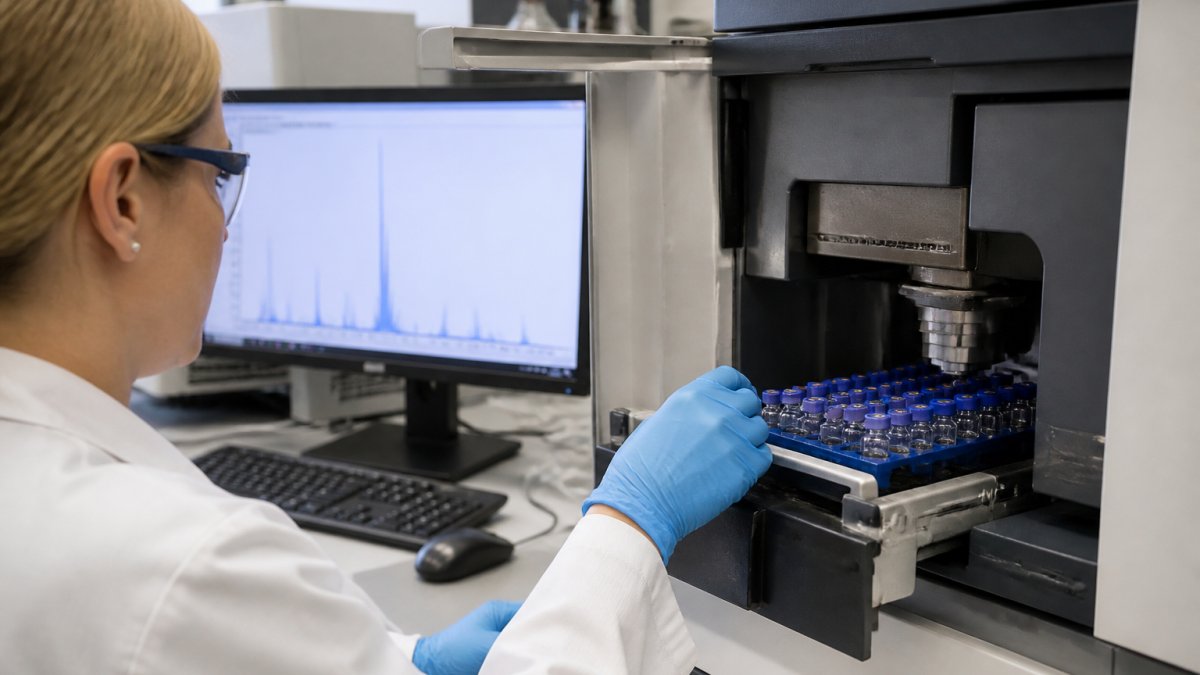
Peptide LC-MS testing combines liquid chromatography with mass spectrometry in one run. The liquid chromatography (LC) separates sample components first, and the mass spectrometer identifies what comes off the column.
The workflow follows a predictable sequence:
- Sample preparation. Dissolve the lyophilized peptide in a suitable solvent at a defined concentration.
- Separation. Inject the sample onto the LC column; components separate by retention time.
- Ionization. The eluent enters the source and the peptide becomes charged ions.
- Mass analysis. The instrument records m/z values and builds the mass spectrum.
- Data interpretation. Software deconvolutes the peaks and compares measured mass to expected mass.
Each step introduces variables. If you want the step-by-step detail on running the analysis, our mass spectrometry analysis for peptides how-to guide walks through it.
Peptide Purity Testing by HPLC and Why It Complements MS
Peptide purity testing by HPLC answers the question MS cannot: how much of the sample is your target compound. HPLC separates components by retention and quantifies each peak as a percentage of total area.
The two methods are complementary, not redundant.
| Question | Method | What It Tells You |
|---|---|---|
| Is this the right molecule? | Mass spectrometry | Identity via molecular mass and fragments |
| How pure is it? | HPLC | Purity percentage from peak area |
| Is the sequence intact? | MS/MS | Fragment pattern and backbone coverage |
| Is it sterile? | Microbiological testing | Absence of microbial contamination |
A batch can pass MS and fail HPLC, or pass HPLC and fail MS. That is exactly why both belong on a Certificate of Analysis. Our own testing runs multi-stage HPLC alongside mass spectrometry on every batch, so identity and purity are documented together.
How to Read a Peptide Certificate of Analysis
A Certificate of Analysis (CoA) is a batch-specific document reporting the analytical results for that lot. Reading it well means checking that the methods, results, and batch numbers all line up, and then checking the raw data behind each number.
Start with the traceability layer:
- Batch or lot number. It must match the vial you received. A CoA without a matching lot number is not traceable to your material.
- Peptide name and sequence. Confirm the stated sequence and molecular formula, because the expected mass is calculated from them.
- Test date and report date. A CoA older than the batch it claims to describe is a red flag.
Then move to the identity layer and cross-check it against the spectrum:
- Expected mass. Calculate or look up the theoretical monoisotopic or average mass for the stated sequence. The CoA should state which convention it uses.
- Observed mass. Find the deconvoluted neutral mass on the report, not just a single m/z peak. A multiply charged peptide produces several m/z peaks that must collapse to one mass.
- Mass error. Compare observed to expected and express the difference in parts per million or daltons. A tight match supports identity; a loose or unstated tolerance weakens the claim.
- Adducts and charge states. Confirm the report accounts for common adducts such as sodium or potassium, which shift peaks without indicating a wrong peptide.
- Method named. Look for the ionization source, instrument type, and whether tandem MS was used. “MS confirmed” with no method is not auditable.
Then move to the purity layer and cross-check it against the chromatogram:
- HPLC method and column. The report should name the column chemistry, mobile phase, gradient, and detection wavelength.
- Purity percentage and integration method. A purity figure with no chromatogram behind it is a claim, not a result.
- Retention time. Compare the reported retention time to the main peak in the chromatogram.
Build a one-page checklist and run every CoA through it: lot match, sequence match, expected mass, observed mass, mass error, method named, chromatogram shown, test date. If any line is blank, ask the supplier for the missing data before you use the material.
A common pattern is a CoA that reports a purity percentage and a molecular weight but omits the spectrum and chromatogram. That document cannot be audited, because there is nothing to compare the numbers against. A CoA that names its methods and shows the actual data is one you can verify independently, and that is the standard worth holding suppliers to.
For a full walkthrough of each CoA field, read our peptide certificate of analysis explained guide. If you are staring at the raw HPLC and MS data and want help reading it, our guide to interpreting HPLC mass spec data covers the step-by-step interpretation.
Mass Spectrometry Sample Requirements and Method Selection
Mass spectrometry sample requirements are stricter than many buyers expect. The sample must be soluble, at a workable concentration, and free of contaminants that suppress ionization. Salt content, buffers, and detergents can all interfere.
Key requirements to plan for:
- Solubility. The peptide must dissolve fully in a solvent compatible with the method. Poorly soluble sequences may need a different solvent system or a digestion step.
- Concentration. Too dilute and the signal is weak; too concentrated and the detector saturates. Ask the lab for its working range before you ship material.
- Clean matrix. Excess salts, buffers, and detergents suppress ionization and skew results (Effects of Buffer Loading for Electrospray Ionization Mass Spectrometry of a Noncovalent…). Desalting or solid-phase extraction may be required.
Method selection follows the question you are asking, and the methods are complementary rather than interchangeable:
| Question | Primary method | What it adds |
|---|---|---|
| Is this the right molecule? | LC-MS | Molecular mass and identity |
| Is the backbone sequence correct? | Tandem MS (MS/MS) | Fragment ions that map to sequence |
| How pure is it? | HPLC with UV detection | Purity percentage from peak area |
| Are there related impurities? | LC-MS plus HPLC | Separation plus mass identification |
| Is it sterile and endotoxin-free? | Microbiological testing | Contamination status |
This is the principle of orthogonal testing: methods that rely on different physical principles catch different failure modes.
Choosing a testing laboratory is its own decision.
Do not submit a sample without confirming the lab’s solvent compatibility, concentration range, and reporting format first. A result that cannot answer your question wastes both the sample and the turnaround time.
If you want the step-by-step detail on running the analysis, our mass spectrometry analysis for peptides how-to guide walks through it.
When Verification Is Worth It: A Practical Decision Guide
Mass spectrometry verification is worth it when identity errors would compromise your work. For most research applications, that means always.
Use this decision guide:
| Situation | Verification Needed? | Why |
|---|---|---|
| Publishing results or filing data | Yes, always | Identity must be documented and traceable |
| Regulated or clinical-adjacent work | Yes, always | Audit trail and batch records are required |
| Routine screening with known-good supplier | Recommended | Confirms batch consistency over time |
| Early exploratory work, non-critical | Optional | Lower stakes, but document what you have |
Some buyers ask whether verification is necessary at all, or whether a supplier’s reputation is enough. Reputation is not a result.
The question is not whether mass spectrometry is necessary in general. It is whether you can afford to run an experiment on a molecule whose identity you have not confirmed. For most research, the answer is no.
If you are weighing whether to pay for verified material, our mass spectrometry verified peptides buyer’s guide lays out what verification is worth in practice.
Mass spectrometry verification is not a luxury add-on. It is the test that tells you the molecule in your vial is the molecule you ordered.
Frequently Asked Questions
Does mass spectrometry confirm peptide purity?
No. Mass spectrometry verification confirms molecular identity and molecular weight, not purity. A sample can show the correct mass while still containing truncated sequences, residual solvents, or water content. Purity is measured by HPLC, where the target peak’s area is compared against total peak area. Use both methods together: MS tells you the compound is the right molecule, and HPLC tells you how much of it you actually have.
How much sample is needed for mass spec?
Most peptide LC-MS testing methods need only micrograms of material, typically 1-10 micrograms injected on column. Mass spectrometry sample requirements are modest because the detector works at trace levels. However, you still need enough sample for duplicate injections and a blank. For lyophilized peptides, dissolving 0.5-1 mg in a suitable solvent usually provides more than enough for several runs plus retention samples.
What cannot be detected by mass spectrometry?
Mass spectrometry cannot reliably detect compounds with no ionizable groups, and it struggles with isobaric species that share the same mass. It also does not measure biological activity, sterility, endotoxin levels, or residual solvents. Counterfeit or mislabeled material with the correct mass will pass. This is why orthogonal testing, combining MS with HPLC, Karl Fischer titration, and amino acid analysis, matters for identity confirmation.
Should every research peptide batch have a certificate of analysis?
Yes, every batch should have a CoA showing the analytical method used, the measured mass versus expected mass, HPLC purity percentage, and the testing laboratory. A CoA without raw data or method details is hard to evaluate. When ordering, ask whether the CoA is batch-specific and whether mass spectra and chromatograms are available. FROPeptides provides batch-level CoA documentation with mass spectrometry verification for every order.
What is the difference between HPLC and mass spectrometry for peptide testing?
HPLC separates components in a sample and measures their relative abundance, giving a purity percentage. Mass spectrometry measures mass-to-charge ratio to confirm molecular identity. Peptide purity testing by HPLC answers how much of the target compound is present. Mass spectrometry answers whether that compound is the correct molecule. Neither method alone gives a complete picture, which is why reputable suppliers run both.
