
Peptide Cold Chain Shipping Standards: 2026 Guide
Table of Contents
- Why Peptide Cold Chain Shipping Standards Matter
- Peptide Shipping Temperature Requirements by Product Form
- Lyophilized Peptide Shipping and Storage: What Changes in Transit
- Peptide Cold Chain Packaging: Insulated Shippers, Gel Packs, and Dry Ice
- Transit Duration, Carrier Choice, and Route Risk
- Peptide Shipment Temperature Excursion Handling
- Qualification, Documentation, and the Limits of General Claims
- Conclusion
- Frequently Asked Questions
Last Updated: October 19, 2026
Why Peptide Cold Chain Shipping Standards Matter
Peptide cold chain shipping standards are the documented temperature, packaging, and handling controls that keep a research peptide within its qualified stability range from dispatch to receipt.
Peptides are not a single category: a lyophilized powder and a reconstituted solution behave nothing alike in transit, and an oxidation- or aggregation-prone sequence has tighter tolerances than a short, stable fragment.
Below, we break down the ranges, packaging decisions, transit risks, and documentation that make a shipment defensible, including how to qualify a shipping lane and handle a logged excursion.
Peptide Shipping Temperature Requirements by Product Form
Temperature requirements are set by the product’s own stability data, not a universal rule: a lyophilized peptide typically tolerates controlled room temperature for short windows, while a reconstituted solution demands stricter cold holding.
Refrigerated, Frozen, and Controlled Room Temperature Ranges
Three ranges dominate peptide logistics, and each carries different handling obligations:
- Controlled room temperature: a defined band, generally well above freezing and below the point where hydrolysis accelerates. Suitable for many lyophilized powders over short transit windows.
- Refrigerated (2-8°C): the standard holding range for reconstituted material and for lyophilized peptides whose stability data calls for cold storage.
- Frozen (-20°C, with -80°C for more labile material): used where the compound degrades even at refrigerated temperatures, or where long-term storage demands it.
The right range for a given vial comes from the supplier’s stability documentation. We publish batch-level Certificates of Analysis because a blanket temperature claim is not evidence.
Never assume a frozen product can ship at refrigerated temperatures “for a day or two.” Repeated freeze-thaw cycling and partial thawing can degrade material even when the vial never reaches ambient. If the stability data specifies frozen, ship frozen.
Lyophilized Peptide Shipping and Storage: What Changes in Transit
Lyophilized peptide shipping and storage differ from solution handling in one way: the absence of bulk water slows most degradation pathways, so a lyophilized powder is generally more forgiving in transit than a reconstituted solution. That margin is real, but not unlimited.
What changes in transit is exposure. A lyophilized vial can tolerate brief excursions that would compromise a solution, provided they stay within stability-testing limits.
Practical implications for lyophilized shipments:
- Confirm the vial closure and secondary containment before packout.
- Choose the shipping range from stability data, not from convenience.
- Treat the arrival condition as part of the record: inspect, log, and store per the label.
Peptide Cold Chain Packaging: Insulated Shippers, Gel Packs, and Dry Ice
Peptide cold chain packaging is the physical system that holds a product inside its qualified range for the full transit duration. It has four parts: an insulated shipper, a conditioned coolant, a packout method, and a temperature monitoring device.
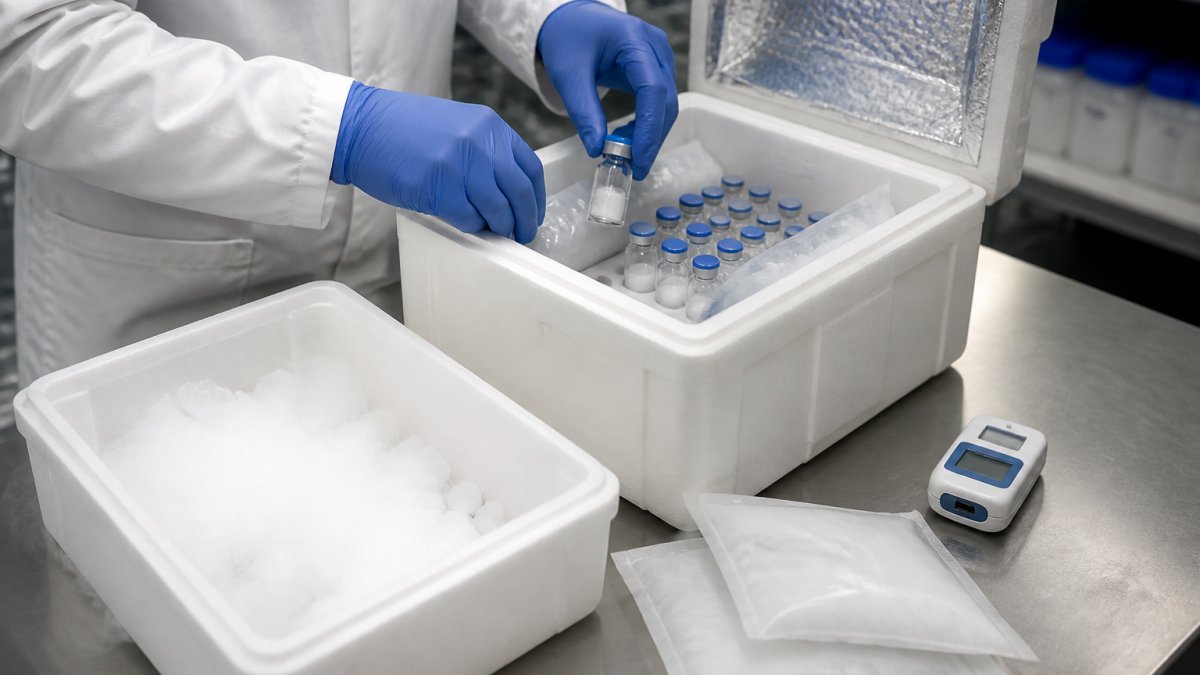
Insulated shippers come in expanded polystyrene and vacuum-insulated panel designs, chosen by transit duration and external conditions.
Coolant Conditioning and Packout Method
Coolant conditioning is the step most often skipped. Gel packs pulled straight from a freezer and packed against a vial can drop the product below its qualified range, causing a freeze event the stability data never covered. Conditioned coolants reach the correct starting temperature before packout so the payload settles into range rather than overshooting it.
A workable packout sequence:
- Verify the shipper specification matches the lane and transit duration.
- Condition coolants to the target starting temperature.
- Place a buffer layer between coolant and product.
- Seat the monitoring device where it records product-level conditions.
- Seal, label, and record the packout time.
Handling consistency is what makes this repeatable. A packout that depends on one technician’s judgment will drift.
Qualifying a Shipper Against Seasonal Extremes and Route Duration
A shipper is not qualified because it has a published performance claim; it is qualified when tested against the worst conditions your lane can produce. Most protocols center on three variables: external temperature profile, transit duration, and payload configuration.
Lane testing extends chamber results to real routes. Ship a placebo or instrumented payload on the actual lane during the season of concern, recover the logger data, and compare it to the chamber profile.
Passive Versus Active Systems, Payload Configuration, and Sustainability Trade-Offs
Passive systems rely on insulated walls and a conditioned coolant load; active systems use powered refrigeration or phase-change materials with controlled setpoints.
Payload configuration matters as much as the shipper. Vials packed tightly together share thermal mass and hold temperature more evenly than vials rattling in a large void.
Sustainability trade-offs are real. Expanded polystyrene is effective but bulky and often landfilled.
Build your lane qualification around the worst realistic transit time, not the average. If a route routinely takes two days but occasionally takes four, the packaging and coolant load must cover four.
Transit Duration, Carrier Choice, and Route Risk
Transit time decides whether a packaging system is adequate. A packout qualified for 24-48 hours is not the same system as one built for several days, and a route crossing multiple climate zones adds risk a single-zone lane does not carry.
Carrier choice follows from that. Same-day and overnight services reduce exposure windows; long-distance ground services extend them. Route risk includes more than weather: customs clearance, hub delays, and weekend holds can all extend time outside controlled conditions.
Peptide Shipment Temperature Excursion Handling
Peptide shipment temperature excursion handling is the documented response when a shipment’s recorded conditions fall outside the qualified range. The response should be defined before the shipment leaves, not improvised on arrival.
A defensible excursion procedure has four steps:
- Detect: read the monitoring device data against the qualified range.
- Quantify: establish the maximum temperature reached and the duration of exposure.
- Assess: compare the excursion against the product’s stability limits to determine disposition.
- Disposition: release, quarantine, or replace, with the rationale recorded.
Monitoring Devices and Shipment Data
Monitoring devices turn a shipping claim into a record. Data loggers capture a continuous temperature trace; indicators show only whether a threshold was crossed. Loggers give the duration and magnitude needed to assess an excursion; indicators give a yes/no.
The shipment data belongs with the batch record. When a receiving lab asks whether a vial was held in range, the answer should be a downloaded trace, not an assurance.
Qualification, Documentation, and the Limits of General Claims
Qualification is the difference between a packaging system that should work and one shown to work on a specific lane. Validated packaging qualification means testing the shipper, coolant load, and packout against a defined transit profile and recording the result; lane testing extends that to your actual routes.
What a Validated Lane Qualification Actually Contains
A defensible qualification package has four elements: a written shipping specification, a qualification protocol, the test data, and a conclusion stating the conditions under which the packout is approved.
Measurable acceptance criteria separate a qualification from a demonstration. A workable criterion is that product-level temperature stays within the qualified range for the full simulated transit, with no single excursion exceeding the stability limit and total time out of range below a defined threshold.
Chain-of-Custody and Shipping Records
A complete shipping record ties the physical shipment to the batch and to the qualification covering it.
For research environments operating under a quality system, these records are the evidence an auditor or receiving lab will ask for. The shipping specification and qualification report belong with the product’s quality documentation; the shipment-specific record belongs with the batch record or shipment file.
Deviation Reports and Excursion Disposition
When a shipment arrives with a recorded excursion, the response should be a documented deviation, not an informal email. A workable report states what happened, when it was detected, the maximum temperature and duration, the product and batch affected, the stability evidence used to assess impact, the disposition decision, and the corrective action to prevent recurrence. The disposition, release, quarantine, or replace, should reference the product’s stability data and the qualification acceptance criteria, not a general assurance that the material is probably fine.
A practical decision tree for excursion disposition:
- Confirm the excursion is real: check the logger data against the qualified range and rule out device placement errors.
- Quantify the exposure: maximum temperature reached, duration above the upper limit or below the lower limit, and whether the product froze.
- Compare to stability evidence: does the product’s stability data cover the observed excursion, or is the excursion outside the tested envelope?
- Decide disposition: release if the excursion is within the stability envelope and the qualification criteria; quarantine if the evidence is ambiguous and additional testing is warranted; replace if the excursion exceeds the stability envelope.
- Record the decision and the rationale, and open a corrective action if the root cause is a packaging or packout failure.
The Limits of General Claims
General temperature claims have limits, and honest suppliers say so. A published range describes a qualified condition, not a guarantee that every route and season is covered. The strongest position is a supplier who can show batch-level stability data, a qualified packout, a lane qualification report, and a monitoring record for the shipment in question. That is the standard backed by multi-stage HPLC testing, mass spectrometry verification, and a Certificate of Analysis for every batch.
Qualification, documentation, and deviation handling are not paperwork for its own sake. They are the mechanism that lets you answer the only question that matters on arrival: is this material still within its qualified range, and if not, what evidence supports using it?
Conclusion
Shipping sensitive research material is a chain of documented decisions, and any undocumented link is where integrity quietly disappears. The labs that avoid degraded arrivals qualified their lanes, conditioned their coolants, and kept the monitoring data.
FROPeptides supports that standard with temperature-controlled storage, batch-level traceability, and Certificates of Analysis backed by HPLC and mass spectrometry for every lot. Shop Now
Frequently Asked Questions
Do peptides have to be shipped cold?
Not always. Lyophilized peptides are typically more stable than reconstituted material and may tolerate controlled room temperature for short transit windows, depending on product-specific stability data. Reconstituted peptides and oxidation-prone sequences usually need refrigerated or frozen conditions. The decision should be based on the supplier’s stability data for that specific peptide, the expected transit time, and the route’s temperature exposure. Ask for documented storage and shipping conditions before ordering, and confirm what the shipment’s data logger shows on arrival.
What temperature should peptides be shipped at?
Common peptide cold chain ranges are 2-8°C for refrigerated shipments, -20°C for frozen, and -80°C for highly labile material. Lyophilized peptides often ship at controlled room temperature for short durations when stability data supports it. The right range depends on the peptide’s form, its stability profile, and transit duration. A supplier should state the target range and the acceptable excursion window in writing, and include a temperature indicator or data logger so you can verify conditions at receipt.
What should you do if a peptide shipment arrives warm?
Do not use the material until you have reviewed the shipment data. Record the arrival temperature, download or read the data logger, and note how long the shipment was outside its target range. Quarantine the vials and contact the supplier with the logger data and timestamps. A documented excursion does not automatically mean the peptide is degraded, but disposition should follow the supplier’s stability data and your own SOP. Reputable suppliers replace compromised stock quickly when the data supports a claim.
How do you monitor temperature during peptide shipping?
Use a data logger or single-use temperature indicator inside the insulated shipper, placed near the product rather than against a gel pack. Data loggers record the full time-temperature profile so you can see whether the shipment stayed in range and for how long any excursion lasted. For high-value or long-haul shipments, pair the logger with a validated packout and lane testing. On receipt, download the data, attach it to the batch record, and compare it against the supplier’s stated acceptance criteria before releasing the material.
How should lyophilized peptides be packaged for shipping?
Lyophilized peptides should ship in sealed vials inside a secondary containment layer, cushioned to prevent breakage, within an insulated shipper sized to the coolant load. Gel packs must be conditioned so they are not so cold they freeze the product, and the packout should be validated for the expected transit time. Include a temperature indicator or data logger, and label the shipment clearly. On arrival, store lyophilized vials per the supplier’s instructions, often at 2-8°C or -20°C for long-term storage, and record receipt conditions.