Peptide Sciences vs Core Peptides: Quality & Pricing
Table of Contents
- Peptide Sciences vs Core Peptides: Key Differences
- Research Peptide Certificate of Analysis: What to Demand
- Peptide Purity Testing: HPLC Mass Spectrometry Standards
- Research Peptide Storage and Handling Requirements
- Research Peptide Supplier Quality Checklist
- Pricing, Availability, and Order Fulfillment
- Which Vendor Fits Your Lab’s Needs
- Frequently Asked Questions
Last Updated: October 17, 2026
Peptide Sciences vs Core Peptides: Key Differences
When evaluating research peptide suppliers, the choice between peptide sciences vs core peptides comes down to three factors: catalog breadth, analytical documentation, and fulfillment reliability.
At FROPeptides, we’ve analyzed what separates vendors that consistently deliver research-grade materials from those that cut corners. A 2% purity variance might seem minor until it tanks your HPLC results.
This comparison examines both vendors across CoA transparency, storage protocols, compound availability, and pricing.
Research Peptide Certificate of Analysis: What to Demand
A Certificate of Analysis (CoA) is your only proof that a research peptide meets stated purity specifications. The real question isn’t whether a vendor provides one, but what it contains, who produced it, and what it does and does not establish.
What a CoA should contain
A batch-level CoA worth relying on typically includes:
- HPLC retention time and peak integration percentages
- Mass spectrometry molecular weight confirmation
- Testing date and batch identification number
- Name of the testing laboratory and its accreditation status, if any
A generic CoA that lists only a purity percentage with no supporting chromatogram or spectrum is a claim, not evidence. Ask whether HPLC traces and mass spec data are attached by default or available on request, and ask for a sample CoA from a recent batch before ordering.
What accreditation and testing results do and do not establish
A CoA, even from an accredited laboratory, establishes that a sample associated with a batch identifier met the stated specification on the date tested. It does not establish:
- That the vial you receive came from the tested batch, unless batch traceability links the two
- That the compound is safe, effective, or suitable for human use, which research-use-only status explicitly disclaims
- That the testing method was appropriate for the specific impurity profile of that compound
- That the sample tested was representative of the full lot rather than a selected aliquot
Accreditation is a statement about a laboratory’s quality-management system, not a guarantee about any single result. The document tells you what was measured, not whether it answers your research question.
Separating claims from evidence
When you compare peptide sciences vs core peptides, sort what you learn into three tiers:
- Vendor claims. Website statements about purity standards or “pharmaceutical-grade” quality. Marketing until documented.
- Customer anecdotes. Forum posts and reviews. Useful for spotting shipping or support patterns, but not evidence of purity for a specific batch.
- Independently verifiable evidence. A batch-specific CoA with raw data, a traceable batch number, and a testing date you can cross-check against the lot you receive.
A practical test: ask each vendor for the CoA for the exact lot number they would ship. If the data match the stated specification, you have moved to tier three. A generic document or a CoA for a different lot keeps you in tier one.
A documentation checklist for lab buyers
- Batch number on the CoA matches the batch number on the vial label
- HPLC chromatogram attached, not just a summary percentage
- Mass spectrometry spectrum attached with the expected molecular weight
- Testing date within a reasonable window of the ship date
- Testing laboratory named, with accreditation status stated if claimed
FDA guidance on analytical method validation for research materials describes the importance of documented testing procedures. Use it as a reference for the level of documentation to expect, while remembering that research-use-only compounds fall outside the approval framework that guidance was written for.
A CoA is a record of a test, not a certification of suitability. Research-use-only status means the supplier makes no claim about human or veterinary use, and a clean CoA does not change that. Do not treat a supplier comparison, or a purity result, as evidence of safety or efficacy.
Questions that reveal documentation depth
- Can you send the CoA for the specific lot you would ship, before I order?
- Is the testing done in-house or by an outside laboratory, and is that laboratory accredited?
- How many HPLC methods are run per batch, and at what detection wavelengths?
- Is mass spectrometry run on every batch or only selected lots?
- How long are raw analytical data retained, and can I request them?
Vendors that answer these in writing, with documents attached, give you something you can verify. Vendors that deflect to a generic purity claim ask you to trust a marketing statement.
Peptide Purity Testing: HPLC Mass Spectrometry Standards
HPLC (High-Performance Liquid Chromatography) and mass spectrometry are the gold standard for peptide purity analysis.
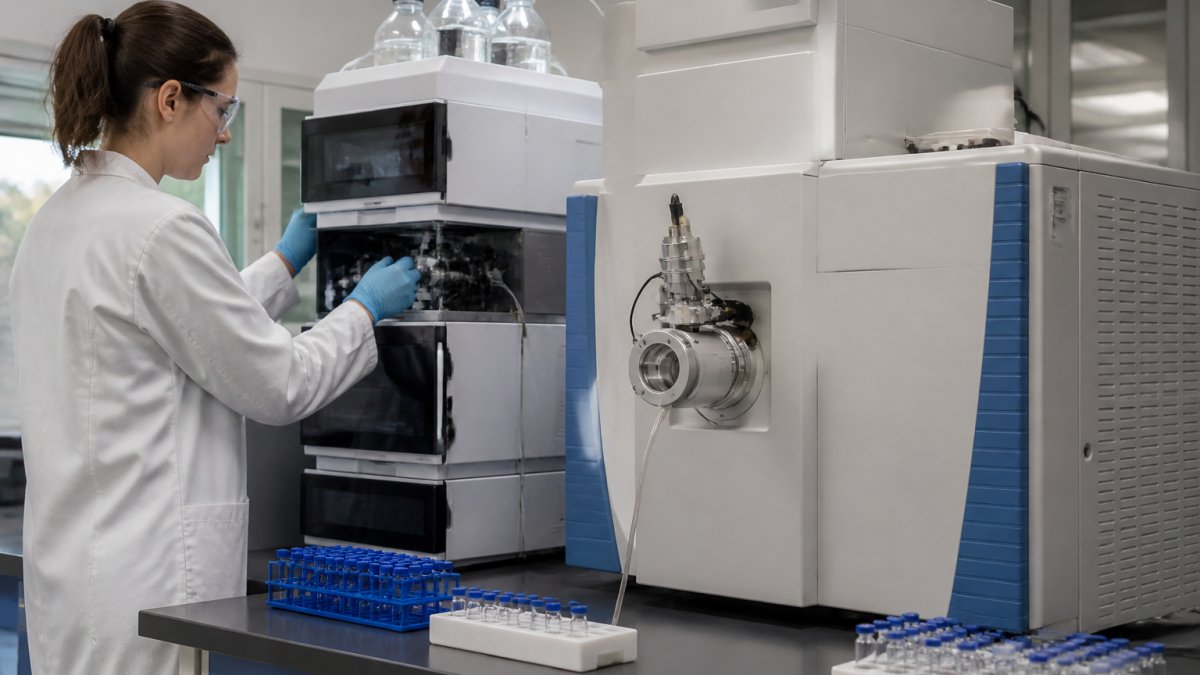
Not all HPLC testing is equivalent.
Mass spectrometry confirms the molecular ion matches the expected peptide weight and detects structural anomalies HPLC alone cannot reveal.
When evaluating research peptide suppliers, ask these specific questions:
- How many HPLC methods do you use per batch?
- Do you perform mass spectrometry on every batch or only samples?
- What detection wavelengths do you use, and why?
- Are your analytical instruments regularly calibrated and validated?
The difference between “we test for purity” and “we perform multi-stage analytical verification” determines whether you get a reliable compound or a batch that barely meets minimum standards.
Research Peptide Storage and Handling Requirements
Peptide degradation begins the moment synthesis ends.
Proper research peptide storage requires:
- Temperature control between 2°C and 8°C for most lyophilized peptides
- Protection from light using amber or opaque vials
- Low-humidity environments (silica desiccant packets in sealed containers)
- Minimal air exposure in the vial headspace
The supply chain matters as much as final storage. A vendor that uses temperature-controlled shipping but hands your package to an unrefrigerated courier defeats the purpose.
When comparing peptide sciences vs core peptides, inquire about cold chain logistics: insulated packaging with ice packs, temperature tracking during transit, and replacement guarantees for compromised shipments.
FROPeptides maintains temperature-controlled dispatch and provides detailed handling instructions with every order.
Research Peptide Supplier Quality Checklist
This checklist helps you compare vendors objectively and identify weak points before ordering.
| Evaluation Criterion | What to Look For | Red Flags |
|---|---|---|
| Certificate of Analysis | Batch-specific CoA with HPLC traces and mass spec data | Generic purity percentage only; no supporting documentation |
| Analytical Testing | Multi-stage HPLC plus mass spectrometry on every batch | Single HPLC pass; mass spec only on request |
| Catalog Availability | Established product list with consistent inventory | Frequent “out of stock” notices; limited compound selection |
| Pricing Transparency | Clear per-unit pricing with volume discount structure | “Contact for pricing”; hidden fees or unclear terms |
| Shipping Speed | Documented turnaround time (typically 2-5 business days) | Vague delivery estimates; frequent delays |
| Customer Support | Direct contact for technical questions; responsive communication | Generic support email; slow response times |
| Documentation Transparency | Batch traceability from synthesis through testing | Minimal documentation; difficulty obtaining batch history |
| Storage Instructions | Detailed stability data and storage protocols provided | Generic “keep cool and dry” guidance only |
Score each criterion as “Meets Standards,” “Acceptable,” or “Does Not Meet Standards.” Deprioritize vendors scoring poorly on analytical testing or documentation transparency, regardless of price.
Pricing, Availability, and Order Fulfillment
Cost per vial matters, but cost-to-purity ratio matters more. A cheaper peptide that arrives degraded or fails your analytical requirements wastes money and lab time. This section lays out a repeatable like-for-like method and explains what the numbers do and do not tell you.
A like-for-like comparison method
To compare peptide sciences vs core peptides on price, hold four variables constant:
- Same compound. Pick a standard, widely stocked peptide (for example, a common research peptide sold in 5 mg lyophilized vials) rather than a custom or modified sequence.
- Same quantity. Compare 1-vial, 5-vial, and 10-vial pricing separately, because volume tiers rarely scale at the same rate between vendors.
- Same date. List prices change. Record the date and time you captured each price and note whether the figure includes shipping.
- Same unit basis. Convert everything to price per milligram so different vial sizes do not distort the comparison.
A simple worksheet looks like this:
| Comparison field | Vendor A entry | Vendor B entry |
|---|---|---|
| Compound and sequence | ||
| Vial size (mg) | ||
| Listed price, 1 vial (USD) | ||
| Listed price, 5 vials (USD) | ||
| Listed price, 10 vials (USD) | ||
| Price per mg at 1 vial (USD) | ||
| Shipping cost and threshold (USD) | ||
| Date and time captured | ||
| Source (product page URL) |
Fill this in for three or four compounds you actually use. Typically one vendor is cheaper at single-vial quantities while the other closes the gap at volume tiers, and shipping thresholds can flip the ranking on small orders. Record what you see and date it.
What the price does not tell you
A lower listed price is not a value advantage if batch documentation is weaker. Before treating a price difference as meaningful, confirm both vendors provide a batch-specific CoA with HPLC and mass spectrometry data for the lot you would receive. A few dollars per vial is trivial next to repeating an assay because a batch failed in-house verification.
Availability and business-status verification
Catalog size is a marketing number until you check whether the compounds you need are in stock. Two practical checks:
- Stock status per compound. Open the product page for each compound on your list and note whether it shows in stock, backordered, or made-to-order. A 300-compound catalog with half the relevant items backordered is less useful than a smaller catalog that ships what you need.
- Business-status verification. Verify current status against primary sources, such as the vendor’s own site and state business-registry records, and timestamp what you find. If a vendor’s site is down or a product page has been removed, note the date you observed it.
Fulfillment questions worth asking in writing
Get answers by email so you have a record:
- What is the stated handling time between order confirmation and dispatch?
- Is quality-control testing completed before or after the order is placed?
- What carrier is used, and is temperature-controlled packaging standard or an upgrade?
- What is the replacement policy if a shipment arrives warm or a vial is damaged?
- Are restocking fees charged on returns, and under what conditions?
Run a single-vial trial order before committing to a supply relationship. Capture the listed price, the CoA you receive, the dispatch date, and the condition of the package on arrival. That one order gives you dated, first-hand data for every row of the worksheet above, which is worth more than any secondhand claim about value.
Which Vendor Fits Your Lab’s Needs
Choosing between peptide sciences vs core peptides depends on your research requirements, budget, and lab size. Neither vendor is universally “best.”
Choose Peptide Sciences if:
- You prioritize an extensive established catalog (300+ compounds)
- Your lab processes high-volume orders (50+ vials monthly)
- You need rapid fulfillment (24-48 hour turnaround)
- You have an established budget and prefer predictable pricing
- You work with standard peptides rather than custom modifications
Choose Core Peptides if:
- You value personalized customer support and direct communication
- Your research involves custom or modified peptide synthesis
- You prefer detailed batch-level documentation and transparency
- You need flexible ordering with smaller minimum quantities
- You require technical consultation on peptide selection or storage
Choose FROPeptides if:
- You demand multi-stage HPLC and mass spectrometry on every batch
- Your research requires documented batch traceability and analytical depth
- You need temperature-controlled shipping with verified cold chain logistics
- You want direct access to analytical data and stability information
- You value transparency about testing methodology and quality standards
The supplier you select becomes an extension of your lab’s quality standards. A vendor that cuts corners on analytical documentation or shipping compromises your research integrity.
Selecting a research peptide supplier requires balancing analytical rigor, catalog breadth, and operational reliability. FROPeptides delivers research-grade materials with multi-stage HPLC testing, mass spectrometry verification, and temperature-controlled dispatch, ensuring every batch meets strict purity benchmarks for your analytical research needs. American Chemical Society standards for peptide synthesis guide our testing protocols.
Frequently Asked Questions
What is the difference between Peptide Sciences and Core Peptides?
Peptide Sciences and Core Peptides differ primarily in catalogue breadth, testing depth, and supplier positioning. Your choice depends on whether your lab prioritizes maximum analytical depth or faster turnaround at competitive pricing.
What testing documentation should a research peptide supplier provide?
A credible research peptide supplier must provide a certificate of analysis (CoA) for every batch, including HPLC purity data and mass spectrometry confirmation. The CoA should specify the exact batch number, manufacturing date, and expiration date. Accredited laboratories performing the testing should be named, and raw analytical data, not just pass/fail summaries, should be available upon request. Batch-level traceability allows you to correlate your experimental results directly to the exact compound specifications used.
How should research peptides be stored to maintain purity?
Keep vials in airtight, moisture-sealed containers away from light. Temperature fluctuations during shipping and storage compromise purity and invalidate batch-to-batch consistency. Reputable suppliers use temperature-controlled packaging and cold-chain logistics to maintain compound integrity from dispatch through your facility receipt.
Why does batch-level traceability matter for research peptides?
Batch-level traceability allows you to correlate your experimental results directly to the exact compound specifications used. This documentation is non-negotiable for clinical-grade or publication-ready research.