
CoQ10 Assay Alternatives: LC-MS/MS and Beyond
Table of Contents
- Why Standard CoQ10 Assays Fall Short and What Alternatives Exist
- LC-MS/MS Coenzyme Q10 Analysis: Sensitivity and Specificity Gains
- Ubiquinone and Ubiquinol Measurement: Capturing Redox Status
- CoQ10 Sample Preparation: The Step That Decides Accuracy
- CoQ10 Assay Validation: Criteria That Separate Research-Grade from Clinical
- Alternatives by Use Case: Blood, Tissue, or Cellular Assessment
- Conclusion: Matching the Assay to the Research Question
- Frequently Asked Questions
Last Updated: October 12, 2026
Why Standard CoQ10 Assays Fall Short and What Alternatives Exist
Most standard coenzyme Q10 assays measure total concentration, not the redox balance that actually matters for mitochondrial health. Coenzyme Q10 exists in two forms: ubiquinone (oxidized) and ubiquinol (reduced).
At FROPeptides, we supply research-grade lyophilized coenzymes with batch-level traceability and multi-stage HPLC verification, so labs can build assays on a consistent starting material. This guide covers the practical alternatives to conventional CoQ10 assays: LC-MS/MS, redox-specific measurement, sample handling, and validation criteria that separate research-grade work from clinical testing.
Total CoQ10 is a surrogate biomarker. If your research question involves oxidative stress or mitochondrial function, you need to measure ubiquinone and ubiquinol separately.
LC-MS/MS Coenzyme Q10 Analysis: Sensitivity and Specificity Gains
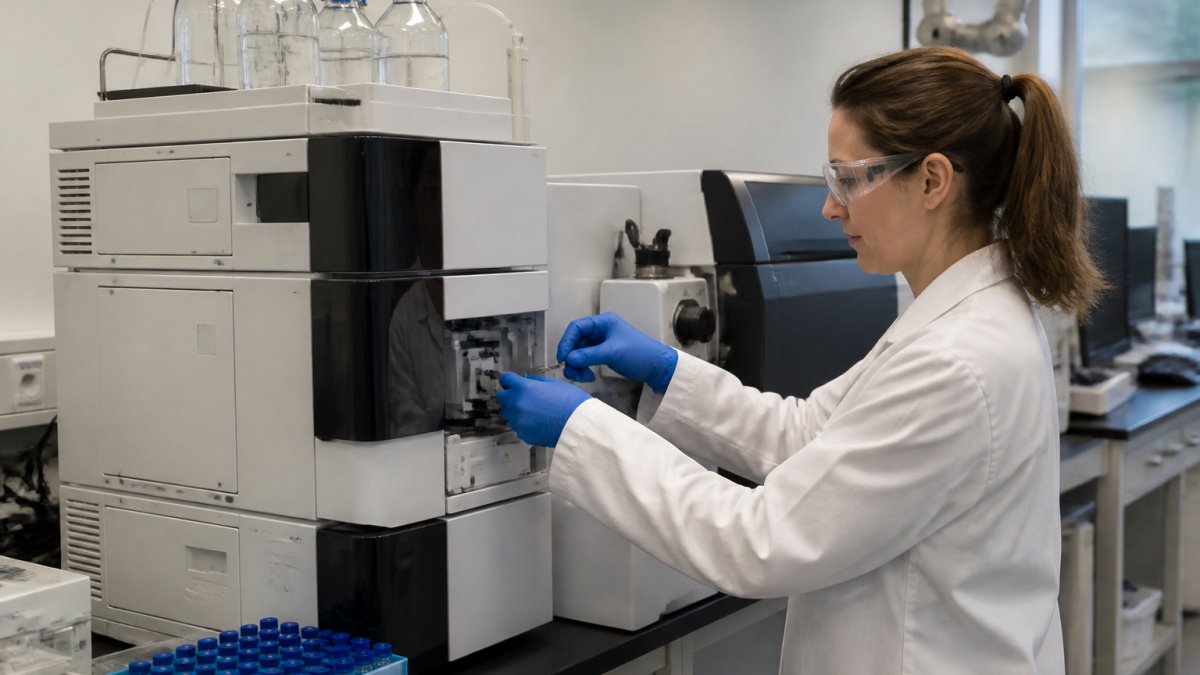
LC-MS/MS coenzyme Q10 analysis is a tandem mass spectrometry method that identifies and quantifies CoQ10 by mass-to-charge ratio, delivering higher sensitivity and specificity than older detection approaches. It distinguishes CoQ10 from structurally similar compounds and can detect both oxidized and reduced forms in a single run.
Side-by-Side Comparison of CoQ10 Assay Methods
Most published comparisons focus on a single method. The table below frames the four common alternatives against the criteria that actually drive method selection. Ranges are typical rather than universal, instrument model, column chemistry, and calibration strategy shift the numbers, but the relative trade-offs hold across most labs.
| Method | Detection Principle | Sensitivity | Specificity | Typical Sample Volume | Instrument Cost | Turnaround |
|---|---|---|---|---|---|---|
| HPLC-UV | Absorbance at ~275 nm | Lowest of the four | Moderate; co-elution risk | Larger (often 200-500 µL plasma) | Lowest | Fast once method is set |
| HPLC-ECD | Electrochemical oxidation | High for ubiquinol | High, but electrode drift | Moderate | Moderate | Fast, with frequent electrode care |
| LC-MS/MS | Mass-to-charge ratio | Highest | Highest; confirms identity by mass | Smallest (often 50 µL or less) | Highest (often into the hundreds of thousands of dollars) | Slower method development, fast run time |
| Redox-specific LC-MS/MS | Mass-to-charge with redox preservation | Highest | Highest, resolves ubiquinone vs. ubiquinol | Smallest | Highest | Slowest, because sample handling is part of the method |
What Each Trade-Off Actually Means in Practice
Sensitivity. HPLC-UV struggles when CoQ10 concentrations are low, which is common in cell lysates and mononuclear cell preparations.
Specificity. UV detection cannot tell ubiquinone from a co-eluting analogue without careful chromatography.
Sample volume. This is often the deciding factor in pediatric or small-animal research.
Cost and complexity. Instruments run into the hundreds of thousands of dollars, and method development takes time. For labs already running LC-MS/MS for other analytes, adding CoQ10 is straightforward.
Turnaround. HPLC methods are fast once validated.
If your research question is total CoQ10 only, HPLC-UV may be sufficient and far cheaper. If it involves oxidative stress, mitochondrial function, or limited sample mass, the specificity and sensitivity gains of LC-MS/MS usually justify the cost.
When LC-MS/MS Is the Wrong Choice
The method is not automatically better for every question. If you only need total CoQ10 for a deficiency screen, the added specificity buys you nothing and the cost and complexity buy you delays. If your lab lacks the infrastructure and you cannot send samples out, a validated HPLC method may be the only realistic alternative. The right choice depends on the question, the sample, and the budget, not on which method is newest.
Ubiquinone and Ubiquinol Measurement: Capturing Redox Status
Ubiquinone and ubiquinol measurement captures the redox status of CoQ10, which reflects the balance between oxidized and reduced forms in a biological sample. This ratio is the key readout for oxidative stress research and mitochondrial function studies.
The challenge is that ubiquinol oxidizes rapidly once a sample leaves the body. If your sample handling doesn’t account for this, your “reduced form” measurement is an artifact of the collection process, not biology.
Sample Handling for Preserving Oxidized and Reduced Forms
A common mistake is processing whole blood or plasma at room temperature. Ubiquinol degrades within minutes under those conditions. Best practice is to collect into chilled tubes, process quickly, and either analyze immediately or store at -80°C with an antioxidant preservative.
ARUP Consult guidance on CoQ10 deficiency evaluation notes that muscle biopsy tissue is considered the gold standard for evaluating CoQ10 deficiency, with skin fibroblasts and white blood cells as alternative sample types.
CoQ10 Sample Preparation: The Step That Decides Accuracy
CoQ10 sample preparation determines whether your final number reflects biology or processing error. Extraction, internal standards, and matrix handling all introduce variables that can dwarf the actual biological signal. But the most damaging variables often occur before extraction even begins, during collection, transport, and storage. This is the pre-analytical phase, and it is where most CoQ10 data quietly goes wrong.
Pre-Analytical Variables That Change the Measured Ratio
Ubiquinol oxidizes to ubiquinone when exposed to oxygen, light, heat, or time. Every step between the subject and the instrument is an opportunity for that conversion to happen. The result is a measured ubiquinol-to-total ratio that reflects handling, not the subject’s redox status.
| Variable | Effect on Measurement | Practical Control |
|---|---|---|
| Collection tube | Some tube materials and additives adsorb or oxidize CoQ10 | Use tubes validated for the analyte; avoid unnecessary additives |
| Processing delay | Ubiquinol oxidizes within minutes at room temperature | Chill tubes, centrifuge promptly, process on ice |
| Light exposure | CoQ10 is light-sensitive | Wrap tubes in foil or use amber tubes |
| Temperature during storage | Degradation accelerates above -80°C thresholds | Store at -80°C or below; avoid frost-free freezers |
| Freeze-thaw cycles | Each cycle degrades ubiquinol | Aliquot before freezing; analyze single-use aliquots |
| Antioxidant preservative | Without one, oxidation continues in storage | Add a suitable antioxidant at collection per validated protocol |
A common pattern is a lab that validates its extraction perfectly but collects samples at room temperature and ships them on ice packs that melt in transit. The extraction is clean; the biology is gone.
Extraction, Internal Standard, and Matrix Effects
The most common extraction approach is liquid-liquid extraction with hexane or a similar nonpolar solvent, followed by drying and reconstitution in the mobile phase. This works, but recovery varies with the matrix.
An internal standard is a compound added at a known amount before extraction to correct for losses during sample prep. Deuterated CoQ10 or a structurally similar analogue like decylubiquinone are common choices. Without one, you are guessing at recovery.
Skipping the internal standard is the fastest way to produce data that looks clean but does not replicate. If your recovery varies between batches, your results vary with it. The same is true if you skip the pre-analytical controls above, no internal standard can correct for ubiquinol that oxidized before the sample ever reached the bench.
Matrix effects are the other trap. Plasma proteins, lipids, and salts can suppress or enhance ionization in LC-MS/MS, skewing quantification. The standard fix is matrix-matched calibration: build your calibration curve in the same matrix as your samples, not in pure solvent. If your samples are mononuclear cells, calibrate in a cell matrix; if plasma, calibrate in plasma.
Documenting the Pre-Analytical Chain
Because pre-analytical variables are invisible in the final number, the only defense is documentation. Record collection tube type, time from draw to processing, storage temperature, and number of freeze-thaw cycles for every sample. When two labs report different ubiquinol ratios for the same subject population, the pre-analytical chain is the first place to look for the discrepancy. This is also the foundation for inter-laboratory comparability, without a shared pre-analytical protocol, two validated methods can still disagree.
CoQ10 Assay Validation: Criteria That Separate Research-Grade from Clinical
CoQ10 assay validation is the process of documenting that a method performs consistently and accurately for its intended use. Research-grade methods and clinical methods have different bars, and mixing them up creates problems.
Clinical assays in the U.S. fall under CLIA regulations, which set requirements for accuracy, precision, and proficiency testing. Quest Diagnostics test directory listing for Coenzyme Q10 describes a CoQ10 assay validated pursuant to CLIA regulations for clinical use.
| Validation Parameter | What It Measures | Research-Grade Target | Clinical Target |
|---|---|---|---|
| Accuracy | Closeness to true value | Spike recovery within acceptable range | Tight, documented across runs |
| Precision | Repeatability | Low intra- and inter-day variance | Strict, monitored continuously |
| Sensitivity | Lowest detectable level | Suited to expected sample range | Clinically relevant range |
| Specificity | Freedom from interference | No co-eluting compounds | No clinically relevant interference |
| Linearity | Response across range | Calibration curve documented | Validated across reportable range |
Build your calibration curve across the full range you expect to see, not just the middle. CoQ10 concentrations in blood mononuclear cells and plasma differ by orders of magnitude, and a curve built for one won’t serve the other.
Alternatives by Use Case: Blood, Tissue, or Cellular Assessment
Choosing an alternative to a standard CoQ10 assay comes down to what you’re measuring and why. A blood-based CoQ10 test suits routine monitoring and deficiency screening. Tissue biopsy is the gold standard for suspected hereditary CoQ deficiency syndromes. Cellular assessment using blood mononuclear cells gives a more stable view of endogenous status over time.
For formulation research, published bioavailability comparisons offer a different kind of alternative. Comparative bioavailability study of CoQ10 formulations compared formulations including a CoQ10 and β-cyclodextrin inclusion complex and reduced CoQ10, calculating pharmacokinetic ratios between reduced and total CoQ10. A 2026 study on microencapsulated CoQ10 bioavailability reported that microencapsulation significantly enhanced bioavailability versus a standard formulation.
| Use Case | Recommended Approach | Sample Type | Key Consideration |
|---|---|---|---|
| Deficiency screening | Blood-based CoQ10 measurement | Plasma or serum | Fast, low-cost, total CoQ10 only |
| Suspected hereditary deficiency | Tissue-based evaluation | Muscle biopsy, fibroblasts, WBCs | Gold standard, invasive |
| Oxidative stress research | Redox-specific LC-MS/MS | Plasma, cells | Requires preserved reduced form |
| Formulation comparison | Published bioavailability studies | N/A | Free or low-cost evidence base |
Conclusion: Matching the Assay to the Research Question
The right CoQ10 assay alternative depends entirely on what you’re trying to learn. Total concentration, redox status, tissue-level deficiency, and formulation bioavailability each demand a different method and a different sample type.
FROPeptides supplies research-grade lyophilized coenzymes with multi-stage HPLC testing, mass spectrometry verification, and Certificate of Analysis documentation for every batch. If your protocol depends on consistent starting material, get started with FROPeptides and build your assay on a traceable foundation.
Frequently Asked Questions
What analytical methods can be used to measure coenzyme Q10?
Common methods include high-performance liquid chromatography (HPLC) with UV or electrochemical detection, and liquid chromatography-tandem mass spectrometry (LC-MS/MS). HPLC with UV detection is widely used but may lack sensitivity for low concentrations. LC-MS/MS offers higher sensitivity and specificity, especially for distinguishing ubiquinone and ubiquinol. Other approaches include electrochemical detection for redox forms. The choice depends on sample type, required sensitivity, and whether you need to measure oxidized and reduced forms separately.
How do HPLC and LC-MS compare for CoQ10 analysis?
HPLC with UV detection is cost-effective and suitable for many routine measurements, but it may not resolve CoQ10 from interfering compounds in complex matrices. LC-MS/MS provides superior sensitivity and specificity, allowing quantification of both ubiquinone and ubiquinol at low concentrations. LC-MS/MS also requires less sample volume and can use isotope-labeled internal standards for better accuracy. However, LC-MS/MS instruments are more expensive and require specialized expertise. For research requiring precise redox status, LC-MS/MS is often preferred.
Can CoQ10 and ubiquinol be measured in the same assay?
Yes, many modern assays measure total CoQ10 (ubiquinone plus ubiquinol) and can also quantify ubiquinol separately. This typically involves sample preparation that preserves the reduced form, followed by chromatographic separation. LC-MS/MS or HPLC with electrochemical detection can distinguish the two forms. Measuring both provides a redox status ratio, which is valuable for assessing oxidative stress and mitochondrial function. Ensure your sample handling prevents oxidation of ubiquinol to ubiquinone during processing.
What factors can affect accuracy in CoQ10 assays?
Key factors include sample handling (light, temperature, and time before processing), choice of internal standard, calibration curve quality, and matrix effects. CoQ10 is light-sensitive and can degrade or oxidize, so samples should be protected from light and processed quickly. Using an isotope-labeled internal standard in LC-MS/MS improves accuracy. For HPLC, electrochemical detection can be affected by electrode fouling. Validation parameters such as precision, recovery, and specificity must be established to ensure reliable results across batches.
How should a CoQ10 analytical method be validated?
Validation should follow guidelines such as those from the FDA or ICH, including assessment of accuracy, precision, specificity, linearity, range, limit of detection, limit of quantification, and robustness. For CoQ10, specificity is critical to separate ubiquinone and ubiquinol from analogs like idebenone. Stability of the analyte in matrix and solution must be demonstrated. Recovery experiments using spiked samples ensure no loss during extraction. A well-validated method provides confidence in data for clinical or research applications.