5 Best Practices for Peptide Purity in Assays
Table of Contents
- 1. Set Purity Thresholds Based on Your Assay Type
- 2. Peptide Purity Testing: Go Beyond a Single HPLC Run
- 3. Peptide HPLC Analysis: Read the Chromatogram, Not Just the Percentage
- 5. Control Peptide Storage and Stability From Receipt to Assay
- How Impurities Bias Quantitative Assay Results
- Conclusion: Build Purity Verification Into Every Assay
- Frequently Asked Questions
Last Updated: October 9, 2026
1. Set Purity Thresholds Based on Your Assay Type
Peptide purity is the percentage of the target peptide sequence relative to all other material in a sample, and it is the single biggest determinant of whether a quantitative assay produces usable data.
A common mistake is treating one purity spec as universal. It is not. A qualitative screening assay can tolerate more impurity than a quantitative standard curve, and a receptor-binding study has different demands than an ELISA.
Why 95% Purity Is the Minimum for Quantitative Work
For quantitative analysis, the accepted floor is 95% purity. Supplier guidance from GenScript’s recommended peptide purity guidelines states that peptides above 95% purity are suitable for quantitative work, and that material above 98% can be supplied in larger quantities.
The reasoning is straightforward: if 5% of your sample is something else, and that something else absorbs, binds, or reacts differently, your calibration curve carries that error into every result.
A Purity Decision Framework Tied to Assay Type
Most guidance stops at a single threshold. A more useful approach is to work backward from the measurement error your assay can tolerate, then choose a purity level that keeps impurity-driven bias inside that budget.
| Assay type | Typical purity floor | Typical target | Why |
|---|---|---|---|
| Qualitative screening, staining, or presence/absence | 70-80% | 85% | Signal is read as yes/no; minor impurities rarely flip the call |
| Immunoassay (ELISA, Western blot) with polyclonal detection | 85-90% | 95% | Cross-reactive impurities can raise background but rarely dominate |
| Receptor-binding or cell-based potency assay | 95% | 98% | Partial agonists and deletion sequences compete for the same site |
| Quantitative standard curve (LC-MS/MS, HPLC-UV, fluorometric) | 95% | 98%+ | The standard defines the curve; its error propagates into every unknown |
| Absolute quantification requiring mass balance | 98% | 98%+ with net content | Purity alone is insufficient; you also need net peptide content |
Two rules make the framework work in practice. First, the more sensitive the readout, the higher the floor. A fluorescence assay that detects picomoles will surface impurities that a colorimetric assay at micromolar concentrations never sees.
Translating Purity Into an Error Budget
A simple way to sanity-check your threshold is to ask what a given impurity level does to your reported number. If your assay reads total signal and an impurity contributes signal at the same efficiency as the analyte, a 5% impurity can bias a result by roughly 5% in the worst case.
That is why the practical floor for a quantitative standard is 95% and the practical target is 98% or better, paired with a net peptide content figure.
Write your purity threshold into the assay’s acceptance criteria, not just the purchasing spec. If the method says results must be within 5% of nominal, the standard’s purity and content need to be tight enough that they do not eat that 5% on their own.
Purity Versus Yield: The Trade-Off You Are Actually Making
Higher purity usually means lower yield and higher cost per milligram, because purification removes material along with impurities. For a quantitative standard, that trade-off is almost always worth taking: you need a small amount of well-characterized material, not a large amount of uncertain material. For a screening reagent used by the gram, a lower purity tier can be the rational choice.
2. Peptide Purity Testing: Go Beyond a Single HPLC Run
Peptide purity testing is the process of measuring what is actually in a vial, not just what the label claims. One HPLC run tells you about one property under one set of conditions.
What most guides miss is that a single reversed-phase run can hide problems. Two compounds can co-elute. A deletion sequence can sit under the main peak. Without a second, orthogonal method, you never see it.
Orthogonal Methods That Catch What HPLC Misses
Pair your chromatography with a method that separates on a different principle:
- Mass spectrometry confirms molecular weight and catches sequence errors that HPLC cannot resolve
- Amino acid analysis (AAA) quantifies actual peptide content, separating it from counterions and water
- Elemental analysis verifies net peptide content independently of the chromatographic profile
According to Biosynth’s peptide analytics documentation, reversed-phase HPLC is the standard purity method, while amino acid analysis and elemental analysis provide the content and identity checks that purity percentage alone cannot deliver.
When a supplier reports 98% purity but your AAA comes back low, the gap is usually counterion or water content, not a bad synthesis. Ask for the net peptide content figure alongside the purity number.
3. Peptide HPLC Analysis: Read the Chromatogram, Not Just the Percentage
Peptide HPLC analysis means interpreting the full chromatogram, not just the headline purity figure. The percentage is a summary. The trace is the evidence.
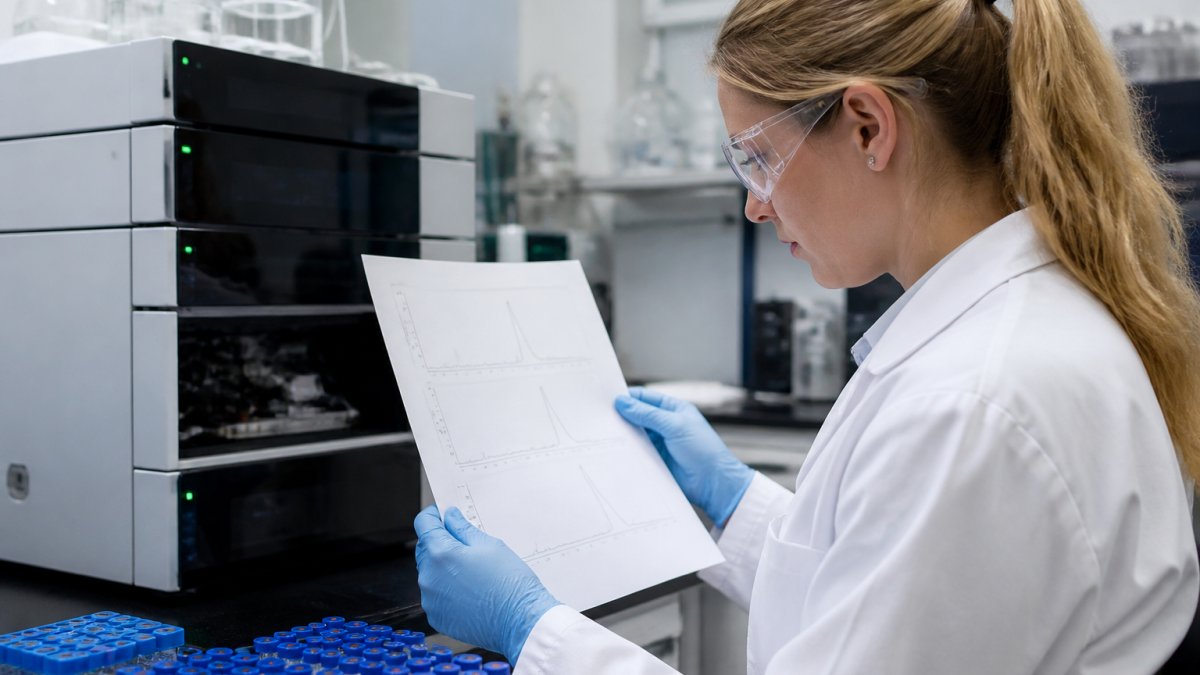
(/peptide-certificate-of-analysis-explained/) is the document that ties a specific lot to specific test results. Generic or catalog-level documentation is not enough for assay work. You need the data for the vial in your hand.
What a Complete CoA Must Include
A complete CoA should carry, at minimum:
- Lot or batch number matching the vial label
- Purity percentage with the analytical method named
- Chromatogram and mass spectrometry data
Guidance from Bachem’s quality control guide for amino acids and peptides notes that a peptide ordered at a stated purity can vary within a range, and that variability is more noticeable at lower purity specifications. That variability is exactly why lot-specific data matters. Without it, you cannot trace a result back to the material that produced it.
5. Control Peptide Storage and Stability From Receipt to Assay
Peptide storage and stability determine whether the purity you paid for survives to the day of the assay. A vial that arrives at 98% and degrades in storage is a 98% number attached to a compromised sample.
Control the variables you can:
- Temperature. Store lyophilized peptide cold and dry; follow the CoA for reconstituted material.
- Moisture. Lyophilized peptides take on water fast. Keep vials sealed and let them equilibrate before opening.
- Reconstitution. Use the solvent the CoA specifies, and note that solubility varies by sequence.
Opening a cold vial before it reaches room temperature pulls moisture onto the powder. That moisture adds weight you did not account for and can degrade the peptide. Wait for equilibration every time.
Stability and Requalification During Assay Use
Most guides treat stability as a storage topic. For a quantitative assay, it is a measurement topic. The question is not only whether the peptide is still there, but whether the standard you are using still matches the value you assigned it.
A working stock that has been through several freeze-thaw cycles, sat in an autosampler tray, or adsorbed onto tube walls can drift without any visible sign. The purity certificate describes the lot at release, not the aliquot on your bench today.
Consider requalifying or replacing a standard when any of the following occurs:
- Freeze-thaw count. After roughly five cycles, most practitioners re-check concentration against a fresh aliquot or a newly prepared standard.
- Time in solution. Reconstituted stocks held at 4 °C for more than a few days, or at room temperature for more than a few hours, should be verified before use in a quantitative run.
- Adsorption signs. If a low-concentration stock gives lower-than-expected signal that recovers at higher concentrations, adsorption to plastic may be pulling peptide out of solution. Use low-binding tubes and consider adding a carrier protein when the assay tolerates it.
A Practical Requalification Workflow
A lightweight requalification does not require a full re-certification. A workable pattern is:
- Prepare a fresh aliquot from a sealed, lot-controlled vial.
- Measure concentration by amino acid analysis or another orthogonal content method.
- Compare the result to the value on the CoA and to the historical mean for that lot.
- If the difference exceeds your assay’s acceptance criteria, retire the working stock and prepare a new one.
- Record the requalification date, method, and result alongside the lot number so the next analyst can trace it.
This is the same logic that applies to any reference standard: the certificate establishes the starting point, and periodic checks confirm the material still deserves the value you assigned it.
Purity is a property of the lot at release. Accuracy is a property of the standard on the day you use it. Requalification is what keeps the two connected.
Requalify material that has been in storage a while, especially if it is a working stock for a long-running assay. Stability is not a one-time check.
How Impurities Bias Quantitative Assay Results
Consider what a 5% impurity actually does. If a related sequence binds your target with partial affinity, it inflates the apparent signal.
This is why purity percentage and peptide content are different measurements. Purity tells you the ratio of target to impurity.
The practical fix is orthogonal measurement. Use HPLC for the impurity profile, mass spectrometry for identity, and amino acid analysis for content.
Conclusion: Build Purity Verification Into Every Assay
The challenge with peptide purity is that it is easy to accept a number and hard to verify one. Set thresholds by assay type, test with more than one method, read the chromatogram, demand lot-specific documentation, and control storage from receipt to bench.
FROPeptides supports that workflow with multi-stage HPLC testing, mass spectrometry verification, and a Certificate of Analysis for every batch, backed by temperature-controlled storage and batch-level traceability.
Get started with FROPeptides and build every quantitative assay on verified, traceable material.
Frequently Asked Questions
What peptide purity level is suitable for quantitative assays?
Most quantitative work needs peptide purity above 95%, and suppliers such as GenScript list greater-than-95% as the benchmark for quantitative analysis. Purity above 98% is available in larger quantities when your assay demands it. The right threshold depends on how much an impurity would shift your result: a 5% impurity in a 1 mg/mL stock introduces measurable bias, while the same impurity in a qualitative check may not matter. Match the specification to the assay, not to a default number.
Is HPLC enough to confirm peptide purity?
No. Reversed-phase HPLC separates components by hydrophobicity, so it quantifies what absorbs at your detection wavelength but cannot confirm what those peaks are. Two peptides with the same retention time look identical on a single run. Pair peptide HPLC analysis with mass spectrometry for identity confirmation and amino acid analysis for net peptide content. Orthogonal methods catch deletion sequences, counterions, and residual solvents that a single chromatogram will not reveal.
How can peptide impurities affect assay results?
Impurities bias results in two ways. They reduce the actual peptide content in your weighed sample, so a stock prepared at a nominal concentration is lower than labeled. They also interfere directly: deletion sequences can compete for binding sites, and residual counterions or solvents add mass without adding activity. If your assay measures a response proportional to peptide concentration, a 5% impurity can shift your standard curve enough to fail acceptance criteria. Always calculate from net peptide content, not vial weight.
What should a peptide certificate of analysis include?
A complete CoA lists lot number, molecular weight, purity percentage from HPLC, the analytical method used, mass spectrometry identity confirmation, and any additional testing such as amino acid analysis or water content. It should be lot-specific, not a generic specification sheet. Check that the chromatogram and mass spectrum are attached or referenced. If a supplier cannot provide batch-level documentation on request, that gap matters more than the purity number printed on the label.
How should research peptides be stored to preserve quality?
Lyophilized peptides are stable for extended periods at -20°C, and many are stable at room temperature for short transit windows. Once reconstituted, store aliquots at -20°C or lower and avoid repeated freeze-thaw cycles, which degrade sequence integrity. Use acetonitrile or water with 0.1% formic acid as your solvent where the peptide’s solubility allows. Track storage conditions and requalify stocks periodically, especially if an assay runs over weeks or months.