How to Verify Peptide Purity: A Step-by-Step Guide
Table of Contents
- Why Peptide Purity Verification Matters for Research
- What You’ll Need Before You Verify Peptide Purity
- HPLC Peptide Purity Standards: How the Method Works
- Mass Spectrometry for Peptide Identification and Confirmation
- Peptide Certificate of Analysis Interpretation: A Field Guide
- Common Impurities, Degradation Products, and What They Signal
- Storage, Stability, and How Handling Affects Purity After Delivery
- Step-by-Step Protocol to Verify Peptide Purity on Every Batch
- Frequently Asked Questions
Last Updated: August 23, 2026
Why Peptide Purity Verification Matters for Research
Peptide purity is the single most consequential variable in whether your experimental results are reproducible, interpretable, or publishable. A peptide nominally labeled at a certain sequence may contain synthesis by-products, truncated sequences, oxidized residues, or residual solvents that compete at binding sites, skew dose-response curves, and introduce batch-to-batch variance that makes your data unreliable.
For molecular biology, drug discovery, and any research destined for peer-reviewed publication, the quality control standard is unambiguous: you need verified purity data, not supplier assurances.
Relying solely on a supplier’s stated purity figure without reviewing the underlying analytical data is one of the most common mistakes in research procurement. A purity claim is only as reliable as the method used to generate it.
What You’ll Need Before You Verify Peptide Purity
Documentation you should request from your supplier before the vial arrives:
- Certificate of Analysis with lot-specific HPLC chromatogram
- Mass spectrometry data confirming molecular weight
- Batch number and synthesis date
- Storage and handling conditions during transit
Instrumentation for in-house verification:
- Analytical HPLC system with UV detection capability
- Mass spectrometer (ESI or MALDI preferred for peptides)
- Analytical balance for accurate sample mass measurement
- Appropriate mobile phase solvents (typically water/acetonitrile with TFA modifier)
If in-house instrumentation is unavailable, you can send samples to a contract analytical laboratory.
Visual Inspection: What It Can and Cannot Tell You
Visual inspection is the first step but is often misunderstood. A lyophilized powder that appears white, fluffy, and homogeneous tells you almost nothing about purity at the molecular level.
What visual inspection can flag: gross physical contamination, visible moisture absorption, discoloration suggesting oxidation or degradation, and caking that may indicate improper storage during transit.
What it cannot detect: truncated sequences, deletion peptides, oxidized residues, synthesis by-products, residual protecting groups, or any impurity below visible thresholds. A peptide sample can look perfect and still fail HPLC analysis at 85% purity.
Use visual inspection as a rapid red-flag screen, not as a quality determination. If the vial looks compromised, flag it immediately. If it looks fine, proceed directly to analytical methods.
HPLC Peptide Purity Standards: How the Method Works
High-Performance Liquid Chromatography is the gold standard for peptide purity determination. HPLC separates components based on their differential affinity for a stationary phase versus a mobile phase, with detection typically performed by UV absorbance at 214 nm, the wavelength at which peptide bonds absorb reliably.
In reversed-phase HPLC, the most common configuration for peptide analysis, a hydrophobic stationary phase retains compounds based on their surface characteristics. The peptide of interest, synthesis by-products, truncated sequences, and other impurities each have distinct retention times, allowing the system to resolve them as separate peaks.
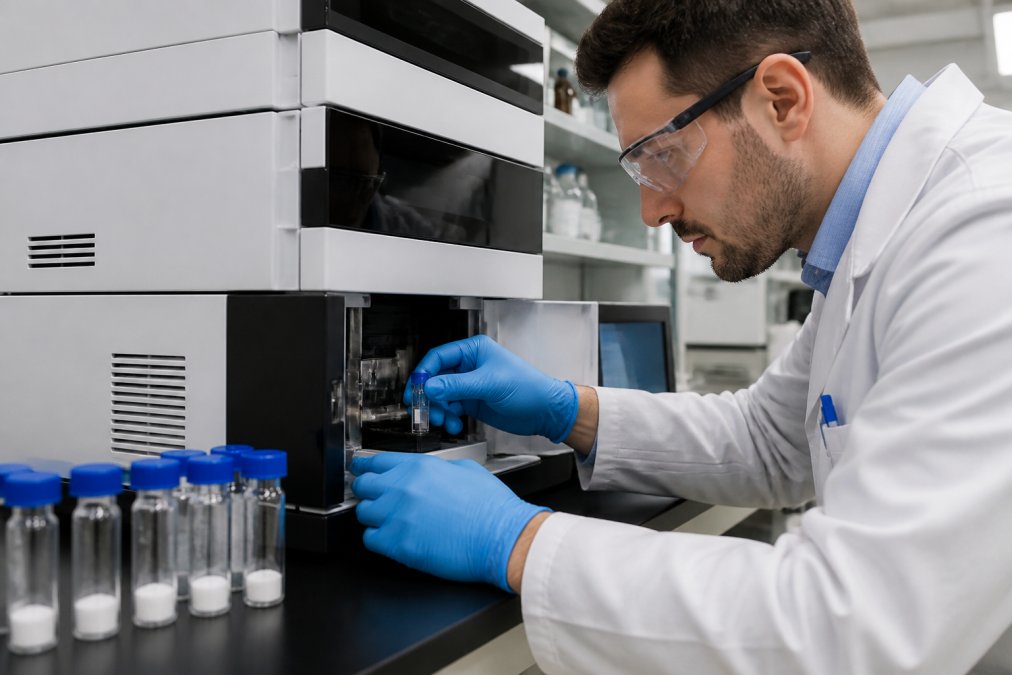
Purity is calculated by quantitation: the area of the target peak divided by the total area of all detected peaks, expressed as a percentage. Research-grade peptides typically show 95% or greater purity; pharmaceutical-grade applications often require 98% or higher (usp.org). At FROPeptides, our multi-stage HPLC testing targets 99%+ purity on every batch, with chromatographic data included in the Certificate of Analysis.
HPLC purity is method-dependent. Column chemistry, gradient conditions, mobile phase composition, and detection wavelength all influence what gets resolved. Comparing purity figures across suppliers without knowing their analytical conditions is unreliable.
Reading a Chromatogram: Retention Time and Peak Area
A chromatogram is a plot of detector signal intensity against time. Each peak represents a compound eluting from the column at a characteristic retention time.
What to look for when reviewing HPLC data:
- Main peak area: Should represent the stated purity percentage of the target peptide
- Baseline resolution: Peaks should be fully separated; co-eluting impurities are not quantified separately
- Early-eluting peaks: Often indicate hydrophilic by-products or residual reagents from synthesis
- Late-eluting peaks: May represent aggregated or more hydrophobic impurities
- Baseline flatness: A noisy or drifting baseline can mask low-level impurities
A clean chromatogram for a 99% purity peptide shows one dominant, symmetrical peak with a flat baseline and no significant satellite peaks. Any shoulder on the main peak warrants scrutiny, as it often signals a co-eluting impurity.
Mass Spectrometry for Peptide Identification and Confirmation
Mass spectrometry confirms molecular identity, not just purity. Where HPLC tells you what proportion of your sample is the target compound, mass spectrometry verifies that the target compound is actually what you think it is.
Electrospray ionization is the most common approach for peptides, generating multiply charged ions that allow accurate molecular weight determination even for larger sequences. The observed mass is compared against the theoretical molecular weight calculated from the amino acid sequence.
A mass spectrum that matches the theoretical molecular weight within acceptable tolerance confirms correct synthesis. Discrepancies can indicate missed deprotection steps, sequence errors, oxidation of susceptible residues, or adduct formation.
Request both HPLC and mass spec data for every batch, not just one or the other. HPLC tells you how pure the sample is; mass spectrometry tells you whether the main component is actually the correct peptide. You need both data points to make a confident quality determination.
As documented in USP guidelines on analytical method validation, the complementary use of chromatographic separation and mass spectrometric identification represents the appropriate standard for compound characterization in research and pharmaceutical contexts.
DIY vs. Professional Lab Testing: Which Is Realistic?
Running in-house HPLC and mass spectrometry requires capital investment in instrumentation, trained personnel, validated methods, and ongoing maintenance. For many academic labs and smaller research facilities, that infrastructure is not available or cost-justified.
In-house testing is realistic when:
- Your facility already has analytical HPLC and mass spec instrumentation for other applications
- You have staff with validated method development experience
- You are testing large volumes of material regularly enough to justify the overhead
Contract laboratory testing makes more sense when:
- You lack in-house instrumentation
- You need independent third-party validation for regulatory or publication purposes
- You are evaluating a new supplier and want unbiased analytical data
The practical middle ground for most research groups is to rely on supplier-provided HPLC and mass spec data for routine procurement, with periodic independent verification through a contract laboratory when switching suppliers or starting a new experimental series. The NIH guidelines on research reagent quality specifically address the importance of independent validation for materials used in federally funded research.
Peptide Certificate of Analysis Interpretation: A Field Guide
A Certificate of Analysis is the primary document that translates analytical testing into a verifiable quality record. Knowing how to read one correctly is essential for anyone procuring research-grade peptides.
Key fields every COA should contain:
| Field | What to Look For |
|---|---|
| Peptide sequence | Matches your order exactly, single-letter or three-letter code |
| Molecular weight (theoretical) | Calculated from sequence; should match MS data |
| Molecular weight (observed) | From mass spectrometry; within ±1 Da or per instrument tolerance |
| HPLC purity (%) | Percentage area of main peak at 214 nm |
| Batch/lot number | Unique identifier for traceability |
| Synthesis date | Relevant for stability assessment |
| Storage conditions | Required temperature and moisture conditions |
| Analytical method | Column type, gradient, detection wavelength |
The most common error researchers make when reviewing a COA is accepting the purity percentage without checking the chromatogram. A stated purity of 98% is meaningful only if the underlying chromatographic data supports it. Always request the raw chromatogram, not just the summary figure.
Chain of Custody: Why Documentation Matters Beyond the COA
Chain of custody refers to the documented sequence of possession, handling, and storage from synthesis through delivery to your lab. A COA without chain of custody documentation tells you the compound was analytically characterized at a specific point in time, but not whether storage conditions were maintained during transit or whether the vial you received is from the same batch as the tested material.
For research destined for publication or regulatory submission, chain of custody documentation is increasingly expected. Batch-level traceability from sourcing to packaging means that if a question arises about compound integrity, you can reconstruct the material’s history.
Common Impurities, Degradation Products, and What They Signal
Understanding the impurity profile of a peptide sample goes beyond knowing the purity percentage.
Synthesis by-products are the most common impurity class. These include deletion sequences (peptides missing one or more amino acids) and truncated sequences (synthesis terminated prematurely), indicating incomplete or inefficient synthesis steps.
Oxidation products arise from susceptible residues, particularly methionine, cysteine, and tryptophan. Oxidized peptides have a molecular weight 16 Da higher per oxidation event, making them identifiable by mass spectrometry. Oxidation can occur during synthesis, workup, or storage under inappropriate conditions.
Residual protecting groups result from incomplete deprotection during synthesis and are detectable by mass spec.
Aggregation is a physical rather than chemical impurity. Peptides with high hydrophobicity can aggregate in solution, reducing effective concentration and complicating dose-response interpretation.
The molecular weight match in mass spectrometry data is your most direct confirmation that you have the correct peptide. An HPLC purity of 99% is meaningless if the compound at that purity is not the sequence you ordered.
Storage, Stability, and How Handling Affects Purity After Delivery
Purity at the point of manufacture is not the same as purity at the point of use. Peptides degrade under conditions of elevated temperature, moisture, repeated freeze-thaw cycling, and exposure to light or oxygen.
Lyophilized powder is the most stable format for storage and shipping. In this state, peptides are significantly less susceptible to hydrolysis and oxidation than in solution. However, lyophilized material still requires proper storage conditions, typically at -20°C or below for long-term stability, with desiccation to prevent moisture uptake.
Handling practices that preserve purity after delivery:
- Allow the vial to equilibrate to room temperature before opening, to prevent condensation on the powder
- Dissolve in an appropriate solvent immediately before use rather than preparing large stock solutions
- Aliquot stock solutions to avoid repeated freeze-thaw cycles
- Store dissolved peptides at -80°C if long-term solution storage is unavoidable
- Record the date of first reconstitution on the vial
Temperature excursions during shipping are a documented cause of purity loss that is often attributed incorrectly to synthesis quality.
Step-by-Step Protocol to Verify Peptide Purity on Every Batch
This protocol is designed for research laboratories that receive peptides from an external supplier and need a systematic approach to verify peptide purity before committing the material to experiments.
Before the vial arrives:
- Request the batch-specific COA, including the raw HPLC chromatogram and mass spectrometry data, at the time of order confirmation
- Confirm the lot number on the COA matches the lot number on the vial label upon receipt
- Verify that storage conditions during transit are documented
On receipt:
- Inspect the outer packaging for signs of temperature excursion
- Perform visual inspection of the vial: check for discoloration, caking, visible contamination, or moisture
- Record the receipt date, lot number, and visual inspection result in your lab notebook or LIMS system
Reviewing the COA:
- Confirm the peptide sequence matches your order
- Check that the observed molecular weight from mass spectrometry falls within acceptable tolerance of the theoretical molecular weight
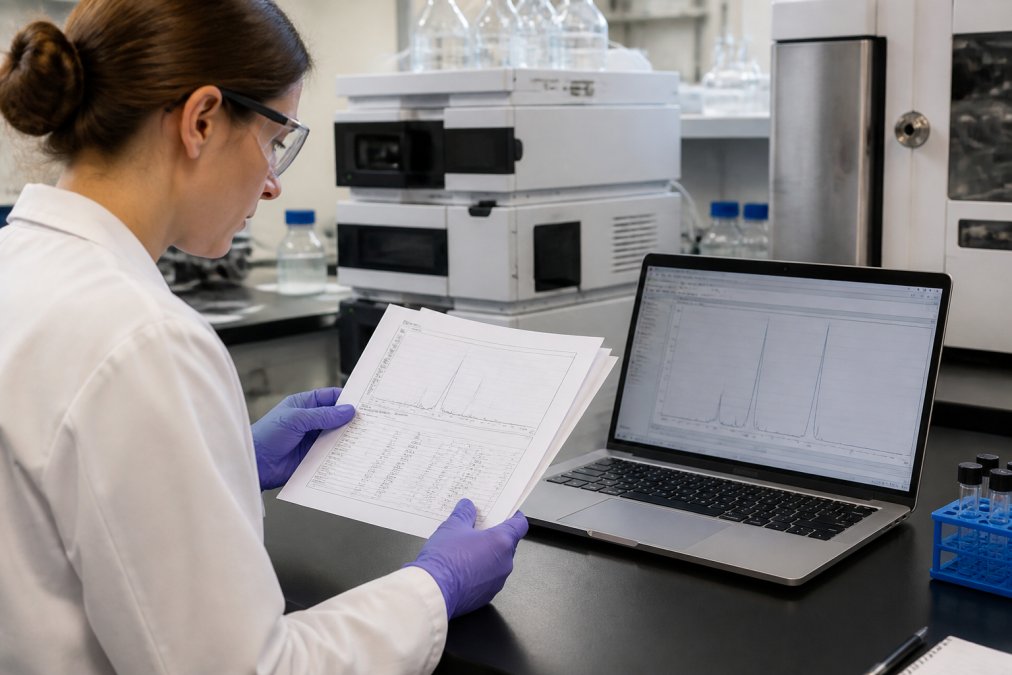
- Review the HPLC chromatogram directly, not just the stated purity percentage
- Verify the analytical method details: column, gradient, detection wavelength (214 nm for peptide bond detection)
- Confirm HPLC purity meets your minimum threshold for the intended application
Optional independent verification:
- If independent validation is required, prepare a sample aliquot for submission to a contract analytical laboratory before committing the full batch to experiments
- Compare the independently generated chromatographic data against the supplier-provided COA
Summary reference table:
| Verification Step | Method | What It Confirms |
|---|---|---|
| Visual inspection | Physical examination | Gross contamination, moisture, discoloration |
| COA review | Document analysis | Supplier-stated purity and identity |
| HPLC chromatogram review | Chromatographic data | Actual purity percentage, impurity profile |
| Mass spectrometry data review | MS data | Correct molecular weight, sequence identity |
| Independent lab testing | Contract analysis | Third-party confirmation of purity and identity |
| Storage condition verification | Documentation review | Integrity of cold chain from synthesis to receipt |
The discipline of applying this protocol consistently on every batch is what separates research programs that generate reproducible data from those that spend months troubleshooting unexplained assay failures.
Inconsistent peptide quality is one of the most preventable sources of experimental failure in research, yet it remains widespread because verification protocols are treated as optional rather than standard. FROPeptides was built around the premise that researchers should not have to choose between convenience and analytical rigor. Every batch ships with batch-level HPLC chromatograms and mass spectrometry data, a full Certificate of Analysis, and temperature-controlled handling from synthesis to your door. If your current procurement process leaves you guessing about what is actually in the vial, that is the problem worth solving first. Shop Now and request your batch-specific COA with your first order.
Frequently Asked Questions
Q: What is the difference between HPLC and mass spectrometry in peptide analysis?
A: HPLC (high-performance liquid chromatography) quantifies purity by separating components in a sample and measuring peak areas against total signal, typically at 214 nm UV detection. It tells you how much of your sample is the target peptide. Mass spectrometry confirms molecular identity by measuring the mass-to-charge ratio of ions, verifying the correct molecular weight. Together, they answer two distinct questions: how pure is the peptide, and is it the right peptide? Both are required for confident batch verification.
Q: How can I determine the purity of peptides without sending them to a lab?
A: Reliably determining peptide purity without professional instrumentation is not practical. Visual inspection of lyophilized powder, checking color, texture, and solubility, can flag obvious degradation but cannot detect synthesis by-products or quantify impurity levels. HPLC and mass spectrometry require specialized equipment and calibrated laboratory protocols. The most reliable approach for researchers is to source peptides that already come with batch-level Certificates of Analysis, eliminating the need to retest in-house.
Q: Is there a way to test peptide purity at home?
A: No consumer-grade or home method can verify peptide purity to research-grade standards. Analytical methods like HPLC and mass spectrometry require controlled laboratory environments, calibrated instruments, and validated protocols. Attempting to assess purity through solubility tests or visual inspection alone will miss degradation products and synthesis by-products that directly affect experimental outcomes. For any research application where purity variance matters, always rely on supplier-provided COA data backed by multi-stage analytical chemistry.
Q: What should a peptide Certificate of Analysis include?
A: A complete Certificate of Analysis for a research peptide should include the peptide sequence and molecular weight, HPLC purity percentage with the chromatogram, mass spectrometry confirmation of molecular identity, batch or lot number for traceability, synthesis date and testing date, and the analytical methods used. It should also specify the detection wavelength (commonly 214 nm) and sample mass used during quantitation. COAs without chromatographic data or batch identifiers cannot be independently verified and offer limited quality assurance.