Peptide Sciences Alternative for Labs: 2026 Supplier Guide
Table of Contents
- Why Labs Are Searching for a Peptide Sciences Alternative
- Quick Comparison: Top Peptide Sciences Alternatives for Labs
- DelixLabs: Batch-Level Transparency for Molecular Research
- Lone Star Peptide Co.: Broad Catalog and Rapid Dispatch
- Core Peptides: Documentation-First Supplier for Academic Labs
- EZ Peptides: Transparent Pricing for Budget-Conscious Labs
- Nova Life Peptides: Direct Replacement for Legacy Sources
- How to Verify Peptide Purity Certificates Before You Buy
- Frequently Asked Questions
Last Updated: September 18, 2026
Why Labs Are Searching for a Peptide Sciences Alternative
When Peptide Sciences stopped taking new orders, thousands of research labs lost a supplier they had trusted for years. This guide from FROPeptides exists because finding a reliable Peptide Sciences alternative for labs is not as simple as swapping one website for another. It requires re-vetting purity documentation, shipping protocols, and batch consistency from scratch.
The vacuum has been filled by a mix of legitimate suppliers and opportunists. According to guidance from the FDA on compounded and research chemicals, buyers bear most of the verification burden for research-grade materials. That puts the pressure squarely on your procurement process.
Most labs are not looking for the cheapest vial. They are looking for a supplier whose Certificate of Analysis they can actually trust.
The biggest mistake labs make right now is switching to the first supplier with a polished website. A clean storefront tells you nothing about whether their HPLC data is real or their cold chain holds up in transit.
Quick Comparison: Top Peptide Sciences Alternatives for Labs
The table below summarizes the five suppliers covered in this guide. Every option here ships from domestic facilities and provides batch documentation.
| Supplier | Starting Price | Documentation | Best For |
|---|---|---|---|
| DelixLabs | Contact for pricing | Third-party HPLC + mass spec | Batch-level transparency |
| Lone Star Peptide Co. | Contact for pricing | Independent third-party testing | Broad catalog, fast dispatch |
| Core Peptides | Contact for pricing | Detailed CoA per batch | Academic documentation needs |
| EZ Peptides | Contact for pricing | Batch-specific testing docs | Predictable pricing |
| Nova Life Peptides | Contact for pricing | Comprehensive batch testing | Legacy source replacement |
DelixLabs: Batch-Level Transparency for Molecular Research
DelixLabs built its reputation on one thing: every batch ships with third-party HPLC and mass spectrometry results. For labs running assays where subtle impurity detection matters, that level of documentation removes guesswork.
Their standardized compliance paperwork is a genuine advantage for research documentation. Shipping is fast and domestic, which keeps laboratory continuity intact when you reorder mid-project.
The drawback is pricing. Costs fluctuate based on compound complexity, and there is no public price list. You will need to request a quote.
Labs that prioritize verified, batch-level purity documentation over lowest unit cost.
Lone Star Peptide Co.: Broad Catalog and Rapid Dispatch
Lone Star Peptide Co. mirrors much of the catalog that legacy suppliers carried. If your lab has standing protocols built around specific compounds, that breadth matters more than anything else.
Independent third-party testing backs every item in inventory, and same-day dispatch handles urgent research timelines. The transparency around testing results is refreshing.
Where it falls short: niche peptides can go out of stock.
Core Peptides: Documentation-First Supplier for Academic Labs
- Batch traceability. Each vial’s lot number should resolve to a single CoA, not a generic ‘representative’ report reused across shipments. If your protocol requires you to document the exact material used in a given experiment, this is the difference between a defensible record and a gap.
- Method disclosure. A CoA that states ‘HPLC’ without naming the column, detector, or gradient tells you almost nothing. The useful version names the analytical method and the confirmation technique, typically reverse-phase HPLC paired with mass spectrometry for molecular-weight confirmation.
- Support that speaks the language. Dedicated research support means you can ask specific questions, synthesis route, counter-ion, residual solvent profile, and get an answer from someone who understands why you are asking, not a scripted reply.
NIH guidelines on research integrity and documentation
Academic and institutional labs that need batch-traceable documentation strong enough to survive peer review, and that value a support team fluent in research terminology over the lowest listed price.
If your priority is the fastest possible dispatch on a broad catalog, this is not the first call. If your priority is a paper trail you can defend, it is.
EZ Peptides: Transparent Pricing for Budget-Conscious Labs
EZ Peptides lists prices publicly. For labs that need predictable procurement costs, that transparency eliminates the back-and-forth of quote requests.
Nova Life Peptides: Direct Replacement for Legacy Sources
Nova Life Peptides positions itself as a compound-for-compound replacement for established high-purity sources. Their synthesis protocols focus on molecular integrity, and comprehensive batch testing backs each lot.
How to Verify Peptide Purity Certificates Before You Buy
Most guides tell you to ‘check the CoA.’ Almost none tell you how to read one. That gap is where bad suppliers hide, because a forged or recycled Certificate of Analysis looks identical to a real one until you know what to look for.
Reading the numbers, not just the headline
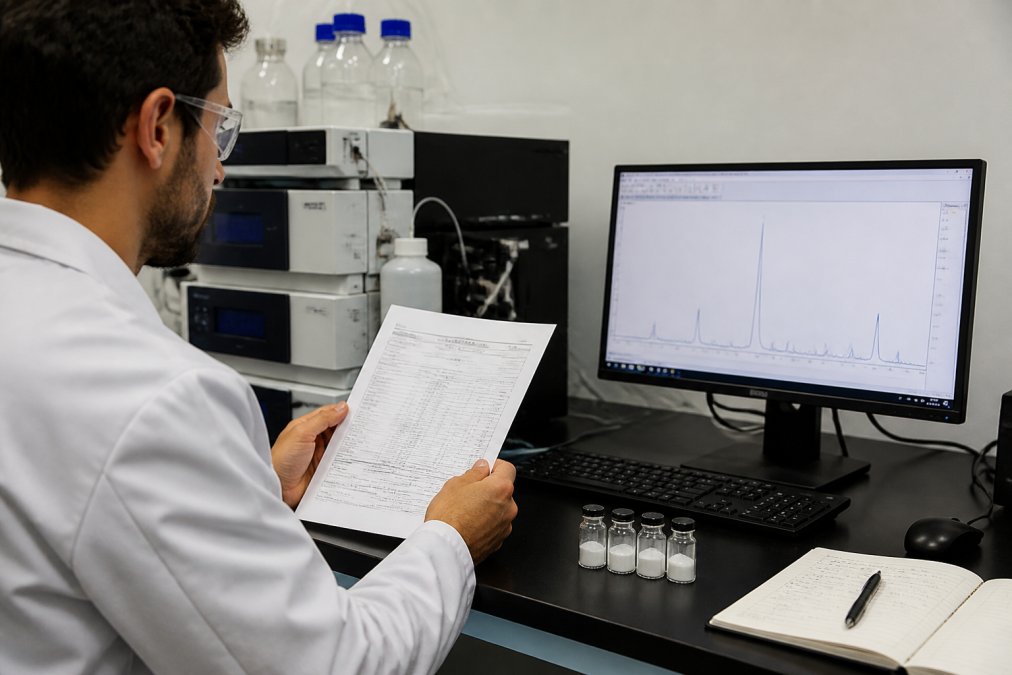
The purity percentage is the number everyone quotes and the one most people misread. A figure like 98.5% is meaningless without context: purity by what method, against what standard, and integrated how? A common pattern in fabricated reports is a suspiciously round number, 99.0%, 99.9%, with no chromatogram attached. Real HPLC data produces messy, specific figures, and the integration method (how the software drew the baseline and measured peak area) is what determines the final number.
Spotting a fabricated or recycled report
- The batch number does not match your vial. This is the single most common failure. A supplier sends a beautiful CoA for a different lot than the one in the box.
- The testing date is stale. A report older than about 12 months may not reflect the material you received, especially for compounds sensitive to moisture and temperature.
- The testing lab is the supplier itself. In-house ‘testing’ is not independent verification. The lab named on the CoA should be a third party with no ownership relationship to the vendor.
- The molecular weight does not match published values. This is a fast, objective check. If the stated mass is off, nothing else on the document can be trusted.
- The document is a generic PDF reused across products. Compare CoAs from the same supplier for two different compounds. If the layout, fonts, and even the chromatogram image are identical, you are looking at a template, not data.
The vetting checklist
- Confirm the CoA lists a specific batch number matching your vial
- Check that purity is reported to at least two decimal places
- Verify the analytical method is stated (HPLC, mass spectrometry, or both)
- Look for a testing date within the last 12 months
- Cross-reference the molecular weight against published values
- Confirm the testing lab is independent, not in-house
- Request the raw chromatogram, not just the summary page
For deeper verification, analytical standards from the United States Pharmacopeia provide reference benchmarks for identity and purity testing. A supplier who cannot produce this documentation on request, or who stalls when you ask for the underlying chromatogram, is not worth your budget.
Request the CoA before you place the order, not after. Suppliers confident in their testing send it within hours. The ones who stall are telling you something. The ones who send a different batch number than the one they ship are telling you more.
Storage and stability after the sale
Verification does not end at the certificate. Lyophilized powder should arrive cold and stay cold, and the cold chain needs to extend to your facility, not just to the airport. Once in hand, most lyophilized peptides are stable for extended periods when kept sealed, desiccated, and frozen, but reconstituted material degrades far faster and should be aliquoted to avoid repeated freeze-thaw cycles.
Frequently Asked Questions
Did Peptide Sciences shut down?
Peptide Sciences ceased operations, leaving many research labs without a supplier. The closure created a gap in the market for verified research-grade peptides. Suppliers like DelixLabs, Core Peptides, and Nova Life Peptides have emerged to fill that gap, offering third-party testing and Certificates of Analysis. When evaluating a Peptide Sciences alternative for labs, confirm the new supplier provides batch-level documentation and independent HPLC testing before placing an order.
What is the most trustworthy peptide company for research labs?
Trustworthy suppliers share three traits: independent third-party testing, batch-specific Certificates of Analysis, and transparent manufacturing standards. DelixLabs and Core Peptides both publish batch-level HPLC and mass spectrometry results. Lone Star Peptide Co. provides independent verification on all inventory. No single company is universally best, so labs should request a sample CoA and verify the testing lab’s credentials before committing to a supplier for ongoing research.
How do I verify the purity of research peptides?
Start with the Certificate of Analysis. Check that it lists the batch number, test date, and results from HPLC (high-performance liquid chromatography) and mass spectrometry. The HPLC chromatogram should show a single sharp peak with purity above 95%, and the mass spec should confirm the molecular weight matches the expected compound. If a supplier cannot provide batch-specific data or the CoA lacks raw chromatogram images, treat that as a red flag. You can also send a sample to an independent lab for verification.
What criteria should labs use to evaluate peptide suppliers?
Use a peptide supplier vetting checklist: (1) third-party testing on every batch, (2) Certificate of Analysis with raw HPLC and mass spec data, (3) batch-level traceability from synthesis to shipping, (4) temperature-controlled cold chain logistics, (5) clear documentation of synthesis protocols, and (6) responsiveness to technical inquiries. Also verify the supplier’s shipping integrity guarantees and whether they offer replacement stock for compromised shipments. Labs handling sensitive assays should prioritize batch consistency data above all else.
Are there reliable alternatives to Peptide Sciences for research-grade materials?
Yes. Several suppliers now offer research-grade peptides with documentation comparable to or better than Peptide Sciences. DelixLabs provides third-party HPLC and mass spectrometry testing for all batches. Core Peptides supplies detailed CoAs with every order. Nova Life Peptides focuses on high-purity synthesis protocols and compound-for-compound replacement. EZ Peptides offers transparent pricing for common compounds. Each Peptide Sciences alternative for labs differs in catalog depth, pricing model, and documentation standards, so match the supplier to your lab’s specific assay requirements.
The hardest part of replacing a legacy peptide supplier is not finding a new catalog. It is rebuilding trust in documentation you can defend in a publication or an audit. FROPeptides was built for exactly this problem, with multi-stage HPLC testing, mass spectrometry verification on every batch, and Certificate of Analysis documentation that ships with your order. Get started with FROPeptides and source research-grade materials you can trace from synthesis to bench.