99PurityPeptides vs ProtideHealth: Which Is Better?
Table of Contents
- 99PurityPeptides vs ProtideHealth: Testing Methods Compared
- How to Verify Peptide Purity Reports Before You Buy
- Third-Party Lab Testing for Research Peptides: What to Demand
- Batch Traceability and Supply Chain Transparency
- Best Peptide Suppliers for Academic Research: Selection Criteria
- Red Flags to Avoid in Any Peptide Supplier Comparison
- Conclusion: Which Supplier Meets Research-Grade Standards?
- Frequently Asked Questions
Last Updated: September 9, 2026
99PurityPeptides vs ProtideHealth: Testing Methods Compared
A meaningful peptide supplier comparison has to start with analytical chemistry, not marketing claims. The core question for any research lab is whether a vendor can document what is actually in the vial, and the only credible way to answer that is through independent, instrument-based verification. At FROPeptides, we hold ourselves to a high standard: multi-stage HPLC testing paired with mass spectrometry for every batch.
HPLC-MS: What the Data Actually Shows
High-performance liquid chromatography (HPLC) separates the peptide from synthesis byproducts, while mass spectrometry (MS) confirms the molecular weight. When a supplier reports “99% purity” without publishing the chromatogram or MS spectrum, that number is an assertion, not a finding. A defensible certificate of analysis (CoA) includes raw analytical traces, the integration method, and the instrumentation used.
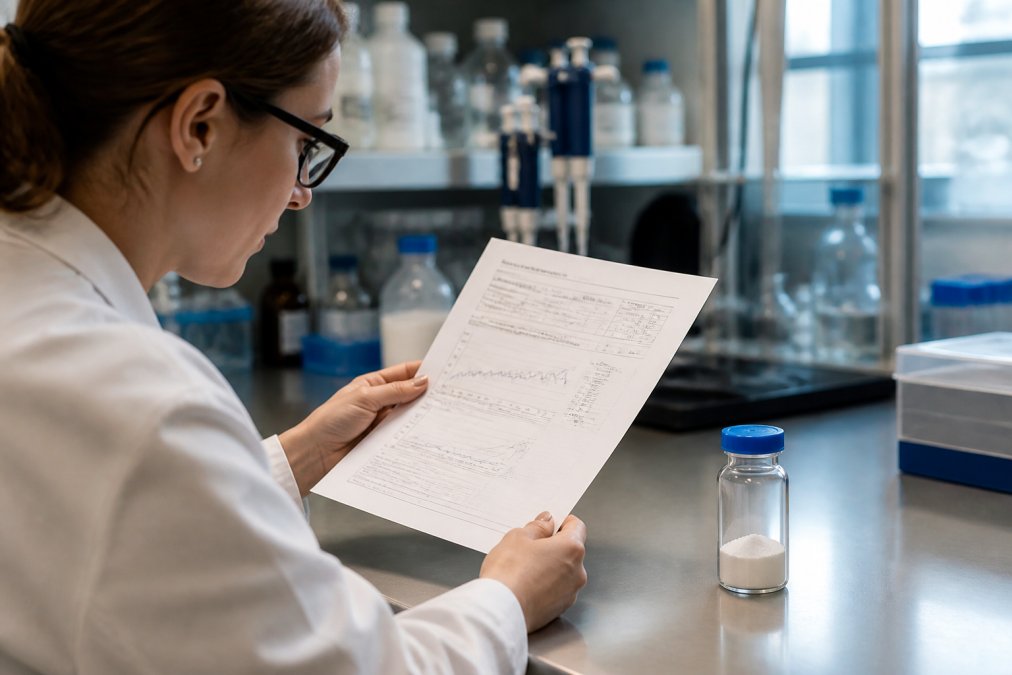
HPLC and MS answer different questions: HPLC quantifies the target peptide versus impurities, while MS confirms the molecule is the peptide you ordered. A supplier that runs only one method cannot verify both identity and purity, which is why research-grade sourcing demands the paired approach.
How to Verify Peptide Purity Reports Before You Buy
A common mistake is accepting a single purity percentage at face value. The verification process starts with requesting the batch-specific CoA before you commit to an order, and it should include several specific checks.
- Confirm the CoA references the exact batch number printed on your vial, not a generic document.
- Look for the HPLC chromatogram with the main peak and all impurity peaks clearly labeled.
- Verify the MS spectrum shows the expected molecular weight for your peptide sequence.
- Check the date of analysis; stability data matters for lyophilized peptides stored over time.
- Ask whether the testing was performed in-house or by an independent third-party laboratory.
This approach to how to verify peptide purity reports separates vendors with real quality systems from those with attractive websites. If a supplier hesitates to share batch-level documentation, that response is itself a data point.
Third-Party Lab Testing for Research Peptides: What to Demand
Third-party lab testing for research peptides is the gold standard because it removes the conflict of interest inherent in self-reported quality. But not all third-party testing is created equal. A vendor may send a single sample to an external lab once a year and call that “third-party tested,” while another sends every batch for full characterization.
The Technical Distinction: HPLC Purity vs. MS Identity vs. Sequence Confirmation
When a third-party lab tests a peptide, the methods used determine what the certificate actually proves. The most common approach is reversed-phase HPLC with UV detection at 214 nm, which quantifies the peptide and its impurities by absorbance. This method reports a purity percentage, but it cannot confirm that the main peak is the peptide you ordered, only that something eluted at that retention time.
Mass spectrometry adds identity confirmation by measuring molecular weight. A mass spectrum showing the expected m/z for your peptide sequence is strong evidence of correct synthesis, but it does not rule out closely related failure sequences that share the same nominal mass.
Amino acid analysis (AAA) or peptide mapping goes further, confirming the actual sequence composition. Few suppliers run AAA on every batch because it is expensive and time-consuming, but it is the only method that fully verifies sequence fidelity. When a vendor claims “99% purity,” the honest follow-up question is: purity by what method, and what does the MS data show about identity?
Standardized Testing Methodology: Why Protocols Differ and What to Ask
There is no single regulatory standard for RUO peptide testing in the United States, so each lab develops its own protocols. The most defensible certificates come from labs that follow pharmacopeial-style methods adapted for research peptides, including:
- Gradient elution profiles that separate hydrophilic and hydrophobic impurities
- Column specifications (e.g., C18, 5 µm particle size, specific dimensions) disclosed in the CoA
- Detection wavelength stated explicitly, since 220 nm vs. 280 nm yields different purity numbers
- Integration parameters that account for all peaks above a defined threshold (typically 0.1% area)
A common pattern is that suppliers report purity from a single HPLC run without disclosing the gradient, column, or detection wavelength, making the number nearly impossible to reproduce or compare across vendors. When you request a CoA, ask whether the method is documented in writing and whether the same method is used for every batch.
The Regulatory Landscape: RUO Designation and What It Means for Testing
In the United States, research peptides are sold under the Research Use Only (RUO) designation, meaning they are not approved for human consumption or clinical use. The FDA does not pre-market review RUO products, and quality assurance falls on the end user, the laboratory, to verify what it purchases (the FDA). This is a defined category under federal regulations.
The burden of verification sits with you. A supplier that runs its own in-house HPLC and publishes a single chromatogram is providing useful data, but it is not the same as independent confirmation. The strongest position is to require both: in-house batch testing for every lot, plus periodic third-party verification using a different analytical method.
What to Demand in Practice
When evaluating a supplier’s third-party testing claims, the demand list should include:
- The name of the testing laboratory, an independent lab with published analytical capabilities is more credible than an unnamed facility.
- The specific method used, HPLC, MS, or both, with instrument parameters disclosed.
- The date of analysis, testing performed months before your order date may not reflect current batch quality.
- Full analytical traces, chromatograms and spectra, not just a summary percentage.
- Batch linkage, the third-party report must reference the same lot number as the vial you receive.
A third-party certificate that does not name the lab, the method, or the batch number provides little more assurance than an in-house claim. The value of independent testing is in its specificity and reproducibility, not in the label “third-party.”
Suppliers that cannot produce third-party documentation with these details are either not running the tests or not willing to share the full record. Both scenarios should factor into your sourcing decision.
Batch Traceability and Supply Chain Transparency
Supply chain transparency is where many peptide suppliers fall short, and it directly affects experimental reproducibility. A batch-specific CoA is only meaningful if you can trace that batch from raw material sourcing through synthesis, purification, and final packaging. Traceability is a chain of custody that determines whether the compound reaching your bench is the compound that was characterized.
The Raw Material Sourcing Problem
Peptide synthesis begins with amino acid building blocks, resins, and coupling reagents. Impurities in raw materials can propagate through synthesis into the final product. A supplier that sources amino acids from a single, qualified manufacturer with documented quality systems has a different risk profile than one that buys on the spot market from multiple brokers.
A common pattern is that suppliers do not disclose their raw material sources at all, citing proprietary concerns. For research labs, the relevant question is not the specific manufacturer name but whether the supplier has a qualified vendor program, meaning they audit or at least document the quality of their inputs. Without that, a purity claim is only as good as the least pure input in the synthesis chain.
Synthesis and Purification: Where Batch Divergence Happens
Solid-phase peptide synthesis (SPPS) is a stepwise process where each amino acid coupling has an efficiency below 100%. Over a 20-residue peptide, even a 99.5% coupling efficiency yields a significant population of truncated sequences (peer-reviewed research). Purification by preparative HPLC removes most of these, but the efficiency of that step determines the final purity profile.
Two batches of the same peptide from the same supplier can diverge if the synthesis scale, resin lot, or purification gradient changes between runs. This is why batch-specific documentation matters more than a generic product-page purity claim. A supplier that maintains consistent synthesis parameters and documents any changes provides a more reliable foundation for longitudinal studies.
Cold Chain Integrity: The Physical Side of Traceability
Peptides are lyophilized to maintain stability, but the lyophilized cake is not immune to degradation. Exposure to temperatures above ambient, especially for extended periods, can accelerate deamidation, oxidation, and aggregation, even in a dry powder (the NIH). The risk is highest during summer months and in extreme climates.
Temperature-controlled shipping is not a single event; it is a chain that includes:
- Cold storage at the warehouse before the order is picked
- Insulated packaging with phase-change materials that maintain temperature during transit
- Transit time limits, a 2-day shipment with cold packs is different from a 5-day shipment with the same packaging
- Receiving-side verification, whether the packaging arrives intact and within temperature range
A supplier that cannot document its cold chain process, or that ships in plain envelopes without thermal protection, is introducing a variable into your experiments that no CoA can address. The certificate describes the product at the time of analysis; it does not guarantee the product survives transit intact.
Long-Term Stability: The Missing Data Point
Most suppliers publish initial purity from the date of manufacture. Few publish stability data showing how purity changes over 6, 12, or 24 months of storage. For labs running extended studies, this gap is significant. A peptide that degrades from 99% to 97% over a year may still be usable for some applications but not for others where impurity profiles matter.
Stability testing typically involves accelerated studies at elevated temperatures (e.g., 40°C) with periodic HPLC analysis to model degradation kinetics. Suppliers that conduct and share this data demonstrate quality infrastructure beyond a single purity measurement. When a supplier cannot provide stability information, the conservative assumption is that degradation is occurring at an unknown rate.
What Traceability Should Look Like in Practice
A defensible traceability system includes:
- A unique batch identifier that follows the product from synthesis through final packaging
- Raw material lot records linking the specific amino acid lots used in each synthesis
- Synthesis and purification logs documenting process parameters
- Analytical records tying the CoA to the specific batch
- Shipping records showing cold chain handling from warehouse to carrier
The most reliable signal of a quality supplier is willingness to share complete, batch-specific analytical documentation. Transparency is the cheapest quality control a vendor can offer, and its absence is telling.
Suppliers that cannot or will not provide this level of traceability are asking you to accept their quality claims on faith. For research-grade sourcing, faith is not a validation method.
Best Peptide Suppliers for Academic Research: Selection Criteria
When evaluating the best peptide suppliers for academic research, the selection criteria should mirror the rigor of your own laboratory protocols. Purity percentage is the entry ticket, not the deciding factor.
The criteria that matter most include documentation quality (complete CoAs with raw analytical data for every batch), consistency across orders (since batch-to-batch variance can invalidate longitudinal studies), and logistics reliability (including temperature-controlled shipping and secure packaging).
| Selection Criterion | What to Verify | Why It Matters |
|---|---|---|
| Analytical documentation | HPLC and MS data per batch | Confirms identity and purity |
| Batch traceability | CoA matches vial lot number | Enables reproducibility |
| Cold chain handling | Temperature-controlled transit | Prevents degradation |
| Inventory reliability | No backorders on catalog items | Maintains study timelines |
| Order consistency | Repeatable purity across lots | Supports longitudinal research |
For sensitive molecular assays where minor purity variance can compromise results, consistency across batches is arguably more important than a single impressive purity number. A supplier that delivers 99% purity once is less valuable than one that delivers verified purity on every order.
Red Flags to Avoid in Any Peptide Supplier Comparison
Several warning signs should disqualify a supplier regardless of their stated purity metrics. Vague or generic certificates of analysis that do not reference a specific batch are a primary red flag, as is any reluctance to share analytical data before purchase.
Pricing that sits far below market norms often indicates shortcuts in synthesis or purification. Similarly, suppliers that cannot articulate their testing methodology, whether HPLC, MS, or both, likely lack the internal quality infrastructure to support their claims.
The most reliable signal of a quality supplier is willingness to share complete, batch-specific analytical documentation. Transparency is the cheapest quality control a vendor can offer, and its absence is telling.
Conclusion: Which Supplier Meets Research-Grade Standards?
The honest answer is that the supplier comparison matters less than the documentation standard you enforce. A vendor that provides complete HPLC-MS data, batch-level traceability, and temperature-controlled logistics will serve your research better than one that merely quotes a high purity percentage.
For laboratories that require verified purity and consistent sourcing, FROPeptides provides research peptides and lyophilized coenzymes with 99%+ purity confirmed by HPLC and mass spectrometry for every batch. Each order includes a Certificate of Analysis, and temperature-controlled storage and handling protect compound integrity from warehouse to lab bench. Batch-level traceability and a no-backorder inventory policy support consistent, reproducible research workflows.
Get started with FROPeptides and bring verified analytical documentation to your next protocol.
Frequently Asked Questions
Which is more reputable: 99PurityPeptides or ProtideHealth?
Reputation hinges on documentation, not marketing. A supplier earns trust by publishing batch-specific Certificates of Analysis (COAs) with HPLC and mass spectrometry data for every lot. Before choosing, request the COA for the exact batch you plan to order and verify the reported purity percentage against the raw chromatogram. Suppliers that provide this documentation readily, like FROPeptides, demonstrate confidence in their quality control. Those that hesitate or provide only generic summaries should raise a red flag for your laboratory studies.
How do 99PurityPeptides and ProtideHealth compare on third-party testing?
The critical question is whether testing is truly independent. Ask if the supplier uses an external ISO-accredited laboratory for third-party lab testing for research peptides, or if they only self-test in-house. Independent verification eliminates conflicts of interest. You should also confirm that both HPLC and mass spectrometry are used, since HPLC alone can miss co-eluting impurities. Request the raw data files, not just a summary sheet, so your team can confirm the molecular weight and purity independently.
What should I look for when I verify peptide purity reports?
Start by confirming the report matches the specific batch number on your vial. Check that the purity percentage is calculated by HPLC area normalization and that the mass spectrometry confirms the expected molecular weight. Look for the date of analysis and the method parameters, including column type and mobile phase. A report without these details is incomplete. For sensitive assays, request the full chromatogram to check for shoulder peaks that might indicate impurities the summary percentage misses.
What are the red flags when sourcing research peptides from a new supplier?
Missing batch-level traceability tops the list. If a supplier cannot link a specific vial to a Certificate of Analysis with a matching batch number, you cannot verify what you are injecting into your assay. Other red flags include vague purity claims without supporting HPLC-MS data, no temperature-controlled storage information, and a history of backorders. For regulatory compliance, confirm the supplier labels products for research use only (RUO) and does not make unsubstantiated claims about human consumption.