
Fast Dispatch Research Grade Materials: 2026 Buyer’s Guide
Table of Contents
- What Fast Dispatch Actually Means for Research Grade Materials
- Quick Comparison: What to Look for in a Supplier
- How to Buy High Purity Research Peptides Without Getting Burned
- HPLC Verified Research Chemicals: Reading the Data Before You Order
- Batch-Level Traceability Standards That Hold Up in Peer Review
- Cold-Chain Logistics: Where Fast Dispatch Often Falls Apart
- Compliance, Documentation, and What Your PI Will Ask For
- Conclusion
- Frequently Asked Questions
Last Updated: September 13, 2026
What Fast Dispatch Actually Means for Research Grade Materials
Fast dispatch for research grade materials means the supplier ships the same day your order clears payment and quality verification. FROPeptides treats dispatch speed as a logistics discipline, not a marketing claim, which matters when your timeline is locked.
Most suppliers advertise “quick shipping” but mean leaving the warehouse within 48 to 72 hours, a gap that destroys reproducibility during a multi-week assay run (the FTC).
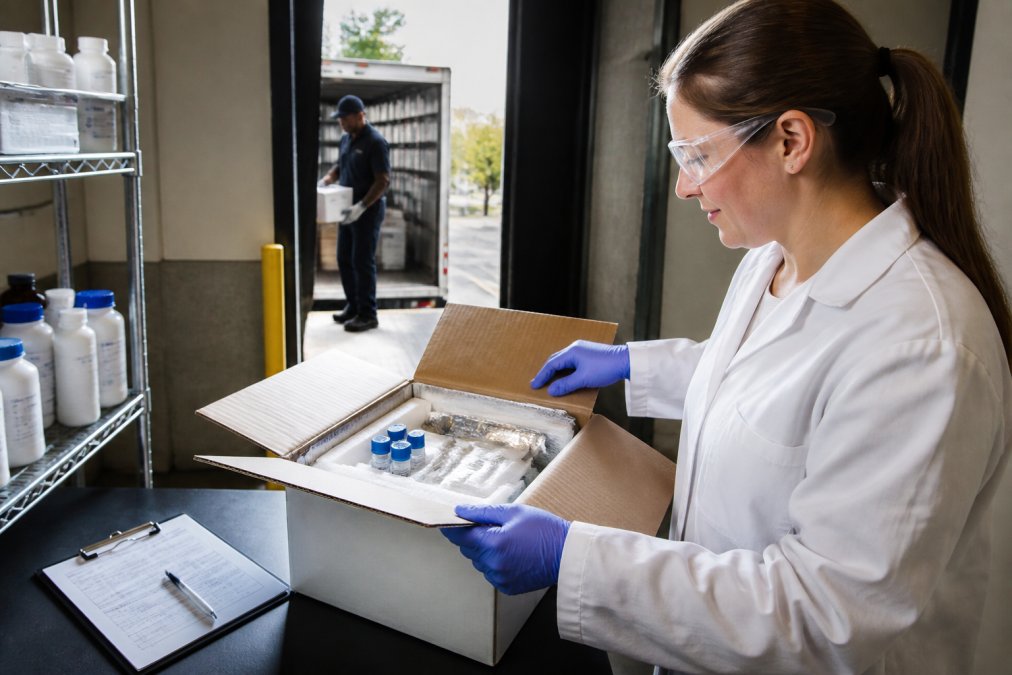
Three things separate genuine fast dispatch from marketing copy:
- Cutoff time transparency: A supplier should tell you the exact hour after which orders roll to the next business day.
- Pre-packed inventory: Compounds that sit in temperature-controlled storage ready to ship move faster than made-to-order batches.
- Tracking handoff: The carrier scan happens the same day, not when someone gets around to it.
Quick Comparison: What to Look for in a Supplier
A supplier worth ordering from publishes five things before you add anything to a cart: dispatch cutoff, purity verification method, batch traceability, cold-chain handling, and documentation turnaround. Use this table to score any supplier, then read the notes below on how to test each claim.
| Criterion | What Good Looks Like | How to Test the Claim | Why It Matters |
|---|---|---|---|
| Dispatch cutoff | Same-day before a stated hour, posted publicly | Place a test order mid-afternoon and check the carrier scan timestamp | Keeps your experiment on schedule |
| Purity method | Multi-stage HPLC plus mass spectrometry | Request the chromatogram and mass spectrum for your specific lot | Confirms identity and purity |
| Batch traceability | Lot number on every vial matching the CoA | Cross-check the vial label against the CoA lot field | Enables peer-review documentation |
| Cold-chain | Insulated, phase-change packing with stated temperature range | Ask for the packing spec and the validated hold time | Protects sensitive compounds |
| Documentation | Certificate of Analysis per batch, SDS on request | Time how long a CoA takes to arrive after you ask | Satisfies institutional review |
The cutoff test. A stated cutoff is only useful if enforced. Ask what happens if payment clears at 4:55 p.m. against a 5:00 p.m. cutoff. A supplier with real dispatch discipline rolls the order to the next business day, and the carrier scan reflects it.
The purity test. Purity percentage is the easiest number to fabricate; the chromatogram is not. Look for retention time, peak integration, and the mass-to-charge ratio. A generic CoA with no lot number means the purity claim is unverified.
The traceability test. Read the lot number on the vial, then find the same string on the CoA. If they do not match, the documentation does not describe your material.
The cold-chain test. Ask the supplier to describe the packing configuration: insulation, phase-change material, validated hold time, ambient temperature. Specifics mean the engineering is done; adjectives mean it is not.
The documentation test. Email for a sample CoA and SDS before ordering, then time the response. A supplier with documentation built into the workflow answers within a business day; one who treats paperwork as a favor takes a week.
Run the five tests on any new supplier before your first paid order. The thirty minutes you spend verifying claims is cheaper than the two weeks you lose to a failed assay.
One trade-off: suppliers with deep pre-packed inventory ship faster but carry a narrower catalog, while made-to-order suppliers offer more compounds but add synthesis time. Match the supplier model to your timeline.
How to Buy High Purity Research Peptides Without Getting Burned
Buying high purity research peptides comes down to verifying three things before payment: the analytical data, the handling protocol, and the replacement policy if something arrives compromised. Plenty of vendors sell impressive-sounding purity claims with no data behind them.
Request batch-specific data, not a generic sample. A Certificate of Analysis should carry the lot number matching your vial. A CoA listing a different batch proves nothing about your purchase.
Check the verification method. Multi-stage HPLC testing separates and quantifies the compound; mass spectrometry confirms molecular identity. You want both.
Confirm the handling chain. Lyophilized peptides tolerate shipping better than solution-phase compounds, but temperature excursions still degrade them. Ask how the supplier packs for transit.
Read the replacement terms. A supplier that stands behind cold-chain integrity replaces compromised stock quickly; one that buries the policy in fine print will not.
FROPeptides runs multi-stage HPLC testing and mass spectrometry on every batch, with CoA documentation tied to the lot number on your vial. That is the baseline any serious lab should demand.
HPLC Verified Research Chemicals: Reading the Data Before You Order
HPLC verified research chemicals carry analytical documentation showing the compound’s purity profile as measured by high-performance liquid chromatography, typically paired with mass spectrometry for identity confirmation.
Reading that data takes about five minutes once you know what to look for.
- Purity percentage: The headline number, usually 95% or higher for research-grade material (peer-reviewed research).
- Chromatogram: The actual trace showing peak separation. A clean single peak indicates a pure compound.
- Retention time: Confirms the compound eluted when expected.
- Mass spectrum: The molecular weight confirmation. This is what proves identity, not just purity.
- Storage conditions: Temperature and light requirements stated on the CoA.
What most buyers miss: a purity percentage without the underlying chromatogram is just a number. Any vendor can type “98%” into a PDF; the trace makes it verifiable.
A CoA with no chromatogram attached is not verification. It is a claim. If a supplier cannot produce the actual analytical trace for your batch, you have no way to confirm what is in the vial.
Batch-Level Traceability Standards That Hold Up in Peer Review
Batch-level traceability standards require that every vial carries a lot number linking it to the specific production run, analytical testing records, and storage history for that batch.
This is not bureaucratic overhead. It is what lets you defend your methods section when a reviewer asks how you verified your starting materials.
A traceability system that holds up includes:
- A unique lot number printed on the vial and the CoA
- Analytical records for that specific lot, not a representative sample
- Storage and handling documentation from production through delivery
- A retention sample the supplier keeps in case questions arise later
When your PI asks whether a compound is validated for publication, traceability is the answer: the lot number, the CoA, and the analytical method. FROPeptides maintains batch-level traceability across every order, so the documentation trail follows the vial from production to your bench.
Cold-Chain Logistics: Where Fast Dispatch Often Falls Apart
Cold-chain logistics is the weakest link in most fast-dispatch promises. A supplier can ship same-day and still deliver a degraded compound if the packaging does not hold temperature through transit.
The failure points are predictable:
- The handoff gap: Package leaves temperature-controlled storage and sits on a dock.
- The carrier leg: Standard shipping exposes the package to ambient conditions for hours.
- The final mile: Delivery to a receiving dock that sits in direct sun.
Sensitive materials need insulated packaging, phase-change materials, and sometimes dry ice. The supplier should describe exactly how the compound stays within its required temperature range from dispatch to delivery. Speed means nothing if the compound arrives compromised.
Fast dispatch and cold-chain integrity are not competing priorities. A supplier that ships quickly but cuts corners on temperature control is not actually fast. It is just early with a damaged product.
Compliance, Documentation, and What Your PI Will Ask For
Compliance documentation for research-grade materials covers the paperwork your institution needs before a compound enters the lab: the Certificate of Analysis, the Safety Data Sheet, and the records tying the material to its analytical history. The useful question is what each must contain to survive institutional review.
Your PI or institutional review board will typically ask for four things:
- Certificate of Analysis, must carry the lot number, the analytical method (HPLC, mass spectrometry, or both), the purity result, the storage conditions, and the date of analysis. A CoA missing the lot number is not batch-specific and will not satisfy review.
- Safety Data Sheet, must follow the OSHA Hazard Communication Standard format with the sixteen standardized sections, including handling, storage, first aid, and disposal guidance (osha.gov). An SDS that is a one-page summary is not a compliant SDS.
- Purity verification records, the underlying chromatogram and mass spectrum, not just the summary percentage. Reviewers increasingly ask for the raw trace because the summary number alone is unverifiable.
- Traceability documentation, the chain linking the vial to its production batch, including the lot number, the analytical records for that lot, and the storage history from production through delivery.
The paperwork chain for institutional procurement. When a compound crosses into a university or contract research organization, documentation passes through three hands: the supplier, the receiving lab’s safety officer, and the institutional review or environmental health and safety office. The safety officer checks the SDS for hazard classification and storage compatibility; the review office checks the CoA for lot specificity and analytical method; the PI checks that documentation matches the vial in hand. A supplier who understands this chain passes all three checks on the first submission.
Where the chain breaks. The most common failure is a CoA describing a representative batch rather than the specific lot shipped. The second is an SDS that predates a formulation change. The third is a traceability record that stops at the supplier’s door and omits cold-chain history through transit. Any of these sends your order back for re-documentation, adding a week or more.
What to ask before you order. Ask three questions: Can you send a sample CoA with the lot number field populated? Is your SDS current to the most recent formulation? Can you provide the cold-chain transit record for a recent shipment? A supplier with a real documentation workflow answers all three without escalation; one who has to check with someone answers none quickly.
Turnaround as a quality signal. Documentation turnaround is a proxy for how seriously a supplier treats compliance. Ask how quickly batch-level documentation can be produced after an order. A multi-day wait or vague promise means plan accordingly; same-day or next-business-day means documentation is built into dispatch.
A Certificate of Analysis without a lot number is not batch-specific documentation. It describes some batch, not your batch. Institutional review offices increasingly reject these on sight, and a rejected CoA can delay your order by a week or more.
Suppliers that treat documentation as an afterthought create work for you; those that build it into every order save the back-and-forth. The difference shows up the first time your safety officer asks a question the CoA cannot answer.
Conclusion
The gap between a supplier that ships fast and one that ships fast and correctly comes down to documentation, cold-chain discipline, and traceability. Speed without those three is just a package arriving on time with nothing useful inside.
FROPeptides was built around that distinction: multi-stage HPLC testing and mass spectrometry on every batch, Certificate of Analysis documentation tied to each lot, and temperature-controlled dispatch that holds integrity from our facility to your bench. If your lab needs research-grade materials that arrive quickly and verify cleanly, that combination is the whole point.
Shop Now and see what batch-level traceability actually looks like on your next order.
Frequently Asked Questions
What defines research grade materials in laboratory settings?
Research grade materials meet purity and characterization benchmarks set for laboratory work rather than clinical or consumer use. They typically come with a Certificate of Analysis (CoA) documenting HPLC purity, mass spectrometry confirmation, and batch-level traceability. For peptides, purity is usually verified at 95% or higher. These materials are labeled laboratory use only and are not intended for human or veterinary consumption. Always request the CoA before committing to a supplier.
How does batch-level traceability affect research outcomes?
Batch-level traceability lets you match every vial to its Certificate of Analysis, so you can confirm purity, identity, and handling history. Without it, a purity shift between batches can quietly skew assay results and make experiments hard to reproduce. Suppliers that assign a unique lot number to each batch and archive test data make it possible to investigate anomalies later. This matters most for sensitive molecular assays where even small purity variance changes outcomes.
Why is fast dispatch critical for time-sensitive molecular analysis?
Many assays depend on reagents arriving within a narrow window before degradation or experimental deadlines. Slow dispatch adds days of transit and exposes temperature-sensitive compounds to more risk. Suppliers offering same-day dispatch and tracked delivery cut that exposure. For time-sensitive work, confirm the dispatch cutoff time, the shipping method, and the cold-chain packaging protocols.
What quality control standards should I look for in research peptides?
Look for multi-stage HPLC testing, mass spectrometry verification for every batch, and a Certificate of Analysis you can review before ordering. Purity benchmarks should be stated clearly, and batch-to-batch consistency data should be available on request. Temperature-controlled storage and cold-chain shipping protect compound integrity in transit. Suppliers that publish their testing methods and let you inspect actual batch data give you more to work with than suppliers that only list a purity percentage.
What is the difference between analytical grade and research grade materials?
Analytical grade materials are prepared for quantitative analysis and reference standards, with tightly controlled purity for calibration work. Research grade materials are produced for general laboratory experimentation and method development, and they also carry documented purity and identity data but are not always traceable to a certified reference standard. The right choice depends on your protocol. If you are calibrating instruments, you need analytical standards; if you are running exploratory assays, research grade is often sufficient.