Peptide Warehouse Alternatives for Labs
Table of Contents
- Why Labs Switch From Peptide Warehouse
- Criteria for Evaluating Peptide Warehouse Alternatives
- Third-Party Tested Research Peptides: What to Demand
- How to Verify Peptide Purity Certificates
- Best Peptide Suppliers for Academic Research
- Red Flags in Peptide Suppliers to Avoid
- Making the Switch: Implementation and Risk Mitigation
- Frequently Asked Questions
Last Updated: August 28, 2026
Why Labs Switch From Peptide Warehouse
Researchers abandon their current peptide suppliers for one reason: the materials don’t perform as promised. A vial arrives with degraded compounds. A batch test shows purity at 94% instead of the claimed 99%. Temperature-controlled shipping turns out to mean “room temperature in a cardboard box.” These aren’t edge cases, they’re the norm when labs rely on suppliers cutting corners to scale.
The real cost isn’t the refund or the replacement order. It’s the lost weeks of research, the failed experiments, and the PI asking why the lab can’t reproduce results from last quarter. When you’re running tight protocols where even 2% purity variance tanks your assay, supplier reliability becomes non-negotiable.
FROPeptides exists because labs needed an alternative to this cycle. Researchers switching from larger, less transparent suppliers cite three consistent reasons: batch-level traceability that actually means something, temperature-controlled logistics that extend all the way to your facility, and Certificate of Analysis data backed by HPLC and mass spectrometry for every single vial.
The question isn’t whether you need to switch, it’s whether your current supplier is costing you more in failed experiments than switching would cost in retraining your lab.
Criteria for Evaluating Peptide Warehouse Alternatives
Not all peptide suppliers are built the same. The difference between a vendor that ships commodity compounds and one that delivers research-grade materials shows up in three places: the lab, the data, and your budget.
Purity Verification and HPLC Testing
High-purity peptides require multi-stage analytical verification, not a single test at the end of synthesis. HPLC (high-performance liquid chromatography) separates peptide components and measures what’s actually in the vial. Mass spectrometry confirms molecular weight and detects contaminants HPLC alone might miss.
A supplier claiming 99% purity without showing HPLC and mass spec data is guessing. Real verification means:
- Initial purity assessment during synthesis
- Final analytical run before packaging
- Batch-specific documentation, not generic specifications
- Detection thresholds for endotoxin levels and residual solvents
This matters because peptide degradation happens in stages. A vial that tests at 99% on day one might be at 96% after three weeks of storage if temperature control fails. Labs using peptides in peer-reviewed research need proof of integrity at the point of use, not just at shipment.
According to FDA guidance on analytical procedures for biologics, verification of peptide purity through HPLC is the standard for research applications. Suppliers skipping this step are cutting costs, not improving efficiency.
Batch-Level Traceability and Documentation
Every vial should arrive with its own story: where the raw materials came from, which synthesis run produced it, what the HPLC curve looked like, and how it was stored. This is batch-specific verification, not a generic certificate saying “all our peptides are 99% pure.”
Batch traceability protects your research in two ways. First, if results diverge between experiments, you can check whether the peptide source changed. Second, if a supplier has a manufacturing issue, you know exactly which of your vials are affected.
Documentation should include:
- Synthesis date and batch number
- Analytical method and instrument used
- HPLC retention time and purity percentage
- Mass spectrometry data confirming molecular weight
- Storage conditions and expiration timeline
- Chain of custody from manufacture to your lab
Suppliers offering “we test everything” without batch-specific data are hiding something. Real transparency means you get the actual analytical curves, not summaries.
Supply Chain Reliability and Shipping
Temperature excursions during shipping degrade peptides. A vial that leaves the supplier at 2-8°C but sits in a 35°C warehouse for 48 hours arrives compromised (peer-reviewed research). Cold chain integrity requires three things: proper packaging, real-time temperature monitoring, and a logistics partner that understands why it matters.
FROPeptides maintains temperature-controlled storage from synthesis through dispatch and offers flat-rate shipping with tracking. This distinction matters for labs running sensitive assays where batch consistency is non-negotiable.
Ask prospective suppliers:
- Do you use phase-change materials or passive thermal packaging?
- Can you provide temperature logs for shipped orders?
- What’s your replacement policy if a shipment arrives outside spec?
- Do you offer expedited shipping for time-sensitive research?
Suppliers that can’t answer these questions are treating peptides like commodity chemicals, not research-grade materials.
Third-Party Tested Research Peptides: What to Demand
The term “third-party tested” gets thrown around loosely. It can mean anything from “we sent a sample to another lab once” to “independent verification is standard for every batch.” For research applications, demand the latter.
Third-party testing means an external laboratory, not the supplier’s own QC team, runs analytical verification. This adds cost but eliminates the conflict of interest. A supplier’s internal lab has incentive to pass marginal batches. An external lab doesn’t.
What to ask for:
- Which lab performs the third-party verification?
- Is testing done on a per-batch basis or on representative samples?
- Can you see the actual analytical report, or just a summary?
- Are results available before shipment, or after?
- What happens if third-party testing fails?
Suppliers offering “certified” peptides without naming the certifying body are overstating their quality. Real certification comes from recognized analytical labs with published methods and traceable credentials.
How to Verify Peptide Purity Certificates
A Certificate of Analysis is only as good as the data it contains. Many suppliers ship generic CoAs that list purity percentage without showing the supporting evidence. That’s not verification, that’s a promise.
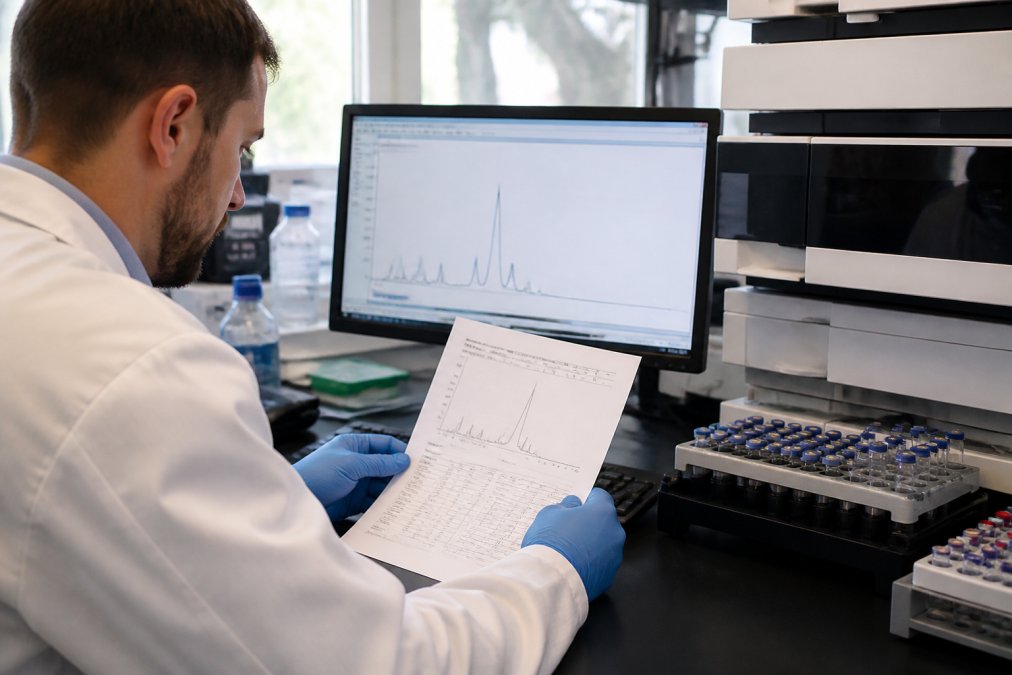
Real CoA verification requires reading the analytical curves, not just the summary line.
Start with these steps:
Check the HPLC chromatogram. The CoA should include a graph showing retention time on the x-axis and detector response on the y-axis. The main peptide peak should account for the stated purity percentage. If the largest peak is 94% of total area and the CoA claims 99%, something’s wrong.
Verify the analytical method. The CoA should specify which HPLC method was used, column type, mobile phase, flow rate, wavelength. This lets you assess whether the method is appropriate for your peptide’s structure and whether it would detect the contaminants you care about.
Look for mass spectrometry data. The molecular weight should match your peptide’s theoretical mass within acceptable error (typically ±0.1%) (peer-reviewed research). If it’s off by more than that, the vial contains something unexpected.
Check the date and batch number. The CoA should be dated after synthesis and before shipment. The batch number should match your purchase order. If they don’t align, the vial you received might not be the one that was tested.
Assess endotoxin and residual solvent levels. For research applications, these contaminants can interfere with assays. The CoA should list limits tested and results. “Not detected” is better than “below limit of detection” unless the limit is specified.
Many suppliers provide CoAs that pass visual inspection but lack detail. A one-page summary with a purity percentage and a signature is not verification. A multi-page report with analytical curves, method details, and batch-specific data is what you need for reproducible research.
Best Peptide Suppliers for Academic Research
The market for research-grade peptides includes commodity vendors, custom synthesis shops, and specialized suppliers focused on purity and traceability. Each serves different needs.
FROPeptides: Lab-Verified Research-Grade Materials
FROPeptides specializes in high-purity peptides verified through multi-stage HPLC and mass spectrometry for every batch. The focus is on researchers who need consistency across experiments, not volume discounts.
What makes FROPeptides different:
- 99%+ purity verified by HPLC and mass spectrometry
- Batch-level traceability from sourcing to packaging
- Temperature-controlled storage and handling
- No backorders, ready inventory
- Certificate of Analysis provided with every batch, including analytical curves
- Fast, flat-rate shipping with free delivery on orders over $200
- Discreet and secure packaging to maintain compound stability
For labs running tight protocols, the batch-level documentation is the real differentiator. You don’t just get a vial, you get the HPLC curve, the mass spec data, and the storage history. This level of transparency means you can troubleshoot if results diverge between experiments.

The pricing model supports higher-volume orders through improved cost efficiency, and the flat-rate shipping with free delivery on larger orders reduces friction for labs ordering regularly.
Custom Synthesis Alternatives for Specialized Needs
When you need a peptide that doesn’t exist in inventory, a specific sequence, a non-standard modification, or a labeled version for imaging, custom synthesis is necessary. These suppliers focus on synthesis capability, not inventory.
GenScript Custom Peptide Synthesis offers microwave-assisted synthesis technology for fast turnaround, with express options as quick as 5 days. The platform handles peptides up to 200 amino acids and supports extensive modifications including fluorescent labels and conjugations. Best for researchers needing custom sequences with quick delivery.
AmbioPharm scales from research quantities to multi-kilogram GMP production. If your project moves from early research to commercial development, AmbioPharm can handle the full pipeline. The trade-off is longer lead times and higher minimums for research-scale orders.
AnaSpec specializes in complex modifications, cyclic peptides, stapled peptides, FRET pairs, and labeled variants. If your assay requires a non-standard design, AnaSpec’s expertise in peptide engineering becomes valuable.
Thermo Fisher Scientific provides the broadest range of standard options: lengths from 2 to 110 amino acids, scales from 1 mg to 1 kg+, and purities from crude to >98%. The advantage is standardization and predictable turnaround. The disadvantage is less specialized support for edge-case designs.
Custom synthesis suppliers publish pricing on request rather than listing it publicly, so cost comparison requires direct quotes. Lead times vary by complexity, simple modifications might ship in two weeks, while complex designs could take eight weeks or more.
Red Flags in Peptide Suppliers to Avoid
Not every supplier claiming “research-grade” actually delivers it. Watch for these warning signs:
Generic Certificates of Analysis. If the CoA lists a purity percentage without HPLC curves or mass spec data, it’s a summary, not verification. Real verification shows your batch’s actual analytical results.
No batch-level documentation. Suppliers that provide only a generic specification sheet instead of batch-specific data are treating peptides as commodities. Research requires traceability.
Vague shipping claims. “Temperature-controlled” without specifying the range, monitoring method, or packaging type is meaningless. Real cold chain management includes phase-change materials, temperature data loggers, and documented procedures.
Inconsistent purity across orders. If one batch tests at 99% and the next at 96%, the supplier either has quality control issues or is not testing every batch. Either way, your research suffers.
Long lead times with frequent backorders. If a supplier regularly tells you “that peptide will be available in three weeks,” they’re not maintaining inventory. Your research timeline shouldn’t depend on their synthesis schedule.
No response to technical questions. If you ask about HPLC methods, endotoxin testing, or storage stability and get a generic answer, the supplier doesn’t understand your needs. Sales-focused vendors often lack technical depth.
Pricing that seems too low. Research-grade peptides with verified purity, batch documentation, and proper cold chain logistics cost more than commodity peptides. If a supplier undercuts the market significantly, they’re cutting corners somewhere.
No guarantee or replacement policy. If a vial arrives degraded or fails your QC check, a reliable supplier replaces it without argument. Suppliers requiring you to prove the problem or charging for replacements are signaling that quality isn’t their priority.
Making the Switch: Implementation and Risk Mitigation
Switching peptide suppliers mid-research carries risk. You’re changing a variable in your experiments, and if results diverge, you won’t know whether it’s the new supplier or your protocol. Manage this carefully.
Run parallel validation. Order the same peptide from your current supplier and the new one. Run identical assays with both batches side-by-side. Document any differences in behavior, purity, or stability. This gives you confidence that the new supplier performs equivalently.
Start with non-critical batches. Don’t switch suppliers for a peptide you’re using in a publication-critical experiment. Begin with pilot work, optimization runs, or preliminary assays where variance is expected and acceptable.
Request detailed documentation upfront. Before placing a large order, ask the new supplier for sample CoAs, batch documentation, and shipping procedures. Verify that their standard practice matches your requirements.
Establish communication protocols. Know who to contact if a batch fails your QC check, how quickly they respond, and what the replacement process looks like. This matters when you’re on a deadline.
Document everything. Keep records of batch numbers, CoA data, and experimental results for each supplier. If you ever need to troubleshoot a failed experiment, this documentation becomes invaluable.
Phase in gradually. If you’re ordering from multiple suppliers, don’t switch everything at once. Move one peptide, confirm it works, then move the next. This approach minimizes risk and gives your team time to adapt to new documentation formats and ordering processes.
FROPeptides supports this transition through detailed batch documentation, responsive customer support, and a replacement guarantee if shipments arrive outside specification. The goal is to eliminate supplier uncertainty so your research focus stays on science, not logistics.
Frequently Asked Questions
Q: What makes a peptide warehouse alternative reliable for academic research?
A: A reliable peptide supplier provides Certificate of Analysis (CoA) documentation for every batch, maintains temperature-controlled storage and shipping, offers batch-level traceability from sourcing through packaging, and delivers consistent purity verified by HPLC and mass spectrometry. Academic labs need suppliers who guarantee 99%+ purity and provide rapid turnaround on replacements if shipments arrive compromised.
Q: How do I verify peptide purity certificates from a new supplier?
A: Request the Certificate of Analysis for your specific batch, not generic product documentation. Verify it includes HPLC chromatograms showing peak integration data, mass spectrometry results confirming molecular weight, and contaminant screening results (endotoxin levels, water content). Cross-check the batch number on the CoA against your invoice and vial labeling. Legitimate suppliers provide CoAs immediately upon request.
Q: Are custom peptide synthesis services better than stock alternatives?
A: Custom synthesis suits labs needing specific modifications, non-standard sequences, or conjugations to carrier proteins. GenScript, AmbioPharm, AnaSpec, and Thermo Fisher all offer custom options with turnaround times ranging from 5 days to several weeks depending on complexity. Stock suppliers like FROPeptides work better for standard research-grade peptides, rapid restocking, and improved cost efficiency for higher-volume orders. Choose custom synthesis if your protocol requires modifications; choose stock suppliers if you need speed, cost efficiency, and ready inventory for established assays.
Q: What should I do if a peptide shipment arrives degraded or impure?
A: Document the issue immediately: photograph the vial, note the arrival date and storage conditions, and run a quick HPLC or mass spec test if possible. Contact your supplier with the batch number and original purchase order. Reputable suppliers like FROPeptides guarantee compound stability and provide replacement stock if cold-chain logistics failed or purity fell below specification. Confirm the supplier’s replacement policy in writing before committing to a long-term partnership.
Switching peptide suppliers is disruptive, but staying with a supplier that doesn’t meet your standards is more costly. The labs that achieve reproducible results across quarters and years are the ones that invested in supplier reliability early. FROPeptides delivers high-purity, batch-verified research peptides with the documentation and cold chain management your assays demand. Start with a pilot order and compare the data, your next experiment will tell you whether the switch was worth it.