Best Peptide Suppliers for Academic Research 2026
Table of Contents
- What Makes a Peptide Supplier Reliable for Academic Research
- Top Peptide Suppliers for Academic Research: Ranked and Compared
- Supplier Comparison: Key Metrics for Evaluating Peptide Suppliers
- How to Read a Peptide Certificate of Analysis
- Research Peptide Storage and Handling Best Practices
- Supply Chain Transparency and Sourcing Ethics
- Troubleshooting Common Peptide Synthesis and Quality Challenges
- Frequently Asked Questions
Last Updated: August 24, 2026
Choosing the wrong peptide supplier doesn’t just waste your budget, it invalidates your data. At FROPeptides, we understand how purity inconsistencies and missing analytical documentation can derail experiments that took months to design. This guide covers reliable peptide suppliers for academic research, focusing on verified purity, lot-level traceability, and documentation quality.
Quick Picks:
- Best Overall for Ready-Inventory Research: FROPeptides, 99%+ HPLC-verified purity, CoA with every batch, no backorders
- Best for Custom Sequences and Modifications: Custom synthesis providers, ideal for novel epitope mapping or modified peptides
- Best for Preclinical Scale-Up: GMP-capable large-scale suppliers, suited for drug discovery programs requiring clinical-grade documentation
What Makes a Peptide Supplier Reliable for Academic Research
A reliable peptide supplier delivers documented, analytically verified compounds with consistent quality across every order. Purity alone is insufficient; the supplier must provide data to prove it, maintain lot-level traceability, and do so consistently.
Most researchers discover too late that choosing a supplier based on catalog breadth or turnaround time means analytical documentation won’t meet publication standards. By the time the problem surfaces, assay data is compromised.
The criteria that matter most:
- Purity threshold of 95% or higher for most biochemical assays; 99%+ for sensitive proteomics or receptor binding work
- Certificate of Analysis provided per batch, not per catalog entry
- High-performance liquid chromatography and mass spectrometry data included
- Amino acid sequence confirmation and molecular weight verification
- Lot-to-lot consistency with documented standard operating procedures
- Lyophilized format with temperature-controlled storage and shipping
Purity Thresholds and Analytical Methods
Analytical purity is measured primarily by high-performance liquid chromatography, which separates the target peptide from synthesis byproducts, truncated sequences, and reagent residues. For most biochemical assay work, 95% analytical purity is the floor (peer-reviewed research). For quantitative proteomics, epitope mapping, or receptor binding studies, 99%+ purity is standard (peer-reviewed research). Mass spectrometry confirms the molecular weight of the target compound, verifying the correct amino acid sequence was synthesized.
HPLC purity and mass spectrometry serve different purposes and neither replaces the other. HPLC shows how much of the compound is your target peptide. Mass spectrometry confirms whether the compound is actually the peptide you ordered. You need both.
Third-Party Testing and Lot-to-Lot Consistency
Third-party validation can signal a supplier’s analytical confidence. While many suppliers run internal testing, fewer are willing to have independent laboratories verify their results. Third-party certificates can carry significant weight in peer-reviewed publication contexts.
Lot-to-lot consistency is often underweighted. A supplier might produce an excellent first batch, then vary on the second due to reagent grade changes or synthesis yield fluctuations. For research protocols running across multiple months, lot-level traceability is essential for reproducibility.
According to NIH guidance on reproducibility, reagent and compound documentation is foundational to reproducible science (the NIH). Suppliers who cannot provide per-lot documentation are a reproducibility risk.
Top Peptide Suppliers for Academic Research: Ranked and Compared
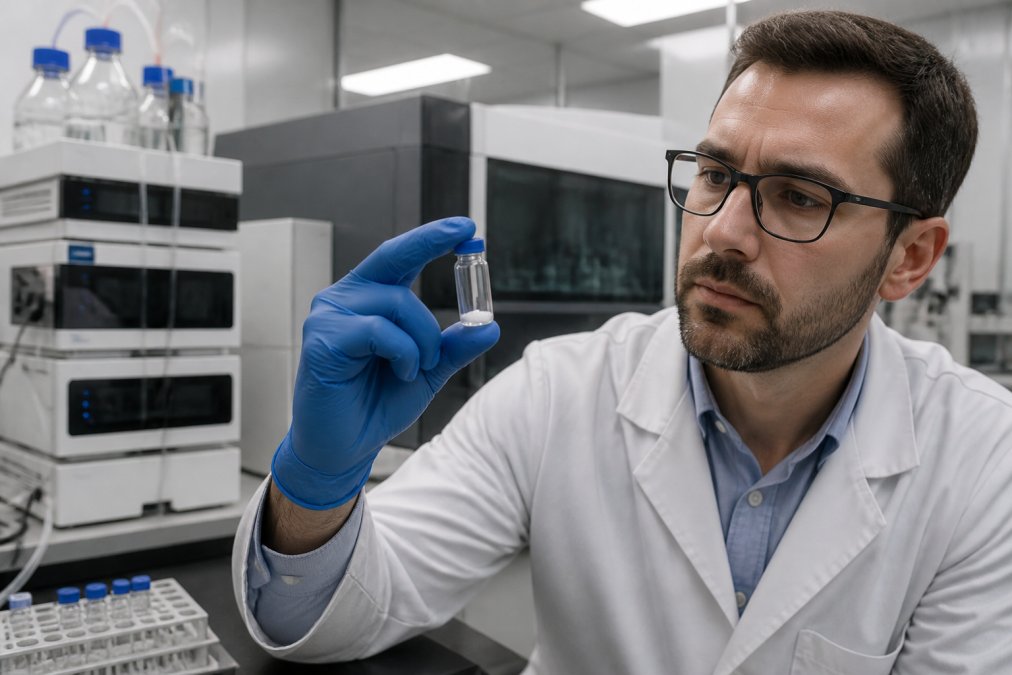
1. FROPeptides: Best for Batch-Verified, Ready-Inventory Research Peptides
FROPeptides is a strong option for academic researchers who need high-purity, analytically documented peptides without the lead times of custom synthesis. Every batch undergoes multi-stage HPLC testing and mass spectrometry verification, with a Certificate of Analysis included per batch.
Principal investigators and research associates who need 99%+ purity peptides with full analytical documentation for molecular assays, proteomics, or biochemical studies, and cannot afford backorders disrupting active protocols.
The practical differentiator: FROPeptides maintains ready inventory, helping to eliminate backorder delays that disrupt research timelines. Batch-level traceability from sourcing to packaging ensures the documentation trail required for publication-quality research is in place. Temperature-controlled storage and secure packaging maintain compound stability through dispatch.
For higher-volume orders, cost efficiency improves, relevant for labs running multiple active projects. Free delivery applies on orders over $200. Visit fropeptides.com for current pricing and catalog availability.
What works: 99%+ HPLC-verified purity, mass spectrometry confirmation, CoA per batch, no backorders, temperature-controlled handling, volume pricing.
What to know: Pricing is quote-based for volume orders; contact directly for bulk program details.
2. Custom Synthesis Providers: Best for Specialized Sequences and Modifications
Custom peptide synthesis is the right choice when your research requires a specific amino acid sequence not available in standard catalogs, or when you need modifications like phosphorylation, acetylation, biotinylation, cyclization, fluorescent dye labeling, or stable isotope incorporation.
The tradeoff is turnaround time. Custom synthesis typically runs two to three weeks for standard sequences under 30 amino acids, longer for complex modifications. For researchers planning ahead, this is manageable; for labs in active experimental phases, it introduces scheduling risk.
Strong custom synthesis providers offer synthesis yield documentation, confirmation of N-terminal and C-terminal modifications, trifluoroacetic acid content reporting, and peptide library synthesis capability for alanine scanning studies.
As documented in NIH guidance on peptide reagent quality, TFA counterion removal is frequently overlooked but affects downstream cell culture assay results.
Do not assume TFA removal is standard. High TFA content in peptide preparations can produce cytotoxic effects in cell-based assays, invalidating results without an obvious cause.
3. Large-Scale GMP-Capable Suppliers: Best for Preclinical and Drug Discovery Scale-Up
For research programs transitioning from discovery-phase assays to preclinical studies, GMP-capable suppliers become relevant. These providers operate FDA-inspected manufacturing suites and produce clinical-grade documentation.
Clinical-grade peptides require current Good Manufacturing Practice documentation, batch release records, and regulatory-ready CoAs that satisfy FDA submission requirements. For most academic labs, GMP-capable suppliers are unnecessary. They’re the right choice when your research feeds a drug discovery pipeline, when producing neoantigen peptides for immunotherapy studies, or when your institution requires clinical-grade documentation for licensing.
Supplier Comparison: Key Metrics for Evaluating Peptide Suppliers
| Supplier Type | Purity Level | CoA Per Batch | Custom Modifications | Best For | Lead Time |
|---|---|---|---|---|---|
| FROPeptides | 99%+ HPLC/MS verified | Yes, every order | Catalog-based | Reproducible lab assays | Ready inventory |
| Custom synthesis providers | 95-99%+ | Yes, per synthesis | Extensive | Novel sequences, modified peptides | 2-4 weeks |
| GMP-capable suppliers | Clinical-grade | Yes, regulatory-ready | Available | Drug discovery, preclinical scale | 4-12 weeks |
For labs running multiple concurrent projects, use ready-inventory suppliers like FROPeptides for standard research peptides and reserve custom synthesis for sequences requiring bespoke work. This reduces average lead time without sacrificing quality.
How to Read a Peptide Certificate of Analysis
A Certificate of Analysis documents analytical results for a specific production lot. Reading it correctly is essential for anyone responsible for compound sourcing.
HPLC Chromatogram and Purity Percentage
The HPLC chromatogram shows detector response as the peptide and impurities are separated by the column. Purity is calculated as the target peak area divided by total peak area, expressed as a percentage.
Check that the baseline is flat between peaks, indicating good separation. A broad target peak with shoulders suggests co-eluting impurities. A purity figure above 99% with a clean, symmetrical peak is the benchmark for sensitive assay work.
The analytical method should state column type, mobile phase, gradient, and detection wavelength. For peptides lacking aromatic amino acids, 214 nm is the correct detection wavelength.
Mass Spectrometry and Molecular Weight Verification
Mass spectrometry confirms the molecular weight of the synthesized compound, verifying that the correct amino acid sequence was assembled. The observed mass should match the theoretical molecular weight within the instrument’s mass accuracy tolerance.
A mass shift of 18 Da suggests incomplete deprotection or hydrolysis. A mass shift of 1 Da may indicate deamidation of asparagine or glutamine residues.
A CoA showing only purity percentage without a mass spectrum is incomplete. Both analytical methods are required to confirm identity and purity.
TFA Content, Amino Acid Sequence, and Lot Traceability
The CoA should state whether TFA removal was performed and report residual TFA content. The lot number on the CoA must match the lot number on the vial label. Cross-check the lot number, synthesis date, and expiry date on every order.
For peer-reviewed publication, report the supplier name, catalog number, lot number, and purity. A CoA documenting all of these per batch is what you need.
Research Peptide Storage and Handling Best Practices
Proper storage and handling directly determines whether the analytical purity you paid for survives to your assay.
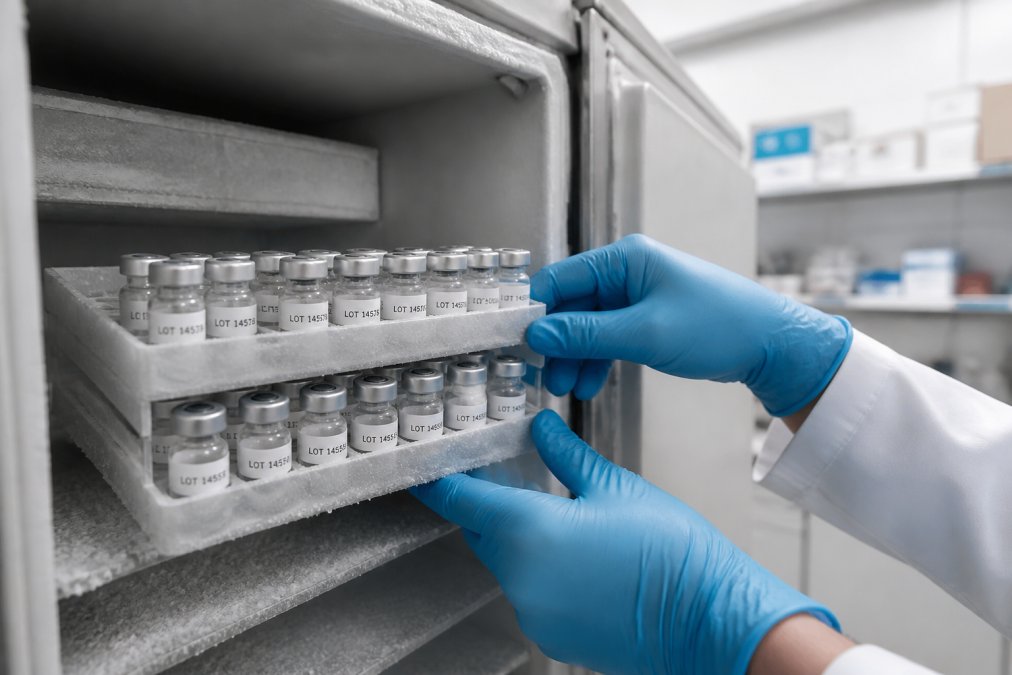
Lyophilized Peptide Storage Conditions
Lyophilized peptides are stable in their dry, powder form at temperatures between -20°C and -80°C when protected from moisture and light. Lyophilization removes water to extend shelf life and maintain compound integrity, but does not make peptides indestructible.
Standard storage recommendations from USP guidelines on biological reagent storage:
- Store at -20°C for general research use; -80°C for long-term archiving or peptides containing methionine, cysteine, or tryptophan residues prone to oxidation
- Keep vials sealed and desiccated until use
- Allow vials to equilibrate to room temperature before opening to prevent condensation
- Record the date of first opening on the vial label
Reconstitution, Aliquoting, and Freeze-Thaw Cycles
Reconstitution solvent choice depends on the peptide’s physicochemical properties. Hydrophilic peptides typically dissolve in water or aqueous buffer. Hydrophobic sequences often require initial dissolution in a small volume of acetonitrile, DMSO, or dilute acetic acid before aqueous dilution.
Aliquoting into single-use volumes immediately after reconstitution is strongly recommended. Each freeze-thaw cycle can degrade peptide integrity, particularly for sequences containing oxidation-sensitive residues.
Practical aliquoting protocol:
- Reconstitute in the minimum volume of appropriate solvent to create a concentrated stock
- Divide into single-use aliquots at the target working concentration
- Label each aliquot with peptide name, lot number, concentration, reconstitution date, and solvent
- Store aliquots at -80°C; use within 6 months of reconstitution
Supply Chain Transparency and Sourcing Ethics
Supply chain transparency goes beyond whether a supplier can produce a CoA. It asks where starting amino acids came from, what reagent grade was used, and how the synthesis environment was controlled.
Reagent grade matters. Research-grade amino acid building blocks from verified suppliers can produce more consistent synthesis outcomes than commodity-grade materials. Many suppliers do not disclose raw material sourcing, making it challenging to evaluate lot-to-lot consistency risk at the source.
Ask any supplier: “Can you provide documentation of your raw material sourcing and reagent grade specifications for this lot?” A supplier who cannot answer is telling you something important about their quality management system.
Standard operating procedures and quality assurance documentation should be available on request. Suppliers operating with documented SOPs for synthesis, purification, lyophilization, QC testing, and packaging are structurally less likely to produce inconsistent batches.
Troubleshooting Common Peptide Synthesis and Quality Challenges
Even with a reliable supplier, synthesis challenges can produce compounds that underperform in assay conditions.
Low synthesis yield on long sequences: Peptides over 30 amino acids are significantly harder to synthesize at high purity. Incomplete coupling produces truncated sequences that co-elute with the target. If your CoA shows multiple peaks of similar area, consider requesting a resynthesis.
Poor solubility: Hydrophobic sequences and aggregation-prone peptides often show poor aqueous solubility. Solutions include using chaotropic solvents for initial dissolution, adding solubility-enhancing tags, or requesting the peptide as a salt form rather than TFA salt.
Unexpected activity in cell-based assays: If your peptide produces unexpected results in cell culture that don’t replicate in cell-free biochemical assays, TFA contamination is a primary suspect. Request TFA content data and consider requesting TFA-free preparation.
Oxidized methionine or cysteine residues: Oxidation during storage shifts molecular weight by 16 Da per oxidized residue. Use freshly prepared reducing agent in your reconstitution buffer, store under argon or nitrogen, and minimize air exposure.
As detailed in ACS guidance on peptide handling and stability, proper reconstitution and storage protocols are as critical to experimental reproducibility as synthesis quality itself.
The challenge for most research labs is finding a peptide supplier whose documentation holds up under peer review scrutiny and whose quality is consistent across a full research program. FROPeptides addresses this directly: 99%+ HPLC and mass spectrometry-verified purity, a Certificate of Analysis with every batch, batch-level traceability from sourcing to packaging, and ready inventory that helps eliminate backorder delays. Shop Now at fropeptides.com to review the current catalog and request volume pricing for your lab’s active projects.
=== FAQ ANSWERS (audit these too, same rules) ===
Frequently Asked Questions
Q: What criteria should labs use to verify peptide purity?
A: The two non-negotiable methods are high-performance liquid chromatography (HPLC) and mass spectrometry. HPLC measures analytical purity as a percentage by detecting impurities in the amino acid sequence profile, while mass spectrometry confirms molecular weight and sequence accuracy. For most biochemical assays and proteomics work, suppliers should provide 98%+ purity with both data sets included in the Certificate of Analysis. Anything below 95% purity can introduce variability into sensitive molecular analysis protocols.
Q: Why is a Certificate of Analysis essential for research peptides?
A: A CoA is the primary document linking a specific peptide batch to its verified quality data. For academic research, it provides the evidence needed to support peer-reviewed publication, confirm lot-to-lot consistency across experiments, and satisfy institutional compliance requirements. A complete CoA should include HPLC chromatogram data, mass spectrometry results confirming molecular weight, trifluoroacetic acid content, synthesis yield, and full lot traceability from raw reagent grade materials through final packaging.
Q: What are the standard storage requirements for lyophilized research peptides?
A: Lyophilized synthetic peptides should be stored at -20°C or colder in a desiccated environment, away from light and moisture. Most research-grade peptides remain stable for several years under these conditions. Once reconstituted, aliquot immediately to avoid repeated freeze-thaw cycles, which can degrade compound integrity. Peptides containing cysteine, methionine, or multiple disulfide bonds require particular care and should be stored under inert gas or with reducing agents depending on the specific amino acid sequence.
Q: How do I distinguish between clinical-grade and research-grade peptide suppliers?
A: Research-grade suppliers provide peptides verified for use in laboratory studies, biochemical assays, drug discovery screening, and proteomics, with CoA documentation confirming purity and identity. Clinical-grade or GMP suppliers operate under FDA-regulated current Good Manufacturing Practice standards, with full regulatory documentation, validated standard operating procedures, and audit trails required for human use. For most academic research and preclinical applications, research-grade peptides with rigorous validation are appropriate and can be more cost-efficient.
Q: What is the best website to buy research peptides in the USA?
A: The best source depends on your specific research requirements. FROPeptides is a strong option for academic researchers needing ready-inventory, batch-verified peptides with 99%+ purity confirmed by HPLC and mass spectrometry, CoA documentation for every order, and temperature-controlled handling. For custom peptide synthesis with specialized modifications or longer sequences, dedicated custom synthesis providers offer tailored services. Always prioritize suppliers that provide validated CoAs, clear lot traceability, and documented solubility testing for your target application.