
Lyophilized Peptides in Cell Culture: Benefits & Best Practices
Table of Contents
- Why Lyophilized Peptides Matter for Cell Culture Research
- How Freeze-Drying Removes Water and Stabilizes Peptide Structure
- Lyophilized vs. Reconstituted Peptides: Stability and Storage Differences
- How to Reconstitute Lyophilized Peptides for Cell Culture Applications
- Lyophilized Peptide Storage: Temperature, Light, and Humidity Control
- Preventing Degradation: Hydrolysis, Oxidation, and Chemical Stability
- Quality Control and Batch-to-Batch Consistency for Reproducible Results
- Practical Considerations: Handling, Shelf Life, and Experimental Validation
- Frequently Asked Questions
Last Updated: October 10, 2026
Why Lyophilized Peptides Matter for Cell Culture Research
Lyophilized peptides cell culture applications rely on freeze-dried compounds that remove water while preserving the peptide’s chemical structure. This preservation extends shelf life, improves stability, and simplifies storage for research teams working with sensitive biological materials. Cell culture research demands consistent, batch-to-batch material performance. Lyophilized peptides remain stable for months or years when stored correctly, whereas liquid peptides degrade within weeks. This difference directly impacts experimental reproducibility and data quality.
Store lyophilized peptides in airtight vials at -20°C or below immediately upon arrival. Even a few hours at room temperature can begin degradation, especially in humid environments.
How Freeze-Drying Removes Water and Stabilizes Peptide Structure
Freeze-drying works by first freezing the peptide solution, then removing water through sublimation under vacuum. The ice turns directly into vapor without passing through a liquid phase, preserving the peptide’s three-dimensional structure far better than other drying methods. Water drives hydrolysis, a chemical reaction where water molecules break peptide bonds. Remove the water, and you eliminate the primary degradation mechanism. The freeze-drying process happens in three stages: freezing at very low temperatures, vacuum removal of ice, and secondary drying to pull away residual moisture.
Lyophilized vs. Reconstituted Peptides: Stability and Storage Differences
Lyophilized peptides are dry powders; reconstituted peptides are dissolved in solution. A lyophilized peptide remains stable for years in proper storage, while a reconstituted peptide typically stays stable for days to weeks. Once you add solvent, you reintroduce water, which restarts the degradation clock. This stability gap makes lyophilized peptides the smart choice for labs that don’t use peptides immediately. Lyophilized peptides can be stored at -20°C or even room temperature for short periods if kept dry and protected from light. Reconstituted peptides must stay refrigerated at 2-8°C and degrade faster. This flexibility in storage is one reason research labs choose lyophilized peptides for their cell culture workflows.
Lyophilized peptides maintain their chemical stability for months to years. Reconstituted peptides degrade within days to weeks. Choose lyophilized when long-term storage or batch consistency matters.
How to Reconstitute Lyophilized Peptides for Cell Culture Applications
Reconstituting a lyophilized peptide correctly is essential to preserve activity and ensure accurate dosing in your cell culture experiments. A poorly executed reconstitution can introduce variability that undermines experimental reproducibility.
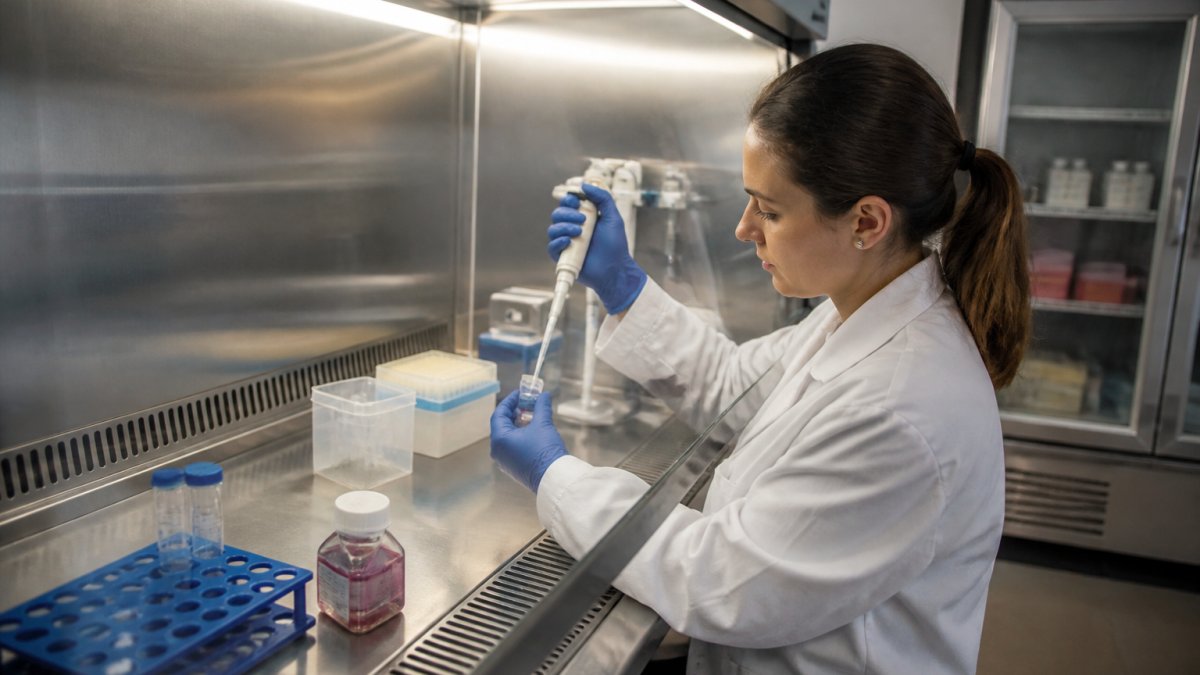
Step-by-Step Reconstitution Protocol
Step 1: Prepare your workspace. Work in a biosafety cabinet or clean bench with minimal air disturbance.
Step 2: Calculate the volume you need. Determine your target concentration before opening the vial.
Step 5: Verify complete dissolution. After the rest period, inspect the vial visually. The solution should be clear or slightly colored.
Step 6: Aliquot into smaller vials. Once fully dissolved, divide the stock solution into smaller working aliquots (typically 100-500 µL per tube).
Step 7: Label and store immediately. Label each aliquot with the peptide name, concentration, lot number, reconstitution date, and your initials.
Choosing the Right Solvent and Cell Culture Media
The solvent you select affects both peptide solubility and cell behavior. Sterile water works for most hydrophilic peptides but lacks buffering capacity. Phosphate-buffered saline (PBS) maintains pH around 7.4 and provides osmotic balance, making it ideal for pH-sensitive peptides. Cell culture media (DMEM, RPMI, or your specific formulation) is often the best choice because your cells are already adapted to that media’s pH, osmolarity, and composition.
For hydrophobic peptides that resist dissolution in aqueous solvents, add dimethyl sulfoxide (DMSO) at 5-10% (v/v) or ethanol at similar concentrations. Do not exceed 10% organic solvent unless your preliminary data confirms that your cells tolerate higher concentrations.
Concentration Calculations and Dosing Examples
Accurate concentration calculations are the foundation of reproducible dosing. Use this formula:
Final concentration (mg/mL) = Peptide mass (mg) ÷ Solvent volume (mL)
Or, if working in molarity:
Final concentration (µM) = [Peptide mass (mg) × 1000] ÷ [Molecular weight (g/mol) × Solvent volume (mL)]
Example: You receive a vial labeled 10 mg of lyophilized peptide and want a 1 mg/mL stock solution. Divide 10 mg by 1 mg/mL to get 10 mL. Add 10 mL of sterile PBS to the vial. After 20 minutes of gentle mixing, you have a 1 mg/mL stock.
Always document your calculations in a lab notebook or electronic record. Include the vial mass, solvent volume, final concentration, molecular weight (if applicable), and the date.
Common Reconstitution Pitfalls and How to Avoid Them
Incomplete dissolution leads to incorrect concentration calculations and under- or over-dosing. Always allow adequate time (15-60 minutes) and verify visually that no particles remain.
Osmotic stress occurs when concentrated peptide solutions are added directly to culture media. Always dilute peptide stocks gradually or pre-equilibrate the peptide solution to match media osmolarity.
Adsorption to plasticware affects hydrophobic peptides. Use low-binding or siliconized plasticware for reconstitution and storage.
Oxidation during reconstitution introduces oxygen, which oxidizes methionine and cysteine residues. Mix gently, minimize headspace in vials, and store under inert atmosphere if your peptide is oxidation-sensitive.
Prepare a master stock at high concentration (e.g., 10 mg/mL), then create working dilutions as needed. This approach minimizes freeze-thaw cycles on your main stock and reduces contamination risk.
Lyophilized Peptide Storage: Temperature, Light, and Humidity Control
Temperature is the primary factor in peptide storage stability. Keep lyophilized peptides at -20°C or colder. Some labs use -80°C for ultra-long-term storage, which extends stability further. Light degrades peptides through oxidation; store vials in dark containers or wrap them in foil. Humidity is your third enemy, lyophilized peptides must stay dry. Keep vials sealed until ready to use. Temperature fluctuations matter more than you might think; each freeze-thaw cycle stresses peptide bonds. Minimize how often you remove vials from storage by aliquoting into smaller vials so you only thaw what you need.
Preventing Degradation: Hydrolysis, Oxidation, and Chemical Stability
Hydrolysis is the primary degradation pathway for peptides in solution. Water molecules attack peptide bonds, breaking them apart. Removing water through lyophilization prevents hydrolysis. Oxidation is the second major threat; oxygen reacts with amino acids, particularly methionine and cysteine, changing the peptide’s structure. Store peptides under inert atmosphere when possible, or in sealed, airtight containers.
pH affects peptide stability significantly. Extreme acidity or alkalinity accelerates hydrolysis. If you reconstitute peptides, use buffered solutions that maintain pH between 6.5 and 8.0. Temperature accelerates all chemical reactions, including degradation. Every 10°C increase roughly doubles the degradation rate, which is why -20°C storage is standard.
Reconstituted peptides left at room temperature degrade rapidly, sometimes losing 50% activity within 24-48 hours. Always refrigerate reconstituted solutions immediately after preparation.
Quality Control and Batch-to-Batch Consistency for Reproducible Results
Reproducibility in cell culture depends on materials that perform consistently from batch to batch. A peptide that works perfectly in one experiment but shows reduced activity in the next introduces noise that obscures real biological effects.
Understanding Peptide Quality Metrics
When you receive a lyophilized peptide, the supplier should provide a Certificate of Analysis (CoA) documenting key quality parameters.
Purity (HPLC). High-performance liquid chromatography measures the percentage of your target peptide versus impurities.
Identity (mass spectrometry). Mass spectrometry confirms that the peptide’s molecular weight matches the expected sequence.
Water content (Karl Fischer titration). Lyophilized peptides should contain minimal residual water, typically less than 5% by weight.
Endotoxin level (LAL assay). For cell culture work, endotoxin contamination matters. Endotoxins trigger cell inflammatory responses at nanogram-per-milliliter concentrations.
Sterility. Suppliers should perform sterility testing (bacterial and fungal culture) on representative samples. A CoA should state “Sterile” or provide specific culture results.
Interpreting and Comparing Certificates of Analysis
When you receive a new batch, compare its CoA to your historical data from previous batches. Look for consistency in purity, mass, and water content. Small batch-to-batch variations (±2-3% in purity) are normal. Larger shifts warrant investigation. Check the lot number on the CoA and ensure it matches the lot number on your vial.
Validating a New Batch Before Full-Scale Experiments
Before committing a new batch to a major study, run a small pilot experiment to confirm that it performs as expected.
Dose-response experiment. Prepare a serial dilution of your new batch (e.g., 0.1, 1, 10, and 100 µM) and apply it to your cells. Measure your endpoint and compare the dose-response curve to historical data.
Stability check over time. Reconstitute a small aliquot and store it at -20°C. Test its activity at day 0, day 7, and day 14. Activity should remain above 90% of the initial level.
Addressing Batch-to-Batch Variability
Use a reference standard. Designate one batch as your reference standard, store it carefully at -80°C, and use it sparingly for dose-response curves and positive controls.
Include positive and negative controls in every experiment. Use a well-characterized positive control and a negative control (vehicle only) in every experiment.
Document everything. Record the lot number, purchase date, CoA data, reconstitution date, storage conditions, and performance in your assays for every batch.
Working with Supplier Quality Assurance
Reputable peptide suppliers maintain rigorous quality control and are willing to work with you if a batch does not meet expectations. Build a relationship with your supplier’s technical support team and share your quality expectations upfront. Some suppliers offer custom quality tiers (e.g., “cell culture grade” with endotoxin testing and higher purity standards) at a modest premium.
Always review the Certificate of Analysis, validate new batches with a small pilot experiment, and document batch performance over time. This discipline ensures that your results reflect real biology, not batch-to-batch variability.
Practical Considerations: Handling, Shelf Life, and Experimental Validation
Proper handling protects peptide integrity from the moment you receive them. Open vials in a biosafety cabinet when possible. Minimize exposure to air and light. Use sterile technique to prevent contamination. Shelf life for lyophilized peptides typically ranges from one to three years under ideal storage conditions (-20°C, protection from light, low humidity). Check your peptides visually before use; discoloration or clumping suggests degradation has begun.
Experimental validation confirms that your peptides work as expected. Run a dose-response curve with a new batch and compare results to historical data. Small variations are normal, but large shifts suggest a problem. Before starting a major project, confirm that your peptide source delivers consistent results.
Frequently Asked Questions
What is the purpose of lyophilization for peptides used in cell culture?
Lyophilization removes water from peptides while preserving their molecular structure, extending shelf life and preventing degradation from hydrolysis and oxidation. For cell culture work, this means peptides remain stable at room temperature during shipping and storage, arrive at your lab in optimal condition, and maintain consistent potency across experiments. The freeze-drying process also eliminates solvent-related complications and allows for precise dosing when you reconstitute the peptide in your specific cell culture media.
How should lyophilized peptides be stored before reconstitution?
Store lyophilized peptides in a cool, dry place away from direct light. Use airtight, desiccated vials and keep them in a dark container or cabinet to block UV exposure. Maintain humidity below 40% to prevent moisture reabsorption.
How do you reconstitute a lyophilized peptide for use in cell culture?
Reconstitute lyophilized peptides using sterile, pH-buffered solvents or your specific cell culture media to achieve your target concentration. Thaw the vial at room temperature or on ice, then add the solvent slowly while gently mixing to avoid foaming or aggregation. Allow 10-15 minutes for complete dissolution. Calculate your exact concentration using the peptide’s molecular weight and the vial’s stated purity (from the Certificate of Analysis). Pipette carefully and maintain sterile technique throughout to prevent contamination and ensure reproducible results across your experimental replicates.
Can lyophilized peptides improve consistency in cell culture experiments?
Yes. Lyophilized peptides provide batch-to-batch consistency because freeze-drying preserves the exact molecular composition and removes variables introduced by liquid storage or solvent degradation. Each vial contains a known, stable mass of pure peptide, allowing precise dosing and reproducible experimental conditions. Multi-stage HPLC and mass spectrometry verification (standard for research-grade suppliers) confirms purity and identity for every batch, eliminating the variability that can arise from older liquid stocks or unverified sources. This consistency is critical for peer-reviewed publications and regulatory-grade research.
Lyophilized peptides deliver the stability and consistency cell culture research demands. Proper reconstitution, storage, and handling preserve peptide activity across months and years. When reproducibility matters, lyophilized peptides are the reliable choice. Get started with FROPeptides and access research-grade peptides with multi-stage HPLC verification backed by batch-level traceability and Certificates of Analysis for every order.