How to Assess Peptide Synthesis Yield Accurately
Table of Contents
- Step 1: Calculate the Theoretical Yield Before You Touch the Resin
- Step 2: Measure Crude Yield and Determine Peptide-Specific Yield
- Step 3: Use Peptide Purity Analysis Methods to Validate Yield
- Step 4: Account for Purification Recovery and Salt Content
- Factors Affecting Solid Phase Peptide Synthesis Yield
- Common Mistakes That Skew Peptide Synthesis Yield Calculations
- Frequently Asked Questions
Last Updated: September 26, 2026
Step 1: Calculate the Theoretical Yield Before You Touch the Resin
Peptide synthesis yield starts before any reagent is weighed. The theoretical yield is the maximum amount of peptide your resin could produce, and every later calculation depends on it.
The Theoretical Yield Formula for SPPS
The theoretical yield formula for solid phase peptide synthesis is simple: resin loading (mmol/g) × resin mass (g) × peptide molecular weight (g/mol) = theoretical yield in milligrams, assuming a 1:1 scale. Resin loading is the millimoles of reactive sites per gram; resin mass is the dry weight you used; molecular weight is the finished peptide’s mass, not the starting material.
Resin Loading and Its Effect on Maximum Yield
Resin loading sets the hard ceiling on peptide synthesis yield: a resin rated at 0.5 mmol/g can never deliver more than 0.5 mmol of peptide per gram, no matter how clean your coupling runs. Two factors shrink that ceiling: substitution errors during first amino acid attachment and moisture uptake that adds weight without adding reactive sites.
Weighing resin that has absorbed atmospheric moisture inflates your mass reading. You will calculate a theoretical yield that is physically impossible to reach, then spend hours chasing a loss that never happened.
Step 2: Measure Crude Yield and Determine Peptide-Specific Yield
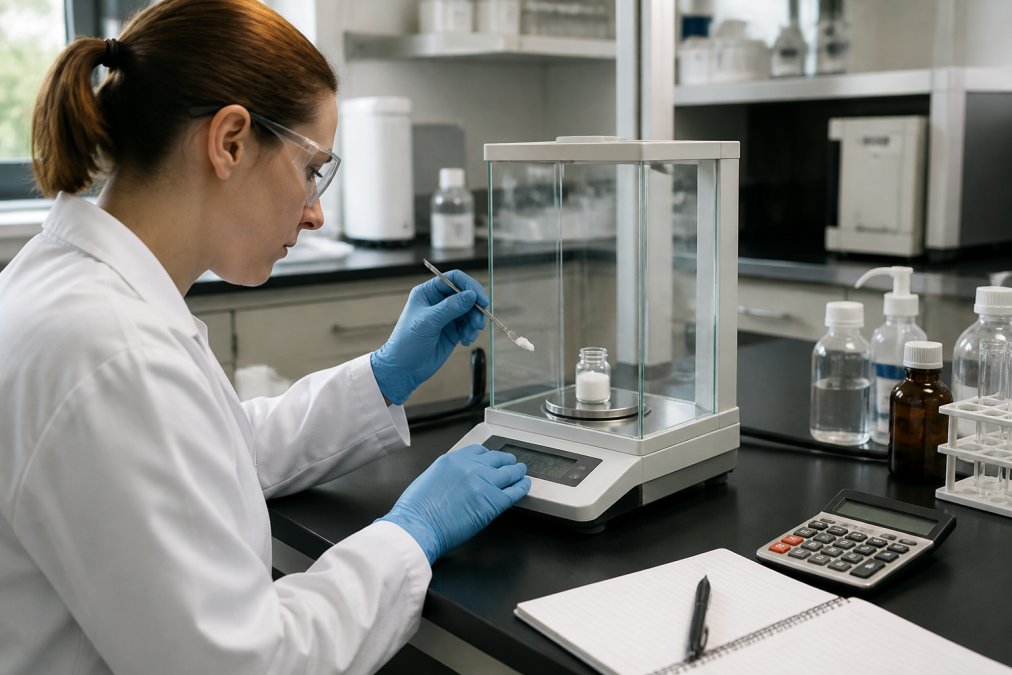
Theoretical yield is the target; crude yield is what you collect after cleavage, and the gap shows how much the synthesis cost you. Weigh the lyophilized crude powder on an analytical balance and record the mass in milligrams, that number includes target peptide, deletion sequences, truncated chains, and leftover salts.
Crude Yield vs. Peptide-Specific Yield
Crude yield is the total mass recovered; peptide-specific yield is the mass of your target sequence alone, and it is always lower. Crude yield flatters bad syntheses, a reaction full of truncated sequences can still produce a heavy powder. To find peptide-specific yield, multiply crude yield by the HPLC purity fraction: a 200 mg crude sample at 70% purity holds 140 mg of target peptide.
Report peptide-specific yield, not crude yield. Crude mass tells you how much powder you made. Peptide-specific yield tells you how much product you made.
Step 3: Use Peptide Purity Analysis Methods to Validate Yield
Purity data converts crude mass into a real number. Two peptide purity analysis methods do most of the work: RP-HPLC for quantity and mass spectrometry for identity.
RP-HPLC and Peak Integration
Reverse-phase HPLC separates your target peptide from its by-products; the target elutes as a distinct peak, and peak integration gives the percentage of total signal it represents. Run a shallow gradient to resolve close-eluting deletion sequences, use a wavelength that captures the peptide backbone (typically 214 nm), and check retention time against a standard when available.
Mass Spectrometry for Identity Confirmation
Mass spectrometry confirms the peak you integrated is actually your peptide: it reports molecular weight, which must match your calculated sequence mass. A mismatch reveals a problem, higher mass suggests incomplete side-chain deprotection, lower mass points to truncation or deletion, and multiple species indicate a mixed product.
Step 4: Account for Purification Recovery and Salt Content
Purification is where most reported yields quietly go wrong. Preparative RP-HPLC removes impurities and target peptide together, and the mass you recover is almost always a fraction of the crude you loaded. Recording that fraction is the difference between a defensible yield number and one you cannot defend.
Track Recovery as a Percentage, Not a Mass
Recovery is the mass of purified, target-containing peptide you collect divided by the peptide-specific mass you loaded onto the column, expressed as a percentage. Worked example:
- Crude powder weighed: 200 mg
- HPLC purity of that crude: 70%
- Peptide-specific mass loaded: 200 mg × 0.70 = 140 mg
- Purified pool collected and lyophilized: 84 mg
- Recovery: 84 mg ÷ 140 mg = 60%
The Yield vs. Purity Trade-off Nobody Quantifies
Pushing crude purity from, say, 85% to 99% is not free, it costs mass. Every additional percentage point of purity is bought by discarding fractions that contain target peptide alongside the impurity you are chasing. A common pattern:
- A wide pool at ~90% purity might recover 70% of peptide-specific mass
- A tight pool at ~98% purity from the same run might recover 45%
- The difference, 25 percentage points of mass, is target peptide thrown away to gain 8 points of purity
Recovery and purity are a single decision, not two independent measurements. State the purity target first, then report the recovery achieved at that target. A yield quoted without its purity specification is not comparable to anything.
Correct for Counter-Ion Salt Content
Lyophilized peptides are rarely pure peptide. They arrive as salts, most often trifluoroacetate (TFA) from the HPLC mobile phase or acetate from ion exchange. The counter-ion adds mass that is not peptide, and if you weigh it, you overstate yield. Two correction routes:
- Counter-ion correction factor. Multiply the weighed mass by the peptide fraction implied by the salt form. A peptide carrying multiple TFA counter-ions can have a peptide content well below the weighed mass, so the factor is sequence- and charge-dependent, not a fixed constant.
- Quantitative amino acid analysis (AAA). Hydrolyze the sample, quantify the amino acids, and back-calculate peptide content directly. This is the reference method when the number has to survive scrutiny.
A vial labeled “25 mg” is 25 mg of powder, not 25 mg of peptide. If peptide content is 80%, you have 20 mg of peptide. Comparing vials by label mass across suppliers with different salt forms produces a yield comparison that is meaningless.
Put Recovery and Salt Correction in One Chain
The full yield chain, in order, is: theoretical yield → crude mass → peptide-specific crude mass (crude × crude purity) → purified mass → peptide-specific purified mass (purified × purified purity × peptide content). Each step is a multiplication that can only reduce the number; if any step increases the total, you have made an error.
Build the recovery and salt correction into the same calculation sheet as the theoretical yield. When every batch runs the identical chain, a bad recovery or an uncorrected salt form shows up as an outlier immediately instead of hiding inside a plausible-looking final number.
Factors Affecting Solid Phase Peptide Synthesis Yield
Yield loss is not random. It concentrates in predictable places, most importantly sequence-level failure modes and how efficiency changes when you scale up.
Coupling Efficiency and Double Coupling
Every coupling that does not go to completion leaves truncated chains on the resin. Those chains are unrecoverable, they cannot be extended later, and they drag down peptide-specific yield even when crude mass looks healthy. Double coupling, running the coupling twice at a difficult position, rescues yield at sterically hindered residues, but it costs reagent and time, so it is applied selectively.
- Coupling reagent choice affects activation speed and racemization risk. Uronium-type reagents activate quickly but can racemize at hindered residues; phosphonium-type reagents are slower but more forgiving.
- Amino acid concentration must stay high enough to drive the reaction to completion before the activated species hydrolyzes.
- Reaction time must be long enough for full conversion at that specific residue, not for the average residue in the sequence.
- Base strength and equivalents control the deprotonation step that gates coupling.
Sequence-Dependent Aggregation and Solvent Environment
Some sequences aggregate on the resin and block reagent access. Hydrophobic stretches and beta-sheet-prone regions are the usual suspects; once chains pack together, coupling efficiency drops sharply and no amount of extra reagent fully recovers it. DMF and DCM remain the standard carriers. Adding a chaotropic agent or switching solvents can break up aggregation, and running couplings at elevated temperature can improve penetration into aggregated regions, at the cost of increased racemization risk at sensitive residues.
Ignoring sequence-dependent aggregation produces a synthesis that looks fine on paper and fails at analysis. Crude yield may look acceptable while peptide-specific yield collapses, because most of the mass is truncated sequence. The failure is sequence-specific, so a protocol that works for one peptide can fail for the next with no change in reagents.
Scale-Up: Where Yield Assessment Changes Character
A protocol optimized at milligram scale does not transfer linearly to gram or kilogram scale, and the yield you measure at lab scale is not the yield you will get at pilot scale. What changes as you scale:
- Mixing and mass transfer. Larger reactors have slower diffusion and less uniform reagent distribution. Coupling that was complete in a small vessel may be incomplete in a large one, and the loss shows up as a lower peptide-specific yield, not a visible failure.
- Resin swelling and bed height. Swelling behavior and packed-bed height change with reactor geometry, which changes reagent access to interior resin sites.
- Reagent stoichiometry. Excess reagent that was cheap at milligram scale becomes a cost and purification burden at kilogram scale, so equivalents are often reduced, and reduced equivalents lower coupling efficiency at hard positions.
- Heat and cooling. Exothermic activation and coupling steps that were trivial to control in a small vessel become thermal management problems at scale, and temperature excursions drive side reactions.
- Purification loading. Preparative HPLC loading capacity does not scale linearly with crude mass, so recovery percentage often drops at larger scale even when synthesis efficiency is unchanged.
A Yield-Loss Budget
Professionals account for yield loss as a budget rather than a single number. A typical breakdown assigns loss to:
- Incomplete couplings at hard positions
- Aggregation-limited couplings in hydrophobic regions
- Cleavage and side-chain deprotection losses
- Purification recovery at the chosen purity target
- Salt and counter-ion mass that is not peptide
Record the yield-loss budget for every batch, even when the batch meets specification. The batches that meet spec are your baseline; when a later batch misses, the difference between its budget and the baseline localizes the problem in minutes instead of days.
Common Mistakes That Skew Peptide Synthesis Yield Calculations
| Mistake | Effect on Yield | Fix |
|---|---|---|
| Weighing wet resin | Inflates theoretical yield | Dry resin fully before weighing |
| Reporting crude yield only | Overstates real product | Calculate peptide-specific yield |
| Ignoring salt content | Counts counter-ions as peptide | Apply counter-ion correction |
| Merging HPLC peaks | Overstates purity | Improve gradient resolution |
| Skipping mass confirmation | Unverified identity | Confirm molecular weight |
| Ignoring purification loss | Unrealistic final numbers | Track recovery percentage |
A few habits protect you:
- Record raw masses before any correction
- Keep a calculation template so every batch uses the same steps
- Compare peptide-specific yield across batches, never crude mass
- Note scale changes, because efficiency shifts as you scale up
Build a standardized calculation sheet that forces theoretical yield, crude mass, purity, recovery, and salt correction into one view. Teams that use a fixed template catch errors that freehand math hides.
FROPeptides supports this kind of rigor by providing multi-stage HPLC testing and mass spectrometry verification on every batch, with certificate of analysis documentation that lets you validate purity data against your own results.
Frequently Asked Questions
How do you calculate the theoretical yield of a peptide in SPPS?
Start with the initial resin loading (mmol/g) multiplied by the resin mass (g) to get the maximum mmol of peptide. Multiply by the peptide’s molecular weight to get theoretical mass. For example, 0.5 mmol/g resin with 1 g resin gives 0.5 mmol maximum. If the peptide molecular weight is 1500 Da, theoretical yield is 750 mg. This assumes 100% coupling efficiency, which never happens in practice.
What is the difference between crude yield and final purified yield?
Crude yield is the mass of lyophilized powder after cleavage from resin, before purification. It includes the target peptide, truncated sequences, and by-products. Final purified yield is the mass of peptide after RP-HPLC purification and lyophilization, and it reflects only the target sequence. The gap between them shows how much material was lost to purification, which often ranges from 30% to 60% depending on the sequence and method used.
How does HPLC analysis confirm peptide synthesis yield?
RP-HPLC separates the crude peptide mixture by hydrophobicity. The main peak represents your target peptide, and its peak area percentage gives purity. Multiply crude mass by purity percentage to get peptide-specific yield. For example, 100 mg crude at 70% HPLC purity equals 70 mg of actual peptide. Retention time and peak integration must be consistent across runs to trust the number. Mass spectrometry then confirms the main peak has the correct molecular weight.
What factors typically cause low peptide synthesis yield?
Common causes include incomplete coupling from steric hindrance, sequence-dependent aggregation during chain assembly, and side reactions from inadequate side-chain protection. Resin loading below the stated specification also caps your maximum yield. Solvent quality matters too: wet DMF or degraded DCM reduces coupling reagent activity. Double coupling at difficult positions and using fresh cleavage cocktails can recover yield. Tracking coupling efficiency at each step helps pinpoint where losses occur.
Peptide synthesis yield assessment rewards discipline more than cleverness. Record every mass, correct for salt and recovery, and confirm identity before you trust a number. When you need research-grade material with batch-level traceability, FROPeptides delivers lab-verified peptides backed by HPLC testing, mass spectrometry verification, and full certificate of analysis documentation. Get started with FROPeptides and build your yield calculations on a reliable foundation.