Is 98% Purity Good for Peptides? A 2026 Lab Guide
Table of Contents
- What 98% Purity Actually Means on a Certificate of Analysis
- HPLC Peptide Analysis: How Purity Gets Measured
- Peptide Synthesis Quality Control: Where Impurities Come From
- Research-Grade Peptide Specifications: What 95%, 98%, and 99% Purity Deliver
- When 98% Purity Is Good Enough (and When It Is Not)
- Storage, Reconstitution, and Degradation: Keeping 98% Purity at 98%
- Frequently Asked Questions
Last Updated: September 24, 2026
What 98% Purity Actually Means on a Certificate of Analysis
The short answer to “Is 98% purity good for peptides?” is that 98% purity means the peptide in your vial is 98% the target molecule and 2% everything else. That “everything else” matters far more than most researchers assume, and FROPeptides built its quality program around explaining exactly why.
A certificate of analysis (CoA) reports what an analytical method detected, not a guarantee of biological performance. The number reflects the ratio of your target peak to all other peaks in a chromatogram. It says nothing about what those other peaks are, whether they are truncated sequences, deletion products, or residual counterions, and whether they will interfere with your assay.
This distinction between a headline figure and a usable specification is where most sourcing decisions go wrong. Below, we break down what the number actually measures, how HPLC peptide analysis produces it, and when 98% is genuinely good enough for your work.
Purity vs. Net Peptide Content: The Number That Changes Everything
Purity describes the proportion of target peptide relative to other UV-absorbing species in the sample. Net peptide content describes how much of the vial’s physical mass is actual peptide versus water, salts, and counterions.
These are separate measurements, and a CoA can report high purity alongside a net content figure that surprises you.
Weighing out a peptide by mass and assuming the label purity equals the peptide content will skew your molar calculations. Always request the net peptide content figure alongside the purity percentage.
HPLC Peptide Analysis: How Purity Gets Measured
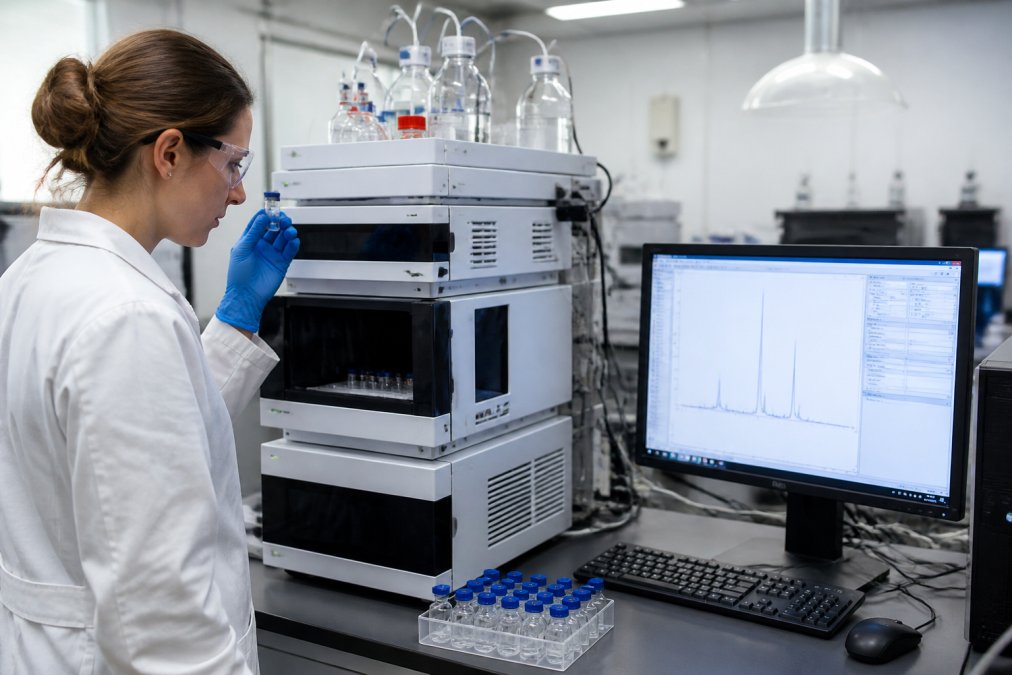
High-performance liquid chromatography separates the components of a sample based on how they interact with a stationary phase. The target peptide elutes at a characteristic retention time, and the area under that peak is compared to the total peak area. That ratio is your purity figure.
Reading the Chromatogram: What the Peaks Tell You
The main peak should be sharp and symmetric. Broad or split peaks suggest co-eluting impurities or degradation. Small peaks eluting before the main peak often indicate truncated sequences, while peaks after it can signal deletion products or aggregates.
Peptide Synthesis Quality Control: Where Impurities Come From
Every impurity in a peptide sample traces back to a specific step in synthesis. Solid-phase peptide synthesis builds chains amino acid by amino acid, and each coupling and deprotection cycle is an opportunity for incomplete reactions.
Truncated Sequences, Byproducts, and Counterion Effects
Truncated sequences are shorter versions of your target peptide, missing one or more residues. They often retain partial activity and can interfere with receptor binding studies. Deletion sequences are similar but involve an internal missing residue, which can change the peptide’s conformation entirely.
Research-Grade Peptide Specifications: What 95%, 98%, and 99% Purity Deliver
The purity threshold you choose is not a quality ranking, it is a statement about how much non-target material your assay can tolerate before the signal stops meaning what you think it means. The right specification depends on three variables: the sensitivity of your detection method, the dose you plan to administer, and whether the impurity fraction is likely to be biologically active.
| Purity Level | Typical Use Case | Key Consideration |
|---|---|---|
| 95% | Screening workflows, initial optimization, qualitative binding | Up to 5% non-target species; acceptable when you are ranking hits, not quantifying them |
| 98% | Standard in vitro assays, most research protocols, method development | 2% impurity fraction; the working standard because it balances analytical reliability against cost |
| 99% | In vivo studies, dose-response work, publication-grade data | Minimizes off-target contribution when the impurity itself may be bioactive |
Why 98% Became the Working Standard
98% is not a scientifically magic number. It is the threshold that most suppliers can hit reproducibly with reversed-phase HPLC purification while keeping cost and yield reasonable. Pushing from 98% to 99% often requires additional purification cycles that cut yield substantially, which is why the price step between those two grades is steeper than the step from 95% to 98%.
When the Threshold Actually Matters
The calculus changes with dose and route. A 2% impurity fraction in a 10 mg/kg in vivo dose delivers a meaningful mass of non-target peptide into a living system. If any of those impurities retain partial receptor activity, truncated sequences often do, they can shift your dose-response curve without any visible sign in the raw data.
If your assay shows unexplained batch-to-batch variability at 98% purity, run a side-by-side comparison with a 99% lot of the same sequence. If the variability disappears, the impurities were driving it, not your protocol.
The Specification You Should Actually Request
Purity percentage alone is an incomplete specification. Ask for the purity figure, the net peptide content, the identity confirmation method, and the chromatogram itself. A 98% pure peptide with 70% net content behaves very differently in molar calculations than a 98% pure peptide with 85% net content, even though the headline number is identical.
When 98% Purity Is Good Enough (and When It Is Not)
The honest answer to “Is 98% purity good for peptides?” is that the percentage alone cannot tell you whether 98% is good enough. What matters is what the other 2% is made of. Two peptides can both report 98% purity on a certificate of analysis and behave completely differently in your assay, because the chemical identity of the impurity fraction drives the biological outcome, not the number.
What the Remaining 2% Actually Contains
In solid-phase peptide synthesis, the impurity fraction is not random. It is a predictable mix of species that trace back to specific failure modes:
- Truncated sequences, shorter chains from incomplete coupling cycles. These often retain partial binding affinity because they still contain the active region of the peptide.
- Deletion sequences, chains missing an internal residue. These can fold differently and may act as weak agonists or antagonists.
- Diastereomers, chains with an epimerized residue from racemization during coupling. These are chemically almost identical to the target and can be very difficult to separate.
- Counterions and residual solvents, trifluoroacetate, acetate, and residual water that contribute to mass but not to UV absorbance at the detection wavelength.
The Decision Framework
Use this sequence to decide whether 98% is sufficient for your work:
- Identify the impurity profile. Ask the supplier what the main impurities are, not just the total percentage. A CoA with a chromatogram lets you see whether impurities elute close to the main peak (hard to separate, often structurally similar) or far from it (easier to separate, often more different).
- Match impurity type to assay sensitivity. Binding assays are sensitive to truncated sequences that retain affinity. Mass-based dosing is sensitive to counterion content. Cell viability assays are usually tolerant of both at 2%.
- Scale the risk by dose. The higher the dose, the more absolute impurity mass enters the system. A 2% fraction at a low dose is negligible; at a high dose it is not.
- Match to endpoint. Qualitative endpoints (does it bind, yes or no) tolerate 98%. Quantitative endpoints (what is the EC50, what is the IC50) are more sensitive to impurity-driven curve shifts.
Where 98% Is Genuinely Fine
For cell culture assays, enzyme kinetics with colorimetric readouts, initial receptor screening, and method development work, 98% is the right specification. The impurities are diluted below their own activity thresholds, and the cost premium for 99% buys you analytical cleanliness you will not detect in the data.
Where 98% Is a Real Risk
In vivo work, dose-response studies intended for publication, and any assay where the impurity itself could be bioactive at the delivered concentration. In those cases, the 2% is not a rounding error, it is a co-administered compound with unknown pharmacology.
A certificate of analysis reporting 98% purity does not tell you the identity of the impurities. If your assay is sensitive to a specific impurity class, request the chromatogram and, where available, mass spectrometry data on the impurity peaks.
The Question Behind the Question
When researchers ask whether 98% purity is good enough, the real question is usually whether their results will be reproducible and defensible. The answer depends less on the purity number than on whether the impurity profile is stable batch to batch. A supplier who consistently delivers 98% with the same impurity profile is more useful than one who delivers 99% with variable impurities, because reproducibility, not peak purity, is what makes your data trustworthy.
Storage, Reconstitution, and Degradation: Keeping 98% Purity at 98%
A 98% pure peptide does not stay 98% pure forever. Degradation begins the moment the lyophilized powder is exposed to moisture, heat, or light.
Purity is a starting condition, not a permanent property. Storage and handling determine whether your 98% peptide is still 98% when you use it.
Frequently Asked Questions
What purity should my peptides be for laboratory research?
The right purity depends on your assay. For routine screening workflows, 95% purity peptides are often sufficient. For quantitative molecular analysis, receptor binding studies, or in vivo studies, 98% or higher is a safer threshold. Always check the certificate of analysis for both HPLC purity and net peptide content, since a 98% pure peptide with low net content may underperform a well-characterized 95% batch.
Is 95% purity good for peptides?
95% purity works for many exploratory applications, including initial screening and non-quantitative assays. However, the remaining 5% can include truncated sequences, deletion products, and residual trifluoroacetic acid or acetate salt, which may interfere with sensitive experiments. If your work involves clinical trials, in vivo studies, or analytical validation, 98% purity or higher is the better starting point.
How can researchers verify the quality of their peptides?
Start with the certificate of analysis. It should report HPLC purity, mass spectrometry confirmation of molecular weight, amino acid sequence data, and net peptide content. Request batch-specific data, not a generic spec sheet. Reputable suppliers like FROPeptides provide multi-stage HPLC testing and mass spectrometry verification for every batch, along with full CoA documentation.
What is the difference between crude, desalted, and HPLC-purified peptides?
Crude peptides come straight from synthesis and may be only 50-70% pure. Desalted peptides have salts removed but still contain synthesis byproducts. HPLC-purified peptides are separated by reversed-phase chromatography to isolate the target sequence, typically reaching 95% to 99% purity. For research-grade peptide specifications, HPLC purification is the standard that matters for reproducible results.