Peptide Degradation During Shipping: Verify Integrity
Table of Contents
- Why Peptide Degradation Happens During Shipping
- Lyophilized Peptide Storage Guidelines and Temperature Control
- Signs of Peptide Degradation in Your Shipment
- Post-Delivery Peptide Stability Testing Methods
- Regional Shipping Protocols for High-Temperature Zones
- Emergency Mitigation Steps if Degradation Is Suspected
- Frequently Asked Questions
Last Updated: September 21, 2026
Why Peptide Degradation Happens During Shipping
Peptide degradation shipping is a real problem for research labs, affecting the stability of compounds in transit. Peptides are delicate molecules. They break down when exposed to heat, light, and moisture. Understanding what causes this damage helps you protect your shipments.
The real risk isn’t a single temperature spike, it’s repeated thermal fluctuations. Each cycle of heating and cooling stresses the peptide more. Consistent, stable cold chain logistics prevent this cumulative damage better than any single protective measure.
Lyophilized Peptide Storage Guidelines and Temperature Control
Lyophilized peptides require strict storage conditions to maintain stability. The ideal storage temperature is between 2°C and 8°C (refrigerated). At room temperature, peptides degrade much faster. At freezer temperatures (below -18°C), they remain stable for years.
Cold Chain Logistics and Thermal Insulation
Cold chain logistics means keeping peptides cool from warehouse to your bench. This requires thermal insulation, ice packs or gel packs, and insulated packaging. The goal is to minimize temperature fluctuations during transit.
Professional shippers use several layers of protection:
- Insulated boxes with thick foam walls
- Multiple ice packs placed strategically around the shipment
- Thermal monitoring devices that record temperature throughout transit
- Overnight or 2-day shipping to reduce transit time
- Vacuum-sealed inner packaging to add an extra barrier
The best thermal insulation uses multiple strategies together: proper packaging, ice packs, monitoring, and fast shipping. Any one method alone is insufficient. All three working together give you the best chance of receiving stable peptides.
Moisture Barriers and Vial Integrity
Moisture is a silent killer for lyophilized peptides. Even humidity in the air can penetrate standard packaging. This is why vial integrity matters so much.
Quality vials have these features:
- Rubber stoppers that seal tightly
- Glass that doesn’t absorb moisture
- Vacuum sealing inside the vial (you’ll see the seal is tight)
- Desiccant packets in the outer packaging to absorb ambient moisture
Signs of Peptide Degradation in Your Shipment
Recognizing peptide degradation signs early prevents wasted experiments. Several visual and behavioral clues tell you if your shipment is compromised.
Visual Inspection Checklist
Start with what you can see:
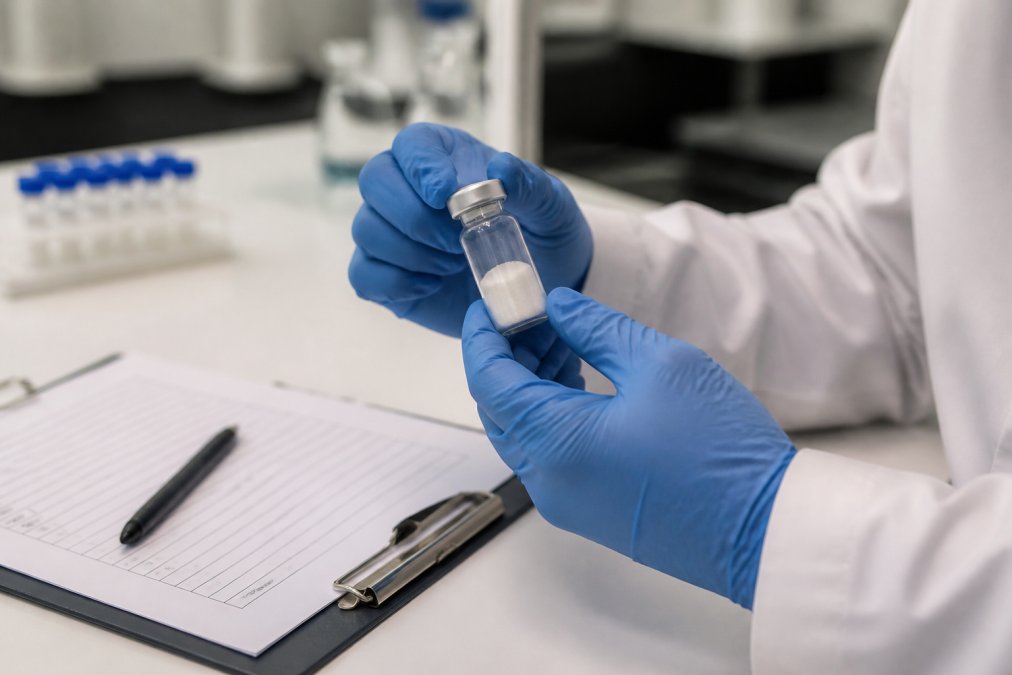
- Powder color: Original lyophilized peptides are white or off-white. Yellowing or browning indicates oxidation or thermal damage.
- Cake formation: The powder should be loose and fluffy. If it’s clumped or caked, moisture entered the vial.
- Vial seal: The rubber stopper should be intact and firm. Cracks or looseness mean the seal failed.
- Discoloration on the stopper: Dark spots or stains suggest chemical reaction or contamination.
- Visible condensation: Any moisture inside the vial is a red flag.
- Vial clarity: The glass should be clear. Cloudiness can indicate peptide aggregation.
These visual signs are your first line of defense. If any appear, do not use the peptide in critical experiments until you verify its state through testing.
Reconstitution Behavior and Bioactivity Loss
How the peptide behaves when you reconstitute it tells you a lot. Reconstitution is when you add solvent to the lyophilized powder to make a liquid solution.
Degraded peptides show these signs during reconstitution:
- The powder dissolves slowly or incompletely
- The solution becomes cloudy instead of clear
- The solution changes color unexpectedly
- Aggregation occurs (visible particles or clumping)
- The peptide sequence has altered, shown by mass spectrometry
If reconstitution behavior looks abnormal, stop and test before proceeding with your research. A single degraded batch can invalidate weeks of experimental work downstream. Testing now saves time and money later.
Post-Delivery Peptide Stability Testing Methods
After your peptide arrives, verification testing confirms its integrity. This is your insurance policy against degradation. However, not all testing methods are equally practical or necessary for every scenario. Understanding which test to run, when to run it, and how to interpret results is critical for making fast, accurate decisions about shipment viability.
Tiered Testing Approach: Speed vs. Certainty
You have three testing tiers. Choose based on urgency and budget:
Tier 1: Visual and Solubility Screening (Same Day, $0-$50)
This is your fastest gate. Perform this immediately upon arrival:
- Examine vial appearance against the Certificate of Analysis photo (if provided)
- Reconstitute a small aliquot (1-2 mg) in your standard solvent
- Observe dissolution time (should be <5 minutes for most peptides)
- Check for cloudiness, unexpected color, or particle formation
- Measure pH if your assay is pH-sensitive
Tier 2: HPLC Purity Analysis (3-5 Business Days, $150-$400)
HPLC separates peptide components and quantifies purity. This is the standard verification test. Compare your results directly to the Certificate of Analysis baseline:
- Request the same HPLC method used for the original batch testing (your supplier should provide this)
- Acceptable degradation threshold: ≤5% loss of purity from baseline (e.g., if original was 98% pure, 93% is acceptable; below 93% suggests significant thermal or hydrolytic damage)
- Additional peaks in the chromatogram indicate breakdown products or impurities
- If purity dropped 5-15%, the peptide is usable for most research but may not meet publication standards
- If purity dropped >15%, request replacement; the shipment likely experienced severe thermal excursion
Tier 3: Mass Spectrometry + Bioactivity (5-10 Business Days, $400-$1,200)
Use this only if Tier 2 results are ambiguous or if your research requires publication-grade certainty:
- Mass spectrometry (MS) detects oxidation, hydrolysis, and structural changes at the molecular level
- Electrospray ionization MS (ESI-MS) is standard for peptides; it shows exact molecular weight and fragmentation patterns
- Bioactivity assays (ELISA, binding assays, cell-based assays) confirm the peptide still functions as intended
- If MS shows altered mass or unexpected fragments, the peptide has degraded chemically
- If bioactivity is >20% lower than the original Certificate of Analysis data, thermal or chemical damage is confirmed
Interpreting Results and Making Replacement Decisions
Once you have test data, use this decision tree:
If Tier 1 passes: Proceed with your research. No further testing needed unless you observe unexpected assay results later.
Cost-Benefit Framework for Test Selection
Consider these factors when choosing a testing tier:
- Experiment criticality: Preliminary work tolerates lower purity; final publications require ≥95% purity
- Peptide cost: If the peptide cost >$500, Tier 2 testing ($150-$400) is justified to verify it before use
- Time sensitivity: If you need results in 24 hours, Tier 1 is your only option; plan accordingly
- Batch size: If you ordered multiple vials, test one vial fully (Tier 2 or 3) and assume the others are similar
- Supplier reputation: If your supplier has a track record of stable shipments, Tier 1 screening may be sufficient; if they have a history of degradation, always run Tier 2
Establishing a Baseline for Your Supplier
Keep detailed records of every peptide you receive:
- Original Certificate of Analysis (purity, mass spec data, HPLC chromatogram)
- Your Tier 2 HPLC results upon arrival
- The date received and ambient temperature in your lab
- Any visual inspection notes
- Assay results from your experiments
After 5-10 orders, you’ll see a pattern. If 80% of shipments maintain ≥95% purity, your supplier’s cold chain is reliable, and Tier 1 screening is sufficient. If degradation occurs in >30% of shipments, escalate to Tier 2 testing for every order, or switch suppliers.
Request that your supplier include a temperature data logger in every shipment to high-temperature regions. This device records temperature every 15-30 minutes during transit. If a peptide arrives degraded, the logger data proves whether the cold chain failed or if degradation occurred before shipment. This documentation is essential for replacement claims.
Do not freeze a peptide immediately after arrival if you suspect degradation. Freezing can cause ice crystal formation, which further damages peptide structure. Instead, store at 2-8°C (refrigerated) while you perform Tier 1 and Tier 2 testing. Only freeze after you’ve confirmed the peptide is stable.
Regional Shipping Protocols for High-Temperature Zones
High-temperature regions are not all the same. A desert climate (low humidity, extreme heat) requires different protection than a tropical climate (high humidity, moderate heat). Standard cold chain logistics often fail in these environments. Effective shipping to high-temperature zones requires matching your protection strategy to the specific climate and season.
Climate-Specific Shipping Strategies
Desert Regions (Southwest, >35°C, <30% humidity)
Desert heat is the primary threat. Humidity is low, so moisture ingress is less critical. The challenge is sustained high temperature over long transit times.
Recommended protocol:
- Use dry ice or phase-change materials (PCM) instead of standard ice packs. Ice packs melt quickly in desert heat; dry ice sublimes slowly and maintains -78°C for 24-48 hours
- Request expedited overnight shipping (24 hours max). A 2-day shipment through desert heat will degrade most peptides
- Use double-wall insulated boxes with 3-4 inches of foam on all sides
- Include a temperature data logger to verify the cold chain held
- Ship early in the week (Monday-Wednesday) to avoid weekend delays that extend transit time
- Avoid shipping during peak summer months (June-August) if possible; spring and fall shipments are more reliable
Recommended protocol:
- Use ice packs or PCM materials (dry ice is less critical here because humidity, not just heat, is the threat)
- Add desiccant packets inside the insulated box AND inside the inner vial packaging. Silica gel desiccants absorb ambient moisture before it reaches the peptide
- Use vacuum-sealed inner pouches around the vial to create a moisture barrier
- Request 24-hour shipping (overnight if available)
- Include a humidity monitor (not just temperature) in the shipment. Humidity >60% inside the package indicates seal failure
- Ship with a carrier that has climate-controlled facilities (FedEx and UPS offer this; regional carriers may not)
Recommended protocol:
- Use PCM materials instead of ice packs (PCM is less sensitive to pressure changes)
- Request ground shipping if possible to avoid pressure changes during flight
- Use vials with extra-tight rubber stoppers (verify with your supplier that they use pharmaceutical-grade stoppers rated for pressure changes)
- Include a pressure-sensitive indicator in the package to detect seal failure
Seasonal Adjustments
Even within the same region, seasonal changes matter:
Summer (June-August): Ambient temperatures peak. Use dry ice or PCM, overnight shipping, and double-wall boxes. Budget an extra 20-30% for shipping costs.
Transit Time Data and Carrier Selection
Transit time is your most powerful variable. Shorter transit = less thermal exposure.
- Overnight (24 hours): Peptides experience minimal thermal stress. Recommended for all high-temperature regions. Cost: baseline + $40-$80
- 2-day expedited (48 hours): Acceptable for spring/fall/winter; risky for summer. Cost: baseline + $15-$30
- Standard ground (3-5 days): High risk in high-temperature regions. Only use if the destination has local refrigeration (e.g., a university receiving dock with a -20°C freezer immediately available)
Carrier choice matters:
- FedEx Priority Overnight: Reliable, climate-controlled facilities, temperature monitoring available. Recommended for critical shipments
- UPS Next Day Air: Similar to FedEx; slightly lower cost in some regions
- Regional carriers (DHL, OnTrac): Cheaper but less reliable cold chain infrastructure. Use only for non-critical shipments or if your supplier has a partnership with them
Real-World Example: Summer Shipment to Phoenix
Phoenix in July: ambient temperature 110-115°F (43-46°C), low humidity, 2-day ground transit time through desert.
Communicating with Your Supplier
When ordering for high-temperature regions, provide this information:
- Exact destination zip code or region (not just “hot area”)
- Intended arrival date (so they know the season)
- Your lab’s receiving conditions (Is there a -20°C freezer immediately available? Or will the peptide sit at room temperature for hours?)
- Criticality of the shipment (Is this for a time-sensitive experiment or a stock order?)
- Your budget for shipping (Premium protection costs more; they can recommend options)
Reputable suppliers will adjust their shipping method based on this information. If a supplier says “We ship the same way to all regions,” that’s a red flag. Climate-aware suppliers customize their approach.
If you receive peptides regularly in a high-temperature region, negotiate a standing agreement with your supplier. For example: “All summer shipments to my location use overnight FedEx with dry ice and temperature monitoring.” This ensures consistency and often qualifies you for volume discounts on premium shipping.
The cost of premium shipping (overnight, dry ice, desiccants) is always less than the cost of a degraded peptide. A $300 peptide with 70% degradation risk costs you $210 in expected loss. Spending $80 on premium shipping reduces that to $15 in expected loss. The ROI on premium shipping is 10:1 or better in high-temperature regions.
Emergency Mitigation Steps if Degradation Is Suspected
If your peptide arrives and shows signs of degradation, act quickly.
Frequently Asked Questions
Will peptides degrade if exposed to high temperatures during transit?
Yes. Peptides are thermally sensitive molecules whose covalent bonds break down when exposed to sustained heat. Even brief temperature excursions above 25°C accelerate hydrolysis and oxidation, degrading bioactivity. Lyophilized peptides are more stable than solutions but still require cold chain protection during shipping in high-temperature regions. Transit time and peak temperature exposure both matter, the longer and hotter the exposure, the greater the molecular damage.
What are the main signs of peptide degradation after shipping?
Visual changes include discoloration (yellowing or browning), cake formation instead of fine powder, or crystallization. During reconstitution, degraded peptides may dissolve slowly, appear cloudy, or show incomplete dispersion. Bioactivity loss is the most reliable indicator, your assays will show reduced potency or inconsistent results. If your peptide sequence has been compromised by thermal or oxidative stress, downstream molecular analysis will fail or produce unreliable data.
How should lyophilized peptides be stored and shipped to prevent degradation?
Lyophilized peptides must be stored at 2-8°C in sealed vials with desiccant packs to minimize moisture exposure. During shipping, use insulated packaging with gel packs or phase-change materials to maintain cold chain integrity. Vacuum sealing and moisture barriers protect against hydrolysis. In high-temperature regions, overnight or express shipping reduces thermal excursion risk. Upon arrival, verify vial integrity, check for discoloration, and store immediately at proper temperature to halt further degradation.
How can I test if my peptides lost potency after shipping?
Perform a bioactivity assay specific to your peptide’s function, this directly measures whether molecular structure and covalent bonds remain intact. HPLC analysis confirms chemical purity and detects degradation products. Mass spectrometry verifies the peptide sequence hasn’t been altered by oxidation or hydrolysis. If your lab lacks these capabilities, contact your supplier for batch-level testing or request a Certificate of Analysis that documents post-shipment stability.