Maintaining Peptide Stability in Labs: 2026 Guide
Table of Contents
- What You’ll Need Before You Start
- Peptide Storage Temperature Guidelines for Lyophilized and Reconstituted Vials
- Peptide Reconstitution Best Practices: Solvent Choice, Aliquoting, and Sterile Technique
- The Impact of Freeze-Thaw Cycles on Peptides and How to Limit Damage
- Degradation Pathways That Threaten Peptide Stability in Labs
- Troubleshooting Degraded Samples: What to Check First
- Shipping and Cold-Chain Logistics for Temperature-Sensitive Peptides
- Common Mistakes That Undermine Peptide Stability in Labs
- Frequently Asked Questions
Last Updated: September 19, 2026
What You’ll Need Before You Start
Maintaining peptide stability in labs starts long before a vial touches a freezer. It starts with having the right tools and habits in place.
- Calibrated freezer or refrigerator with a visible temperature display
- Sterile water or appropriate buffer for reconstitution
- Low-binding microcentrifuge tubes for aliquoting
- Personal protective equipment: gloves, lab coat, safety glasses
- A clean, draft-free workspace away from direct light
- Batch documentation including Certificate of Analysis (CoA) records
Peptide Storage Temperature Guidelines for Lyophilized and Reconstituted Vials
The best storage temperature depends on the peptide’s form, its sequence, and how long you need it to last. Lyophilized peptides are more forgiving; reconstituted peptides need colder, stricter conditions.
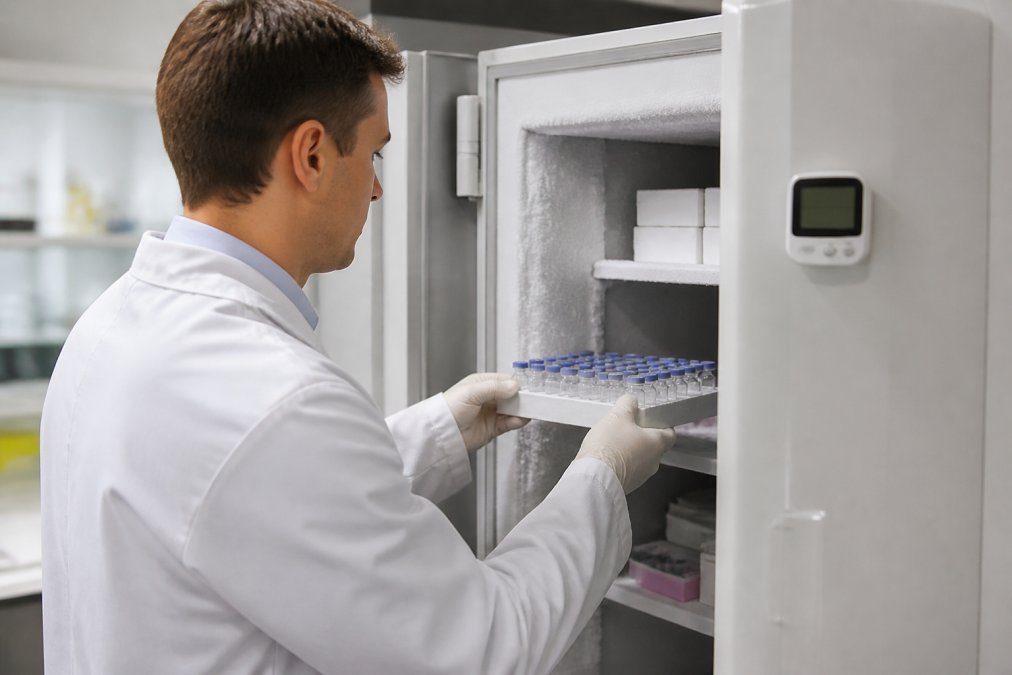
Lyophilized Peptides: -20°C Routine, -80°C Long-Term
Lyophilized (freeze-dried) peptides are stable as dry powders because the absence of water removes the primary driver of hydrolysis and slows most chemical degradation. For routine storage measured in months, -20°C is adequate for most sequences. For long-term storage measured in years, or for peptides with known labile residues (methionine, cysteine, tryptophan, Asn-Gly motifs), -80°C is the safer choice.
The practical rules:
- Keep vials dry. Moisture uptake during repeated freezer-door openings is a real risk.
- Keep them dark. Amber vials or foil wrap block the UV that drives oxidation.
- Keep them sealed. Parafilm or a tight cap limits moisture and oxygen ingress.
- Equilibrate to room temperature before opening to prevent condensation on the powder.
Peptide Reconstitution Best Practices: Solvent Choice, Aliquoting, and Sterile Technique
Proper reconstitution is where most stability problems begin. Get it right and you avoid weeks of headaches.
Follow these steps:
- Equilibrate the vial to room temperature before opening. This prevents condensation.
- Add solvent slowly down the vial wall, not directly onto the powder.
- Swirl gently to dissolve. Never vortex or shake vigorously.
- Check pH if the peptide is pH-sensitive.
- Aliquot immediately into single-use volumes.
- Label each tube with peptide name, concentration, date, and batch.
- Freeze aliquots at -20°C or below.
Solvent Compatibility Matrix: Matching Buffer to Peptide
Not every peptide dissolves well in water. The wrong solvent can cause aggregation or precipitation before you even start.
| Peptide Type | Preferred Solvent | Avoid |
|---|---|---|
| Hydrophilic peptides | Sterile water | High-salt buffers |
| Hydrophobic peptides | Small amount of acetonitrile, then water | Pure aqueous solvents |
| Acidic peptides | Dilute ammonium hydroxide | Acidic buffers |
| Basic peptides | Dilute acetic acid | Basic buffers |
| pH-sensitive peptides | Buffered saline at target pH | Unbuffered water |
The Impact of Freeze-Thaw Cycles on Peptides and How to Limit Damage
Every freeze-thaw cycle damages peptides a little more. Ice crystals form, concentration shifts, and the peptide’s structure can change.
Here’s how to limit freeze-thaw damage:
- Aliquot before the first freeze. Split into single-use volumes.
- Freeze fast, thaw slow. Use a -80°C freezer for rapid freezing.
- Thaw on ice or at 4°C, never at room temperature or in your hand.
- Never refreeze a thawed aliquot.
- Track your cycles. Write the number of freezes on each tube.
Refreezing a thawed aliquot is the single most common cause of unexplained assay failures. Once a peptide is thawed, use it or discard it. Do not put it back.
Degradation Pathways That Threaten Peptide Stability in Labs
Peptides break down through several chemical and physical routes. Knowing which one is attacking your sample tells you how to stop it, and how to read the analytical evidence it leaves behind.
Hydrolysis: Backbone Cleavage Driven by Water and pH
Hydrolysis cleaves the peptide backbone at the amide bond, generating fragment peptides that show up as new, earlier-eluting peaks on reverse-phase HPLC. The rate is strongly pH- and temperature-dependent. Most peptides are most stable near pH 4-6, where the terminal carboxyl and amino groups are least reactive; stability drops sharply above pH 8 because hydroxide ion directly attacks the carbonyl carbon.
Oxidation: Methionine, Cysteine, and Tryptophan Under Attack
Oxidation modifies specific side chains rather than the backbone. Methionine oxidizes to methionine sulfoxide (a +16 Da mass shift), cysteine forms disulfides or sulfenic acid, and tryptophan can form kynurenine and other products. The drivers are molecular oxygen, trace metal ions (especially copper and iron), light, particularly UV, and residual peroxides in solvents like ether or some grades of DMSO.
Proteolysis: Enzyme-Driven Breakdown From Contamination
Proteolysis is enzymatic, not chemical, and it comes from bacterial contamination, residual proteases on glassware or tips, or skin and saliva contact. It produces a ladder of fragments rather than a single modified species, so the HPLC trace looks like a smear of new peaks across the run.
Deamidation: Asparagine and Glutamine Residues
Deamidation converts asparagine to aspartate (and glutamine to glutamate), producing a +1 Da mass shift that is easy to miss on low-resolution mass spec. It is favored at neutral to basic pH and elevated temperature, and it is sequence-dependent, Asn-Gly and Asn-Ser motifs are especially labile. Over weeks at 4°C, a susceptible peptide can accumulate measurable deamidation even without obvious visual change.
Aggregation and Conformational Change
Aggregation is physical, not chemical: hydrophobic patches on partially unfolded peptides associate into dimers, oligomers, and eventually visible precipitate. It is promoted by high concentration, hydrophobic sequence content, agitation (vortexing, shaking), and interfaces (air-liquid, vial wall). Conformational change, loss of alpha-helical or beta-sheet structure, often precedes aggregation and can be detected by circular dichroism before any precipitate appears.
Matching the Pathway to the Fix
| Pathway | Typical Trigger | Analytical Signature | Primary Mitigation |
|---|---|---|---|
| Hydrolysis | High pH, heat, Asp-Pro bonds | New earlier-eluting fragments | pH control, cold storage |
| Oxidation | O2, light, trace metals | +16 Da mass shift | Inert gas, dark vials, chelators |
| Proteolysis | Bacterial or protease contamination | Fragment ladder on HPLC | Sterile technique, single-use consumables |
| Deamidation | Neutral/basic pH, heat, Asn-Gly motifs | +1 Da mass shift | Cold storage, pH control |
| Aggregation | Agitation, high concentration, hydrophobicity | Turbidity, SEC high-MW peak | No vortexing, low-binding tubes |
When a sample fails, the analytical signature usually points to one dominant pathway. Run intact mass and reverse-phase HPLC side by side against the CoA reference before you change anything, the pattern tells you which fix to apply.
Troubleshooting Degraded Samples: What to Check First
- Check the freezer log. Was there a power outage or door left open?
- Review thaw history. How many freeze-thaw cycles has this aliquot seen?
- Inspect the vial. Cloudiness, precipitate, or color change?
- Test the pH. Has it drifted from the target?
- Run a quick HPLC. Compare to the reference chromatogram from the CoA.
- Check for contamination. Look for turbidity or unusual smell.
Keep a reference aliquot from every batch, untouched, in a separate freezer. When something looks wrong, you have a baseline to compare against. Most labs skip this and regret it.
If the HPLC trace shows new peaks, the peptide has degraded. If it matches the reference, the problem is likely in your assay, not the sample.
Shipping and Cold-Chain Logistics for Temperature-Sensitive Peptides
Cold-chain breaks are a leading cause of degraded peptide shipments. The vial can leave the supplier perfect and arrive ruined.
What to check when a shipment arrives:
- Inspect the packaging for damage or thawing
- Read the temperature logger if one is included
- Confirm the dry ice weight matches expectations
- Photograph anything unusual before opening
- Store immediately at the correct temperature
Common Mistakes That Undermine Peptide Stability in Labs
Even experienced labs fall into the same traps.
- Vortexing to speed up dissolution. It causes foaming and aggregation. Swirl instead.
- Storing reconstituted peptide at room temperature. It degrades within hours.
- Using the same aliquot repeatedly. Each thaw damages the sample.
- Skipping pH checks. Small drifts cause big problems.
- Leaving vials in light. UV exposure drives oxidation.
- Reusing needles or tips. Cross-contamination ruins both samples.
- Ignoring the CoA. Purity, solvent, and storage notes are all there.
The three habits that protect peptide stability more than anything else: aliquot before freezing, thaw on ice, and never refreeze. Everything else is secondary.
Frequently Asked Questions
How long can lyophilized peptides be left at room temperature before they degrade?
Lyophilized peptides tolerate short room-temperature exposure during handling, weighing, and aliquoting, typically a few hours without measurable loss of peptide stability. Extended storage above 25°C accelerates hydrolysis and oxidation, especially for peptides containing methionine, cysteine, or tryptophan. For anything beyond same-day use, move vials to -20°C or colder. If a shipment arrives warm, inspect the vial for clumping or discoloration and run a quick HPLC check before committing the material to a sensitive assay.
What is the recommended temperature for storing reconstituted peptide stock solutions?
Reconstituted peptides in aqueous solution are far less stable than lyophilized powder. Store working aliquots at 4°C and use them within days to a couple of weeks, depending on the sequence. For longer storage, freeze aliquots at -20°C or -80°C. Avoid storing stock solutions at room temperature, and never leave them on the bench between runs. Aqueous solutions are vulnerable to microbial contamination and hydrolysis, so sterile technique and short bench time matter as much as the setpoint.
How do freeze-thaw cycles impact peptide integrity in practice?
Each freeze-thaw cycle forces ice crystal formation that can disrupt alpha-helical structure and promote aggregation, particularly for hydrophobic sequences. Repeated cycling also concentrates salts and buffers as ice forms, shifting local pH and accelerating degradation pathways. The fix is aliquoting: split reconstituted stock into single-use volumes sized to your typical experiment before the first freeze. Once thawed, keep the aliquot on ice and use it the same day rather than refreezing. Tracking cycle counts on the vial label prevents silent drift in experimental reproducibility.
What should I do if a peptide shipment arrives warm or shows signs of degradation?
Document the condition immediately with photos and the temperature indicator reading, then contact the supplier before opening the vial. Reputable suppliers with batch-level traceability and Certificates of Analysis will compare the shipment against release data and replace compromised stock. For FROPeptides orders, multi-stage HPLC and mass spectrometry records let you verify identity and purity against the original batch. In the meantime, quarantine the vial rather than adding it to your working inventory, and run a small HPLC or mass spec check if you have in-house capability.
Peptide stability in labs comes down to discipline. Every thaw, every pH check, every aliquot either protects your sample or erodes it. FROPeptides supports that discipline with multi-stage HPLC testing, mass spectrometry verification, and batch-level Certificates of Analysis on every order. When you need research-grade peptides you can trust from the first freeze to the last assay, shop with FROPeptides and get compounds built for exacting protocols.