AmericanPeptides Alternative for Research: 4 Vetted Labs
Table of Contents
- Why Labs Are Searching for an AmericanPeptides Alternative for Research
- What Defines a Research-Grade Peptide Supplier
- Vetted AmericanPeptides Alternatives for Research Use
- How to Verify Peptide Purity with CoA Documents
- Storage, Stability, and Supply Chain Risk Mitigation
- The Chemistry of Peptide Degradation: Why Storage Conditions Matter
- Temperature Specifications: What to Demand from a Supplier
- Reconstitution and Post-Reconstitution Stability: A Frequently Overlooked Variable
- Supply Chain Risk Mitigation: Identifying Stable vs. Volatile Suppliers
- A Framework for Assessing Supplier Supply Chain Stability
- Evaluating Supplier Responsiveness and Contingency Policies
- Building a Supply Chain Risk Assessment into Your Vendor Vetting Checklist
- Criteria for Choosing the Best Peptide Suppliers for Academic Research
- Final Verdict: Selecting Your Supplier
- Frequently Asked Questions
Last Updated: September 5, 2026
Why Labs Are Searching for an AmericanPeptides Alternative for Research
Recent industry shakeouts have intensified the search for an AmericanPeptides alternative for research as principal investigators demand more rigorous documentation than typical vendor catalogs provide. A peptide supplier is only as reliable as its analytical data.
The core problem is verification. When a batch fails, the cost is weeks of wasted bench time and compromised experimental integrity. A viable alternative must demonstrate batch-level traceability, provide Certificates of Analysis (CoA) with raw data, and maintain cold-chain integrity.
What Defines a Research-Grade Peptide Supplier
A research-grade peptide supplier provides analytical documentation sufficient for a principal investigator to verify compound identity and purity before the material touches an assay. This goes beyond a purity percentage on a website.
The Role of HPLC and Mass Spectrometry in Purity Claims
HPLC and LC-MS are the analytical backbone of peptide verification. HPLC establishes purity, while mass spectrometry confirms molecular weight and sequence identity. Expect both methods cited on every batch CoA.
Why Third-Party Testing for Research Peptides Matters
In-house testing alone creates a conflict of interest that prudent lab managers should not ignore. Independent third-party testing for research peptides provides an unbiased check on the manufacturer’s purity claims and impurity profile. According to NIH guidance on reagent validation, rigorous authentication of chemical reagents, including peptides, is essential for ensuring the reproducibility of biomedical research. When a supplier refuses to share third-party data, treat that as a red flag rather than a minor inconvenience.
Vetted AmericanPeptides Alternatives for Research Use
After evaluating documentation practices, testing rigor, and supply chain reliability, four suppliers consistently meet the bar for laboratory use.
FROPeptides: Batch-Level Traceability and Multi-Stage HPLC
Our top pick is FROPeptides, built around the documentation demands of exacting laboratory protocols. Every batch undergoes multi-stage HPLC testing and mass spectrometry verification, with a CoA for each order.
FROPeptides maintains temperature-controlled storage and no-backorder inventory. For labs running sensitive assays where minor purity variance compromises results, consistency across every order is decisive.
FROPeptides is the strongest choice when your work demands full traceability and documented purity for every single batch, not just a representative sample.
Biotech Peptides: Rigorous Documentation for Sensitive Assays
Biotech Peptides specializes in high-purity compounds for academic research, with multi-stage HPLC testing and mass spectrometry verification for every batch, alongside temperature-controlled storage. This suits researchers who prioritize compound integrity and are willing to pay a premium, though the higher price may strain tighter budgets.
Kylo Peptides: Independent Verification and Supply Consistency
Kylo Peptides has built a reputation for consistency and quality control. Their model includes independent third-party verification, comprehensive CoA documentation, and a consistent supply chain. The main limitation is that pricing is not always publicly listed, which complicates budget planning for procurement officers.
Core Peptides: Broad Catalog for Varied Experimental Protocols
Core Peptides serves researchers needing an extensive catalog across multiple protocols. Their direct-to-researcher model and regularly updated inventory make them practical for labs exploring diverse questions. However, public CoA transparency varies, so request batch-specific documentation before large orders.
| Supplier | Key Strength | Documentation | Best For |
|---|---|---|---|
| FROPeptides | Batch-level traceability | CoA with every batch, HPLC + MS | Labs needing full audit trails |
| Biotech Peptides | Rigorous testing protocols | Detailed analytical docs | Sensitive academic assays |
| Kylo Peptides | Independent verification | Comprehensive CoA | Consistency-focused teams |
| Core Peptides | Broad product catalog | Varies by batch | Diverse experimental needs |
How to Verify Peptide Purity with CoA Documents
Learning how to verify peptide purity with CoA documents is the single most valuable skill for any lab manager evaluating a new supplier. A CoA is only useful if you know which data points matter and how to interpret them.
Reading the Certificate of Analysis: Key Data Points
The CoA should list the lot number, peptide sequence, molecular weight confirmed by mass spectrometry, and HPLC purity percentage. Check that the lot number on the vial matches the CoA; mismatches indicate poor inventory control.
Interpreting Raw Lab Data and Impurity Profiles
A purity percentage alone does not tell you what the remaining material is. Examine the impurity profile to see whether contaminants are identifiable. Sequence verification via mass spectrometry confirms the correct peptide was synthesized, not a truncated variant.
A Step-by-Step CoA Audit Protocol for Researchers
Adopt a systematic audit protocol that takes under ten minutes per batch but catches most documentation failures before they cost you a failed experiment.
Step 1: Verify the Lot Number and Sequence Identity.
Then verify the peptide sequence matches what you ordered. A common error is shipping a closely related analog or truncated fragment. Cross-reference against your order confirmation, not just the product page.
Step 2: Check the Molecular Weight Confirmation.
Mass spectrometry data should report an observed molecular weight (PubMed). Compare this to the theoretical value; acceptable tolerance is typically ±0.5 Da. If the CoA lists only a calculated weight without an observed value, mass spec confirmation may not have been performed.
Step 3: Scrutinize the HPLC Chromatogram, Not Just the Purity Percentage.
The purity percentage is a single number, but the chromatogram tells the real story. Look for a single dominant peak with a clean baseline. Multiple peaks indicate closely related impurities such as deletion sequences or oxidation products.
Step 4: Evaluate the Impurity Profile for Known Contaminants.
A high-quality CoA will list identifiable impurities rather than lumping everything into an “other” category. If the CoA reports “impurities: 2%” without specifying what they are, request the raw data.
Step 5: Cross-Check the Date of Analysis Against the Ship Date.
Peptides degrade over time, even in lyophilized form. The CoA should have an analysis date reasonably close to the ship date. Ask whether the CoA reflects your batch or a representative sample from an earlier run.
A CoA that reports only a purity percentage without a chromatogram, observed molecular weight, or identifiable impurities is not a verification document, it is a marketing sheet. Treat it accordingly.
Red Flags in CoA Documentation Practices
Certain patterns should trigger follow-up questions or disqualify a supplier. A CoA with a purity percentage but no analytical method is incomplete. A CoA without the peptide sequence or lot number is useless for traceability. A single “representative” CoA rather than batch-specific documentation is not research-grade.
Building a CoA Archive for Your Lab
Archive every CoA you receive, organized by lot number and peptide sequence. This becomes your reference library for troubleshooting. Over time, this archive helps you evaluate supplier consistency, downward drift in purity across lots signals a production problem.
Storage, Stability, and Supply Chain Risk Mitigation
Peptide stability is a function of storage conditions from synthesis to reconstitution. Lyophilized peptides are generally stable at controlled room temperature for short periods, but long-term storage requires refrigeration or freezing.
The Chemistry of Peptide Degradation: Why Storage Conditions Matter
Peptide degradation follows predictable chemical pathways. The primary routes are hydrolysis, oxidation, and deamidation. Hydrolysis, cleavage of peptide bonds by water, is why lyophilized peptides are preferred for long-term storage. Oxidation affects cysteine, methionine, and tryptophan residues when exposed to air or light.
A peptide containing methionine is more oxidation-prone; one with multiple cysteine residues may form disulfide-linked aggregates if stored improperly. The supplier cannot control your storage after delivery, but they must control theirs before, and document that control.
Temperature Specifications: What to Demand from a Supplier
Most research-grade suppliers store lyophilized peptides at -20°C or colder; some maintain -80°C for unstable sequences (peer-reviewed research). A supplier that stores at -20°C but ships at ambient temperature without cold packs introduces a thermal cycle that promotes moisture uptake and degradation.
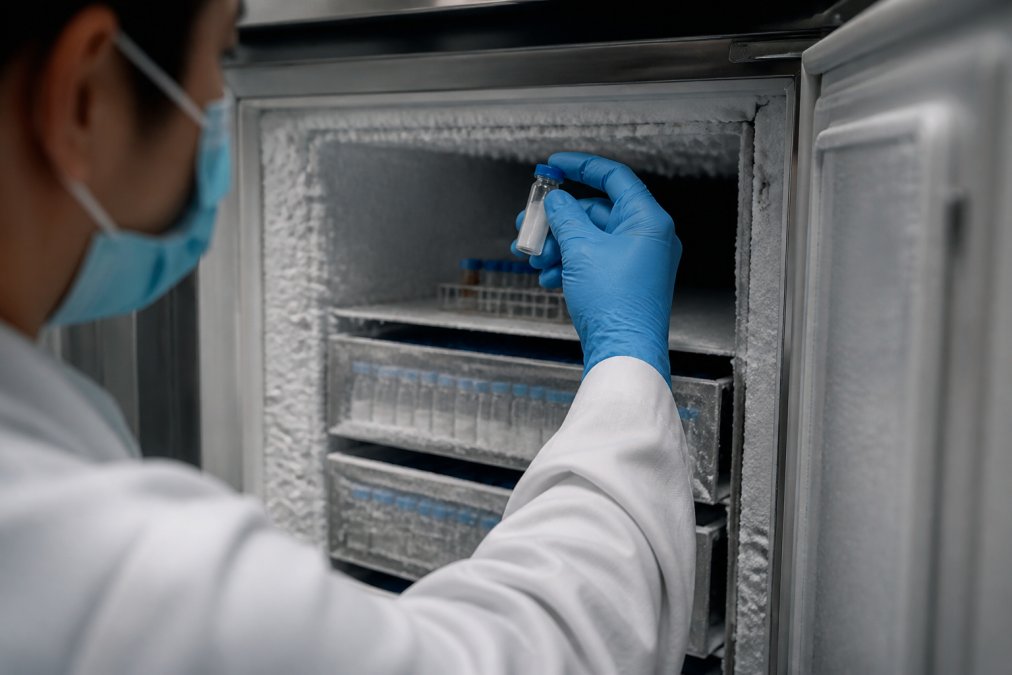
For international shipments, cold-chain logistics become critical. A supplier must maintain temperature control through final delivery, not just to the departure airport. Ask whether shipments include temperature data loggers.
Reconstitution and Post-Reconstitution Stability: A Frequently Overlooked Variable
Once reconstituted, the stability clock accelerates dramatically. A peptide stable for months as a powder may be stable for only days or weeks in solution. Most protocols recommend reconstituting in sterile water or buffered solution at neutral pH, then aliquoting and freezing.
A supplier that provides reconstitution guidelines with solvent recommendations, solubility data, and stability timelines demonstrates technical competence beyond shipping vials.
Supply Chain Risk Mitigation: Identifying Stable vs. Volatile Suppliers
Supply chain risk mitigation extends beyond temperature. A vendor with no backorders and ready inventory eliminates production delays that can derail a time-sensitive experiment. Suppliers that cannot guarantee temperature integrity through final delivery are not suitable partners.
A Framework for Assessing Supplier Supply Chain Stability
A common pattern is the small supplier operating on a just-in-time production model. These suppliers may offer competitive pricing but carry minimal inventory, meaning your order is synthesized only after you place it. This introduces production delays and batch-to-batch variability.
A more stable supplier maintains ready inventory of commonly requested peptides, with batch-level CoAs available before purchase. This allows you to verify analytical data before spending money.
Evaluating Supplier Responsiveness and Contingency Policies
Supply chain risk is also about how the supplier responds when something goes wrong. Ask about their policy for replacing compromised stock. A clear, written replacement policy demonstrates confidence in quality control; requiring you to return the vial for analysis creates friction that can delay research by weeks.
The most reliable suppliers are those that can document their storage conditions, provide temperature data for shipments, maintain ready inventory, and offer clear replacement policies.
Building a Supply Chain Risk Assessment into Your Vendor Vetting Checklist
When evaluating a new supplier, ask: What temperature do you store lyophilized peptides at? Do you provide temperature data loggers? What is your replacement policy for compromised stock? Do you maintain ready inventory or synthesize to order? Can you provide batch-level CoAs before purchase?
Criteria for Choosing the Best Peptide Suppliers for Academic Research
Selecting the best peptide suppliers for academic research requires a structured evaluation beyond price comparisons. Build a vetting checklist covering analytical testing standards, documentation transparency, shipping reliability, and customer support.
A common procurement mistake is prioritizing the lowest unit price without accounting for the cost of failed experiments. A batch that fails QC wastes far more in labor and materials than the modest savings on the vial itself.
Consider whether the supplier maintains ready inventory or operates on a backorder model. Confirm shipping reliability for your region, including whether temperature-controlled packaging extends to your facility.
Final Verdict: Selecting Your Supplier
The search for an AmericanPeptides alternative comes down to one question: can the supplier prove what is in the vial? Documentation, not marketing language, protects your experimental integrity. FROPeptides meets that standard with multi-stage HPLC testing, mass spectrometry verification, and a CoA for every batch, backed by temperature-controlled storage and batch-level traceability.
Frequently Asked Questions
What criteria define a trustworthy research peptide supplier?
A trustworthy supplier provides batch-level Certificates of Analysis (CoA) with HPLC and mass spectrometry data, practices temperature-controlled storage, and maintains transparent supply chains. Look for documented purity of 99% or higher, clear lot numbers, and third-party testing for research peptides. Reliable vendors keep ready inventory to avoid backorders and ship with cold-chain protocols that protect compound stability from their facility to yours.
How do I verify the purity of research-grade peptides?
Request the Certificate of Analysis for your specific lot number before ordering. Confirm the purity percentage meets your protocol requirements, and check that both HPLC and mass spectrometry methods were used for verification. Review the impurity profile for any peaks that could interfere with your assays. Legitimate suppliers provide these documents for every batch, not just upon special request.
What documentation should accompany high-quality research peptides?
Every shipment should include a Certificate of Analysis showing the lot number, purity percentage, testing method (typically HPLC and LC-MS), and date of analysis. A quality supplier will also provide storage and handling instructions for compound stability, plus clear chain-of-custody documentation from synthesis through dispatch. Batch-level traceability ensures you can correlate your experimental results with specific manufacturing and testing data.
Are there reliable alternatives to American Peptides for academic studies?
Yes. Several suppliers now meet rigorous academic standards with documented purity verification. FROPeptides provides 99%+ purity confirmed by multi-stage HPLC and mass spectrometry, with batch-level traceability and temperature-controlled storage. Biotech Peptides offers detailed analytical documentation, while Kylo Peptides maintains consistent third-party verification. Evaluate each vendor’s CoA transparency and shipping reliability against your lab’s specific assay requirements.
Choosing a peptide supplier is a procurement decision with direct consequences for data quality and reproducibility. FROPeptides supports exacting laboratory protocols with 99%+ purity verified by HPLC and mass spectrometry, temperature-controlled handling, and consistent sourcing with no backorders. Get started with FROPeptides and bring batch-verified, research-grade materials to your next experiment.