Peptide Certificate of Analysis Explained
Table of Contents
- What Is a Certificate of Analysis for Peptides?
- Why Your Research Depends on an Accurate COA
- Key Components Every Peptide COA Must Include
- HPLC vs Mass Spec for Peptide Analysis
- Understanding Peptide Batch-Level Traceability
- How to Identify Fake Peptide COAs and Red Flags
- How to Verify the Authenticity of Your Peptide COA
- Frequently Asked Questions
Last Updated: August 31, 2026
What Is a Certificate of Analysis for Peptides?
A peptide certificate of analysis is a detailed laboratory report documenting the identity, purity, and quality of a research peptide compound. It provides objective evidence that a specific batch meets established analytical standards and contains what the supplier claims. This document includes batch-specific data from multiple analytical techniques, molecular weight verification, purity percentages, and identification of any detected impurities.
For researchers working with high-purity peptides, the COA is essential documentation, proof of compound integrity. At FROPeptides, every vial includes a Certificate of Analysis documenting multi-stage HPLC testing and mass spectrometry verification, ensuring you know exactly what you’re working with.
The COA bridges the gap between supplier promises and independent verification. A proper COA gives you the analytical fingerprint to confirm that the contents match the label. Without one, you cannot troubleshoot failed experiments or defend your methodology in peer review. The FDA’s guidance on analytical method validation establishes that research-grade compounds require documented analytical evidence. A comprehensive peptide certificate of analysis allows you to assess whether a compound suits your specific application.
Why Your Research Depends on an Accurate COA
Batch-to-batch variability silently undermines reproducible research. You run an experiment with Peptide Batch A, get clean results, then order more six months later. The new batch arrives under the same product name but results don’t replicate. The culprit is often undetectable without a detailed COA: a shift in purity from 99.2% to 97.8%, or a new impurity profile that interferes with your assay.
Understanding your peptide certificate of analysis becomes critical here. The COA documents lot-specific data, not generic product specifications. Batch number and lot identification ensure complete traceability from synthesis through quality testing to your lab. When you reference a COA in your methods section, you provide readers with the exact molecular composition you used, a requirement for peer-reviewed publications.
The purity percentage and impurity profile documented in a COA directly impact experimental outcomes. Even trace contaminants can skew results in sensitive assays like HPLC analysis, mass spectrometry, or binding studies. A detailed COA allows you to evaluate whether detected impurities fall within acceptable ranges for your application. Some researchers tolerate 98% purity; others require 99.5% or higher.
FROPeptides includes comprehensive COA documentation with every order because your research is only as reliable as your source material. Temperature-controlled storage and multi-stage HPLC testing ensure batch consistency, and the accompanying certificate provides the analytical proof you need.
Key Components Every Peptide COA Must Include
A complete peptide certificate of analysis contains several critical sections that establish compound identity and quality.
Batch Number and Lot Identification
Every peptide batch receives a unique identifier, typically a batch number or lot number, that ties the COA to a specific synthesis run. This number appears on the vial label, shipping documentation, and certificate itself. Batch-level traceability is essential for research reproducibility. If you need to reference the exact compound used in a publication, the batch number is your anchor point.
The lot identification also enables rapid recalls or reorders of identical material. If you discover a problem with a particular batch months after purchase, the batch number allows you to pinpoint exactly which synthesis run was affected.
Purity Percentage and Impurity Profile
The purity percentage is the headline number on any COA, typically expressed as a percentage by weight. A peptide listed as 99.2% pure means 99.2% is the target compound; the remaining 0.8% consists of detectable impurities, residual solvents, or water content.
The impurity profile breaks down what that remaining percentage contains. A COA should list individual impurities by name or chemical structure, along with their concentrations. Solvent residues (acetone, ethanol, water) are common. Heavy metals testing may show trace amounts of iron or lead. Some COAs document endotoxin levels, critical for research involving cell culture or in vivo work. Understanding the specific impurity profile helps you determine whether a batch suits your application.
Molecular Weight and Peptide Sequence
The molecular weight listed on the COA confirms the peptide’s chemical composition and should match your original specification exactly. Mass spectrometry provides direct measurement of the intact peptide mass, offering definitive proof of correct synthesis. If the measured mass deviates significantly from the theoretical mass, the peptide may be truncated, modified, or contaminated.
The peptide sequence should be documented clearly, typically using the one-letter amino acid code (e.g., MVHLTPEEKS…). This documentation is essential for publications and cross-referencing your order with the COA.
Spectroscopic Data and Retention Time
Spectroscopic data includes results from HPLC (high-performance liquid chromatography) and mass spectrometry. HPLC retention time is when the peptide elutes from the chromatography column under specified conditions. This value should be consistent across batches of the same peptide. A significant shift in retention time can signal structural changes or contamination.
Mass spectrometry data typically shows the m/z ratio (mass-to-charge ratio) and confirms molecular weight. Advanced COAs may include tandem mass spectrometry (MS/MS) fragmentation patterns, providing a molecular fingerprint unique to that peptide.
HPLC vs Mass Spec for Peptide Analysis
HPLC and mass spectrometry are the two primary analytical techniques for peptide characterization.
HPLC separates peptide molecules based on their chemical properties, size, charge, and hydrophobicity as they pass through a column (peer-reviewed research). The detector measures absorbance at 214 nm (peptide bond wavelength) or 280 nm (aromatic amino acids), producing a chromatogram showing peaks for each component. A single sharp peak indicates a pure compound; multiple peaks suggest impurities or degradation products. Retention time serves as a fingerprint for identity confirmation.
Mass spectrometry measures the exact mass of intact peptide molecules by ionizing the sample and separating ions by their mass-to-charge ratio (peer-reviewed research). For peptides, this directly confirms molecular weight and detects modifications, truncations, or unexpected chemical changes. Mass spectrometry is more specific than HPLC for identity verification because it measures actual molecular mass. However, HPLC provides better purity quantification because peak area directly correlates to compound concentration.
Many suppliers, including FROPeptides, use both techniques in sequence. HPLC establishes purity percentage and detects degradation products; mass spectrometry confirms identity and molecular weight. Together, they provide comprehensive validation. A complete COA should include data from both methods, not just one.
Understanding Peptide Batch-Level Traceability
Batch-level traceability means you can trace a specific vial through the entire supply chain: from raw materials used in synthesis, through manufacturing, quality testing, storage conditions, and final packaging. This transparency separates research-grade peptides from commodity chemicals.
When a COA documents batch number, synthesis date, and testing date, it creates a timeline for that specific compound. You know exactly when the peptide was made and when it was analyzed. This matters because peptides degrade over time, especially if stored improperly. A COA from a supplier practicing batch-level traceability specifies storage conditions: typically 2-8°C for most peptides, or -20°C for long-term stability.
FROPeptides maintains batch-level traceability through temperature-controlled storage and handling from synthesis to shipment. Every vial includes documentation linking it to a specific synthesis batch, analytical testing record, and storage history. This transparency allows you to defend your methodology in peer review and troubleshoot unexpected results by referencing the exact material you used.
Traceability also enables rapid response if problems emerge. If you discover that a particular batch behaves unexpectedly, you can immediately contact your supplier with the batch number. A supplier with strong traceability systems can investigate whether other customers received the same batch and identify whether the issue is batch-specific or widespread.
How to Identify Fake Peptide COAs and Red Flags
Not all certificates of analysis are created equal, and some are outright fabrications.
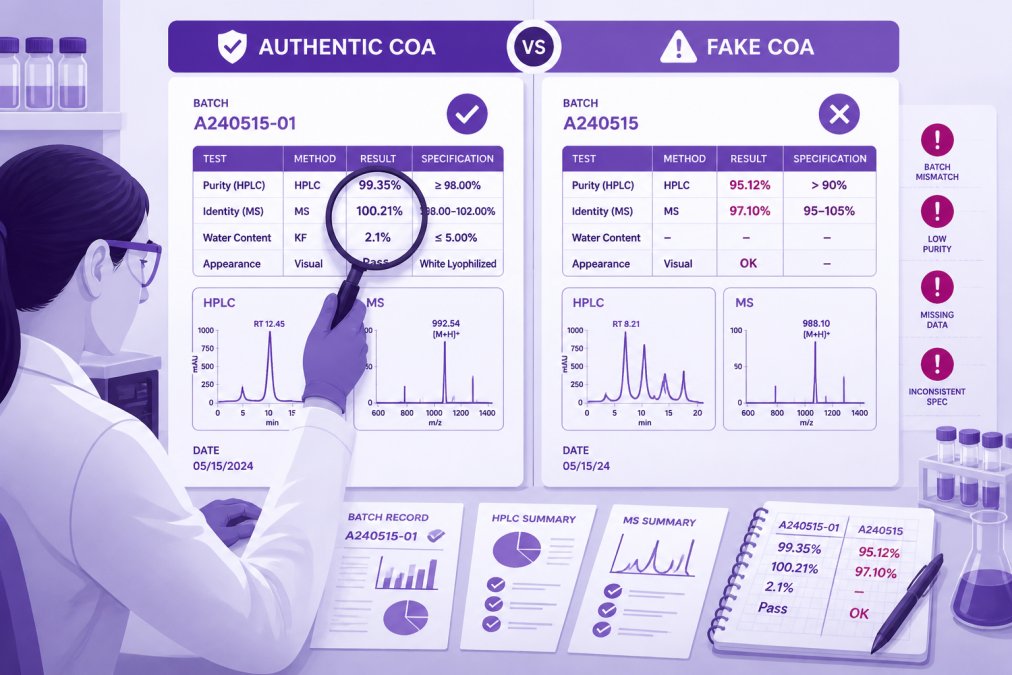
A fake or incomplete COA often lacks specific numerical data. If a certificate lists only the purity percentage without an impurity profile, molecular weight, or retention time data, it’s incomplete. Legitimate COAs include detailed analytical results: specific impurity names and concentrations, exact molecular weight measurements, and chromatogram or mass spectrum references.
Watch for generic language or vague descriptions. Genuine COAs document specific batch numbers, synthesis dates, and testing dates. If the certificate uses placeholder language (“batch information available upon request”) or lacks lot identification, treat it with suspicion. If a supplier cannot provide separate COAs for different batches, instead offering a single generic certificate for all units, traceability is compromised.
Inconsistencies between the COA and vial label are major red flags. The batch number, peptide name, and purity percentage should match exactly. Mismatched information suggests either poor quality control or deliberate mislabeling.
Another warning sign is missing analytical method details. A legitimate COA specifies which HPLC column was used, the mobile phase composition, the detection wavelength, and other method parameters. If a COA provides only results without method details, you cannot verify the data independently.
Suspicious purity claims warrant investigation. If a supplier claims 99.9% or higher purity for every peptide regardless of complexity, be skeptical. Highly complex peptides typically show lower purity. Unrealistic claims often indicate fabricated data or mislabeled products.
Check for third-party testing verification. Many legitimate suppliers use independent third-party laboratories for analytical work. A COA referencing third-party testing and including contact information for the testing laboratory adds credibility. If a supplier claims all testing is in-house with no external verification, potential for bias increases.
Finally, examine the presentation quality of the document itself. Professional COAs use consistent formatting, clear labeling, and proper scientific notation. Typos, inconsistent units, or poor formatting suggest hasty preparation or potential fabrication.
How to Verify the Authenticity of Your Peptide COA
Verifying COA authenticity requires active investigation. Start by contacting your supplier directly with the batch number and asking for confirmation. A legitimate supplier can immediately verify that the batch number exists in their records and that the COA data matches their testing results.
Request raw analytical data if available. Many suppliers can provide chromatograms, mass spectra, or detailed method parameters beyond what appears on the summary certificate. If a supplier refuses to provide supporting data or becomes evasive, that’s a red flag.
Cross-reference the COA against published standards for your peptide if one exists. Literature values for molecular weight, retention time, and purity should be available for well-known research compounds. Compare these against your COA data. Significant deviations may indicate either a batch problem or an inaccurate certificate.
For critical research applications, consider independent verification through a third-party laboratory. You can submit a sample for re-analysis. This costs money and time, but for high-value research or if you suspect a problem, it’s worthwhile insurance.
Verify the supplier’s credentials and reputation. Check whether they maintain proper laboratory accreditation (such as ISO 17025 certification). Read reviews from other researchers. Ask whether they’ve published research using their own peptides, a strong signal of confidence in their quality. FROPeptides maintains rigorous multi-stage HPLC testing and mass spectrometry verification for every batch, ensuring that COA data is accurate and defensible.
Document everything in your lab notebook or electronic lab record. Record the batch number, COA data, storage conditions, and any verification steps you took. This documentation becomes part of your experimental record and supports reproducibility claims in publications or regulatory submissions.
Understanding a peptide certificate of analysis requires technical literacy, but the effort pays dividends in research reliability. A thorough COA is your evidence that the compound in your vial matches its label and meets your purity requirements. When you choose a supplier like FROPeptides that provides detailed batch-level traceability, comprehensive analytical documentation, and temperature-controlled handling, you’re investing in research integrity. Your experiments depend on knowing exactly what you’re working with, and a complete, verified COA is how you know.
Frequently Asked Questions
How do I read a Certificate of Analysis for peptides?
Start with the batch number and lot identification to confirm you have the correct compound. Check the purity percentage, this is your primary quality indicator. Review the analytical fingerprint data, including HPLC retention time and molecular weight confirmation. Verify the testing date is recent and matches your order. Look for third-party laboratory accreditation stamps. Cross-reference the peptide sequence and molecular weight against your research protocol requirements. If any section is missing or unclear, contact your supplier before using the material in your assay.
What’s the difference between HPLC and Mass Spectrometry results on a COA?
HPLC measures purity by separating peptide components and quantifying the main compound as a percentage of the total sample. Mass Spectrometry confirms the exact molecular weight and peptide identity by ionizing the sample and measuring mass-to-charge ratios. HPLC tells you how pure your peptide is; Mass Spectrometry confirms you have the right peptide. A complete COA includes both: HPLC for purity percentage, Mass Spectrometry for identity validation. Together, they provide objective evidence that your batch meets specification.
Why is batch-level traceability important for research peptides?
Batch-level traceability links every vial directly to its Certificate of Analysis, manufacturing date, and analytical data. This matters because peptide degradation varies by storage conditions and time. If your results fail to replicate, traceability lets you identify whether a specific batch was compromised. For peer-reviewed publications, reviewers expect you to cite batch numbers and COA data. Traceability also protects you if a supplier recalls material due to contamination or testing errors. Always verify that your supplier provides batch numbers on both the vial label and the COA.
How can I spot a forged or invalid peptide COA?
Red flags include missing third-party laboratory accreditation, purity percentages suspiciously close to 100% (unrealistic for peptide synthesis), no batch number or lot identification, vague analytical data without specific retention times or molecular weight values, testing dates older than 12 months, and no contact information for the testing laboratory. Request the original analytical chromatogram data. Legitimate suppliers provide detailed, verifiable documentation; vague or incomplete COAs are a sign to find a different source.